
Safia Ramzan
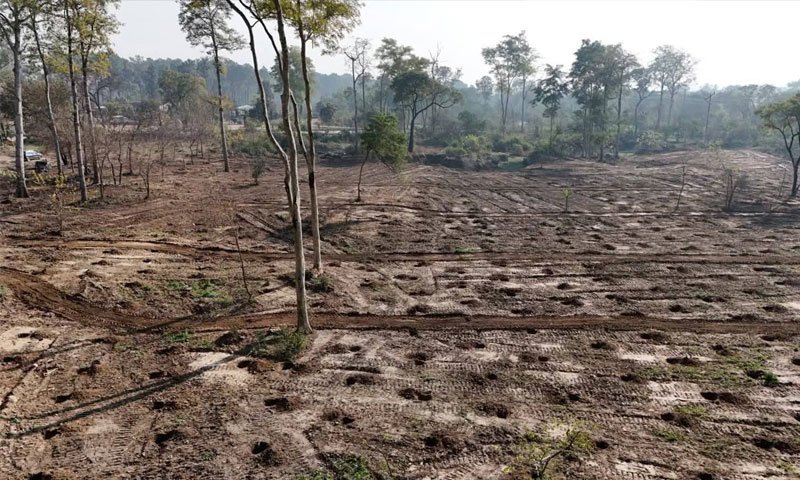
The political leadership in Islamabad appears disconnected from the environmental consequences of urban development. Recent large-scale tree felling across the capital has left residents and environmentalists alarmed, with once-green areas now turning barren. In the Shakarparian area, four large patches have been stripped of trees, leaving the landscape “bald and barren.” Similar deforestation is underway in H-8, Chak Shahzad, and along Park Road. In the latter, towering trees have been removed to make way for a dual carriageway connecting to the Margalla Enclave housing project. Authorities are reportedly constructing an interchange beside Park Road to facilitate access to the new housing scheme.
These actions have triggered widespread criticism. Residents and environmental activists accuse authorities of prioritizing development over ecological preservation. In response, Minister for Climate Change Musadiq Malik defended the tree-cutting, claiming that 29,000 paper mulberry trees, known to trigger allergies and pose risks to chronic asthma patients, were removed in compliance with Supreme Court orders issued in 2023. He further stated that each tree removed would be replaced with three saplings.
However, Dr. Malik’s defence has raised skepticism among experts and activists. Many of the trees cut in Chak Shahzad, H-8, and Shakarparian were decades old and did not belong to the paper mulberry species. Paper mulberry trees are identified by their light green leaves, while the dark green leaves of sheesham trees—many of which were removed—clearly indicate that the felling extended well beyond the prescribed targets. Critics argue that this constitutes a misuse of legal authority and violates the guidelines of the Pakistan Environment Protection Agency, which mandates strict procedures for tree cutting and urban forest management.
In addition, the rushed plantation drive in January has drawn criticism. Frosty winter conditions make it unsuitable for planting new saplings, as young trees are highly vulnerable to freezing temperatures. Planting in such conditions is not only counterproductive but risks the survival of newly planted greenery. Environmentalists warn that such misguided efforts undermine the goal of replacing lost trees and restoring urban ecosystems.
The loss of greenery in Islamabad is more than an aesthetic issue. Trees and forests are essential for moderating extreme temperatures, reducing flood and landslide risks, and supporting biodiversity. Green cover acts as a natural shield against climate change, helping soil retain water, regulating microclimates, and sustaining life-supporting ecosystems. Urban deforestation disrupts these functions, leading to desertification, reduced rainfall absorption, and loss of habitat for birds, insects, and other wildlife.
Experts also note that rapid deforestation in urban areas amplifies the effects of climate change. Cities with limited greenery experience higher temperatures, often called urban heat islands, which increase energy consumption and worsen air quality. Trees play a crucial role in absorbing carbon dioxide, producing oxygen, and filtering harmful pollutants from the air. The removal of mature trees, which take decades to grow, cannot be quickly offset by planting saplings, especially under unsuitable conditions.
The Shakarparian, H-8, and Park Road incidents illustrate a larger problem: a lack of integration between urban planning and environmental protection. Infrastructure projects are often prioritized over ecological considerations, with minimal consultation with environmental experts or local communities. This approach not only harms the natural environment but also risks public backlash and long-term ecological damage.
Urban planners and environmentalists advocate for a more balanced approach. Development should incorporate green corridors, parks, and preservation of mature trees, rather than relying solely on post-felling plantations. Strategic urban forestry ensures that city growth does not come at the cost of environmental sustainability. Preserving mature trees is far more effective than planting saplings, as older trees provide shade, stabilize soil, and support wildlife immediately, whereas saplings take years to mature.
Internationally, urban deforestation is increasingly viewed as a crime against the environment. Cities around the world are adopting stringent laws to protect green cover, recognizing its role in climate resilience and public health. Islamabad’s recent actions, by contrast, suggest a shortsighted approach where immediate development objectives overshadow long-term ecological priorities. Experts warn that repeated destruction of urban forests could compromise the city’s ability to cope with heatwaves, floods, and other climate-related events.
The ecological consequences of these tree-felling projects extend beyond Islamabad. Forest cover is crucial for maintaining regional water cycles, preventing soil erosion, and sustaining biodiversity. Urban greenery also has social benefits, providing recreational spaces, reducing stress, and improving overall quality of life. By removing mature trees without careful planning or adherence to environmental regulations, authorities risk undermining the city’s environmental resilience and public health simultaneously.
In conclusion, the widespread cutting of trees in Islamabad has sparked understandable outrage. While officials justify their actions on public health and compliance grounds, the facts suggest that many old, non-targeted trees have been destroyed, in violation of environmental laws. Coupled with poorly timed plantation drives, these measures threaten the city’s ecological balance and long-term sustainability. It is essential for the government to adopt a science-based approach to urban forestry, preserving mature trees while carefully integrating new saplings under suitable conditions.
If Islamabad is to remain a livable and climate-resilient city, authorities must recognize that green cover is not expendable. It is a critical infrastructure that supports human health, biodiversity, and environmental stability. Protecting and restoring trees should be a central priority, ensuring that urban development and environmental preservation advance hand in hand. Without decisive action, the city risks losing its natural heritage and undermining the resilience of its urban ecosystem for generations to come.