
Dr Bilawal Kamran
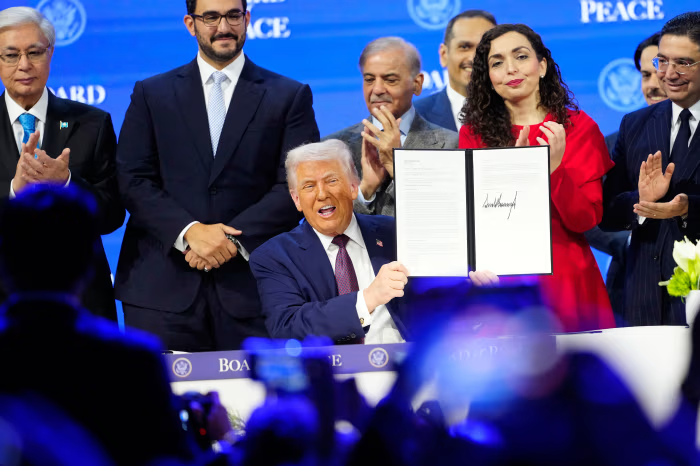
Pakistan has joined seven other Muslim states in supporting US President Donald Trump’s new initiative to rebuild and demilitarize Gaza, known as the “Board of Peace.” The initiative, which has attracted interest from more than 60 countries, is being positioned as a platform to address the longstanding Israel-Palestine conflict and potentially tackle other global flashpoints. While Washington has hailed the initiative as a bold step toward global conflict resolution, analysts warn that proceeding unilaterally could create significant diplomatic and strategic risks, inadvertently strengthening the influence of China and Russia on the world stage.
The Board of Peace, unveiled by Trump at the World Economic Forum in Davos, is framed as a multilateral effort to restore governance and stability in Gaza following the recent Israel-Hamas conflict. The US president has actively promoted a 20-point agenda for Gaza, emphasizing reconstruction, demilitarization, and long-term stability. Islamabad’s participation reflects Pakistan’s strategic vision of playing an active role in Middle Eastern peace efforts. By endorsing the initiative, Pakistan aligns itself with the objectives of UN Security Council Resolution 2803, supports Palestinian statehood, and signals a willingness to facilitate dialogue within the Muslim world.
For Pakistan, the move also demonstrates a desire to exercise influence in global diplomacy and coordinate a collective stance among Muslim nations on one of the world’s most sensitive conflicts. By taking a proactive approach, Islamabad has earned recognition from Washington for its efforts to help build consensus on Gaza, showcasing its capacity to contribute meaningfully to international peace processes.
However, despite growing support from Muslim countries, the initiative has encountered significant pushback from European allies. France, the UK, and several NATO members have expressed skepticism over the Board of Peace, arguing that it undermines the authority of the United Nations. Critics worry that the initiative, with Trump as its permanent chairman holding broad executive powers, threatens the established rules-based international order. The perception that the US is positioning itself as the ultimate arbiter of global conflicts has raised eyebrows, and some governments fear that it may sideline traditional multilateral institutions.
The $1 billion membership requirement for permanent board seats adds further complexity. For countries like Pakistan, such a financial demand is substantial, and it raises questions about inclusivity and equitable participation. Observers caution that this “pay-to-play” element risks creating a platform dominated by wealthier nations, which could undermine the board’s legitimacy as a truly international peace-building organization.
Beyond financial concerns, there are deeper strategic risks if the US proceeds without building wider consensus. Unilateral action could inadvertently create a vacuum that rival powers are eager to fill. China, for instance, has steadily expanded its global footprint through multilateral initiatives such as the Belt and Road Initiative. By portraying the US as acting alone, Washington risks giving Beijing an opportunity to present itself as a credible alternative leader in international diplomacy. Russia, too, could leverage the initiative to enhance its geopolitical influence, particularly if it gains recognition as a participant in the board. The perception of US unilateralism might allow both China and Russia to claim legitimacy on a global stage from which they have historically been excluded, reshaping international power dynamics in their favor.
The potential diplomatic fallout is not limited to China and Russia. European countries, long-standing US allies, may perceive a unilateral approach as overreach, undermining trust in Washington and complicating cooperation on other pressing global issues. Differences over Russia’s possible inclusion could further deepen divisions among Western allies, creating friction within NATO and the EU. The resulting fragmentation could weaken the very international coordination the Board of Peace seeks to achieve.
Strategically, the risks extend to the Middle East itself. While the initiative is framed around Gaza, any perception that it is being driven primarily by US interests may generate suspicion among regional actors. Countries in the Gulf and beyond may be reluctant to commit fully if they feel excluded from decision-making or believe that the board’s authority is concentrated in Washington. Such dynamics could limit the board’s effectiveness in achieving meaningful peace and reconstruction in Gaza, and may even inflame regional tensions if stakeholders feel sidelined.
Furthermore, the optics of including Russia while the country continues its invasion of Ukraine raise concerns about credibility. European nations and NATO allies could see US endorsement of Russia’s participation as condoning aggression, undermining the board’s image as a neutral mediator. This could complicate not only European support for the initiative but also broader US efforts in global conflict resolution.
In short, moving forward unilaterally carries multiple risks: it could alienate traditional allies, create space for China and Russia to assert themselves on the global stage, and reduce the initiative’s legitimacy among smaller nations. While the Board of Peace has the potential to make meaningful contributions to Gaza’s reconstruction, success depends on broad-based consensus, inclusive decision-making, and careful coordination with established international institutions.
Ultimately, the initiative highlights a fundamental tension in global diplomacy. Bold action can bring results, but unilateralism in a complex world can backfire, undermining long-term objectives. By trying to act alone, the US risks losing influence while giving its rivals an opportunity to shape international affairs to their advantage. For Pakistan and other participating countries, careful navigation will be essential to ensure that support for the board strengthens rather than complicates their strategic interests.
The Board of Peace could become a transformative mechanism for addressing one of the world’s most entrenched conflicts—but only if it is built on trust, collaboration, and multilateral legitimacy. Otherwise, what begins as an ambitious peace initiative could inadvertently accelerate the rise of China and Russia as alternative centers of global influence, shifting the balance of power in ways that may not align with US interests or the broader international community.