
Arshad Mahmood Awan
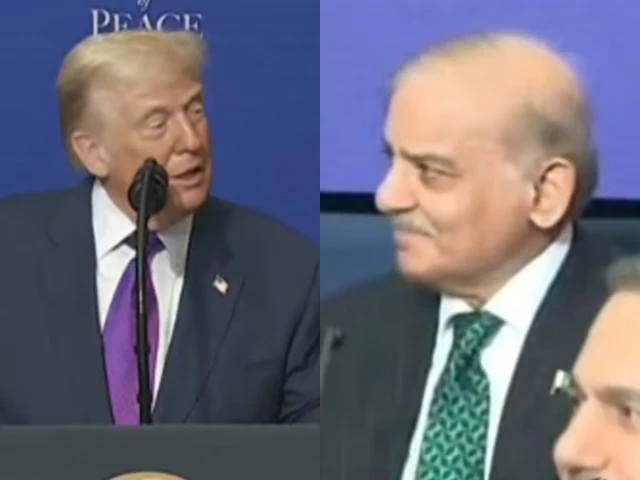
There is a particular kind of political performance that substitutes the appearance of action for action itself. It fills rooms with flags, microphones, and carefully worded declarations. It produces photographs of powerful men shaking hands. It generates headlines about historic commitments and bold visions. And then, when the cameras leave and the pledges are filed away, the people it was supposedly designed to help continue to bleed. The inaugural meeting of the Board of Peace in Washington on Thursday was precisely this kind of performance, executed with the theatrical flair that has become the defining signature of the Trump political brand — maximum spectacle, minimum substance, and an audience of suffering people waiting for something real that never quite arrives.
The meeting produced the expected atmospherics. There was optimistic language about peace, about reconstruction, about a new chapter for Gaza. Billions of dollars were pledged to rebuild the occupied territory, generating the kind of headline figures that sound transformative in a press release and mean considerably less when examined against the realities on the ground. Israel still controls every access point into Gaza. Israel still determines what enters, who enters, and under what conditions. Without a fundamental shift in that control, foreign money pledged for reconstruction is not a commitment — it is a conditional promise whose fulfilment depends entirely on the goodwill of the state that has spent the last year and a half systematically destroying the very infrastructure the money is supposedly meant to rebuild. Whether these billions actually materialise, and whether they can reach the people who need them if they do, remains entirely unresolved.
The International Stabilisation Force, the military centrepiece of this exercise, is similarly burdened with contradictions that its architects appear reluctant to confront. An American general will command the force. Indonesia, which has committed approximately 8,000 troops — the largest national contribution announced — has been explicit that its soldiers will perform humanitarian functions and will not engage in combat. Jakarta is not being coy about this. The Indonesian government understands, with an honesty that Washington and Tel Aviv prefer to avoid, that any force sent into Gaza which finds itself confronting Palestinian resistance groups will face devastating political consequences at home and across the Muslim world. Indonesia’s population of 280 million people would not tolerate their military being deployed as a de facto enforcement mechanism against Palestinian fighters on behalf of an Israeli agenda dressed in the language of peace. Jakarta knows this. That is why the distinction between humanitarian mission and combat mission was drawn so publicly and so firmly.
This creates a fundamental incoherence at the heart of the entire enterprise. The United States and Israel have been unambiguous that Hamas must disarm as a precondition for any serious progress. Benjamin Netanyahu has stated plainly that there will be no reconstruction before Gaza is demilitarised. Israel’s participation — or more accurately, Israel’s tolerance — of the Board of Peace process appears conditioned on this outcome. Yet the force being assembled to supposedly guarantee stability explicitly refuses to pursue disarmament through confrontation. The ISF cannot simultaneously be a humanitarian mission acceptable to Muslim-majority contributor nations and a disarmament enforcement mechanism acceptable to Israel. These objectives are irreconcilable, and the Washington meeting did nothing to resolve the contradiction. It simply allowed both narratives to coexist in the same room long enough for a communiqué to be issued.
Pakistan’s decision not to contribute troops to the ISF deserves recognition as an act of sober judgment. The Board of Peace and the International Stabilisation Force are experimental constructs without clearly defined mandates, legal frameworks, or exit strategies. Their relationship to international law, to Palestinian governance structures, and to the question of sovereignty remains undefined. More concerning is the reported American intention to establish a large military base in Gaza. The strategic logic of such a facility, situated on Palestinian land, in an occupied territory, in the shadow of an ongoing genocide, points in one direction regardless of how it is described publicly. It points toward a permanent American military footprint on Palestinian soil that serves Israeli security interests while being packaged as part of a peace architecture. Pakistan was right to read these signals and decline participation in an arrangement whose ultimate shape and purpose remain deliberately obscured.
The human cost against which all of this diplomacy must be measured is staggering. Since October 2023, Israeli military violence in Gaza has killed over 72,000 Palestinians, with some credible studies suggesting the actual toll may be significantly higher when deaths from disease, starvation, and the collapse of healthcare infrastructure are counted. Since the ceasefire announced last October, approximately 600 more Palestinians have been killed. These deaths did not pause for the Washington summit. They did not pause for the pledges or the handshakes or the declarations about helping Gaza. Donald Trump told the assembled delegates that the United States will help Gaza. The Palestinians who have been buried since October’s ceasefire were presumably waiting for that help to arrive.
Meanwhile, in the West Bank, Israeli settlement expansion continues uninterrupted. Land seizures, demolitions, forced displacement — a recent United Nations report has characterised these activities in terms that describe ethnic cleansing with considerable directness. The Washington meeting produced no unambiguous American commitment to halt these actions. Trump offered no condemnation of West Bank dispossession. The countries that spoke most clearly for Palestinian rights — Pakistan, Indonesia, and others from the Muslim world — did so within a forum where the power to enforce any outcome rests entirely with Washington, and Washington remains unwilling to apply meaningful pressure on Israel.
The Board of Peace was designed to look like a turning point. It was designed to project seriousness and momentum. What it actually demonstrated is the persistent architecture of impunity that surrounds Israeli conduct — an architecture in which Palestinian suffering is acknowledged rhetorically while the conditions that produce it are protected structurally. Expecting this exercise to chart a genuine path toward Palestinian liberation is not optimism. It is a refusal to read what is plainly written in front of us. Peace built on Israeli preconditions, enforced by an American general, and funded through Israeli-controlled access is not peace. It is occupation rebranded for a more palatable international audience.