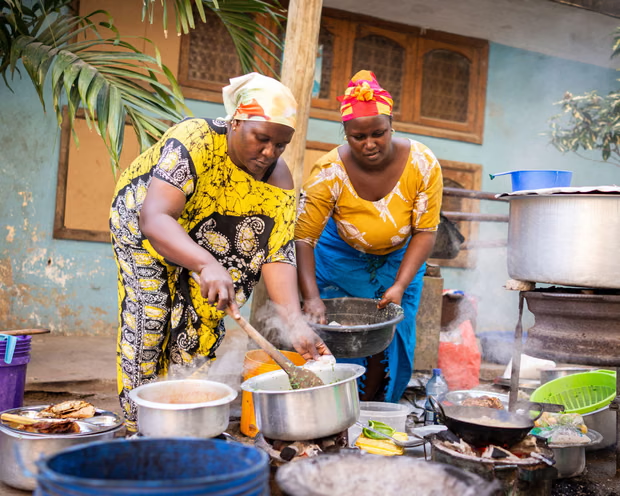

One in three people worldwide cannot afford to eat a healthy diet, according to a new UN report, prompting renewed calls for urgent action on food affordability.
Roughly 2.69 billion people are unable to afford a diet diverse enough to meet their energy and nutrient needs, the annual report from five UN agencies found, warning that “immense” work remains to reach the global target of zero hunger by 2030.
Global hunger did decline for a third consecutive year in 2025, affecting 7.8% of people, down from 8.1% in 2024, with signs that a prolonged upward trend in Africa was finally leveling off. Even so, the share of people unable to afford a healthy diet remains “extremely high,” said Maximo Torero, chief economist of the Food and Agriculture Organization and one of the report’s authors.
The State of Food Security and Nutrition in the World 2026 report puts the cost of a healthy diet at 4.28 purchasing power parity dollars a day, meaning it costs, in local currency, whatever amount holds the same buying power as $4.28 in the United States. Torero noted that this figure sits well above the extreme poverty line of $3 PPP per person.
He attributed part of the problem to government policy, which has typically focused on subsidizing cereals and starchy staples rather than meat, dairy, fruit, and vegetables. That approach delivers calories, he said, but not dietary diversity, a gap with consequences for obesity and diseases like cancer and diabetes. World Health Organization figures cited in the report show adult obesity rising from 12.1% in 2012 to 16.2% in 2024, a trend Torero called extremely urgent to address.
He called for greater investment in infrastructure, research, and development, pointing to modeling in the report suggesting that more efficient supply chains could lower the cost of meat, dairy, fruit, and vegetables alike. New policies encouraging greater fruit and vegetable consumption could also help offset the economic burden of diet-related illness, he added.
Africa has now overtaken Asia as home to the largest number of hungry people for the first time, with about 309 million compared to Asia’s 292 million. In Africa, 66.6% of the population could not afford a healthy diet in 2025, more than double the rate seen in Asia or Latin America and the Caribbean. Torero said the shift largely reflects the continent’s faster population growth rather than worsening conditions, noting that the proportion of Africans going hungry has actually begun to decline for the first time in years. He cautioned, however, that this progress predates recent cuts to overseas development assistance in the region and that shipping disruptions in the Strait of Hormuz tied to the Middle East conflict are likely to weigh on next year’s figures.
The report was jointly authored by the FAO, WHO, UNICEF, the UN World Food Programme, and the International Fund for Agricultural Development.