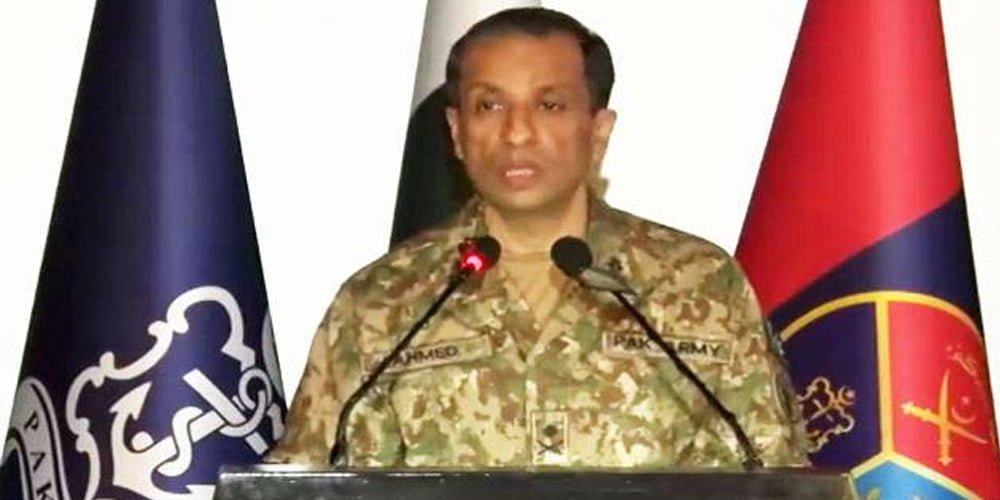

RAWALPINDI, Pakistan — Addressing a comprehensive press briefing on the nation’s security landscape, Inter-Services Public Relations (ISPR) Director General Lieutenant General Ahmed Sharif Chaudhry emphasized on Friday that good governance remains the fundamental requirement for establishing long-term stability and security across Pakistan.
Aligning with recent statements from Interior Minister Mohsin Naqvi regarding potential administrative restructuring, Lt. Gen. Chaudhry noted that the military, as a primary security stakeholder, views constitutional and administrative reform as essential to resolving systemic national challenges.
“Good governance is quintessential for Pakistan,” Lt. Gen. Chaudhry stated, highlighting the necessity of implementing the 14-point National Action Plan (NAP). Touching on the debate regarding administrative units, he added: “Our population is 240–250 million people, and we still have four provinces. Whether this serves the purpose of good governance is a debate that must be held sensibly by political leadership through constitutional and legal procedures.”
Escalating Counter-Terrorism Operations in 2026
Providing a statistical breakdown of ongoing operations, the military spokesperson revealed that security forces—comprising police, civil armed forces, intelligence agencies, and the armed forces—have conducted 40,348 intelligence-based operations (IBOs) nationwide this year. Over 31,000 of these operations were executed in Balochistan alone, averaging nearly 200 daily engagements.
Key security indicators reported for 2026 include:
- Operations Conducted: 40,348 intelligence-based operations.
- Terrorist Incidents Recorded: 3,145 nationwide (1,971 in Khyber Pakhtunkhwa, 1,148 in Balochistan, and 26 in other regions).
- Insurgents Neutralized: 2,084 confirmed terrorists killed (an average of 10 per day).
- Casualties Sustained: 819 martyrs, including 303 army personnel, 194 law enforcement officers, and 322 civilians.
- Suicide Attacks: 28 incidents, which the ISPR attributed primarily to Afghan nationals and elements linked to cross-border security forces.
Lt. Gen. Chaudhry noted that while kinetic operations have intensified, the kill-to-casualty ratio has shifted significantly from previous years, with security forces now neutralizing an average of 2.5 insurgents for every martyr lost.
Addressing the Root Causes of Instability in Balochistan
Reflecting on the situation in Balochistan, the spokesperson pointed to institutional weakness, digital disinformation, and deep-seated local power dynamics as primary drivers of unrest. He criticized historical feudal systems (“sardarism”) and political elite structures for attempting to preserve a status quo that impedes socio-economic development and civilian empowerment.
“The fundamental issue is elitism and the desire to maintain a status quo that predates 1947,” Lt. Gen. Chaudhry remarked, reaffirming that the state would engage directly with the public rather than appease insurgent networks or regional power brokers.
The ISPR detailed broader structural and external challenges facing the province:
- Rule of Law & Civic Obligations: Citing Article 5 of the Constitution, the spokesperson emphasized that constitutional rights are fundamentally anchored in citizen loyalty and obedience to the law, urging a national movement focused on civic obligations.
- External Networks and Disinformation: The briefing highlighted coordinated hybrid warfare efforts, alleging that over 300 websites and 1,000 social media accounts operating out of India actively amplify propaganda and coordinate with banned outfits like the Tehreek-i-Taliban Pakistan (referred to by authorities as Fitna-al-Khawarij) and Baloch insurgent groups (Fitna-al-Hindustan).
- Missing Persons Data: Addressing allegations regarding missing persons, the ISPR cited data from the state inquiry commission, noting that out of 10,901 total applications received since the early 2010s, 9,372 cases have been officially disposed of—with 4,896 individuals returning home and others traced to prisons or accounted for.
To bolster operational capability across Balochistan’s expansive 347,190 square kilometer terrain, the military confirmed ongoing administrative transitions, including shifting the local Levies force into a standardized police structure and raising a dedicated command under FC West to strengthen frontier security.