
Naeem Afzal
Zahid, a friend of mine, works in a private factory in Lahore. He has strict working hours. He hardly gets free time, so we could meet together and have a visit to some place we always wanted to visit. Academically, he is a graduate from one of the notable universities in Pakistan in a highly specialized educational field: Computational Physics. At the university, he studied extremely technical subjects; often he had to struggle in passing the difficult mathematical subjects such as Numerical Analysis and Mathematical Method. However, He passed and came to work in the field.
He found work based on his other skills, not what the university taught him. For me too, I found work as an editor based on the reading and writing I learned on my own in the university, not the basis of skills the university had to offer to me. Instead, University’ red tapism pressureized me to learn those subjects which proved rarely relevant to work. But I followed my passion of reading and writing and learned humanities, philosophy of science, and whatever I could. It helped me develop critical thinking, empathy, and most importantly, narrative imagination.
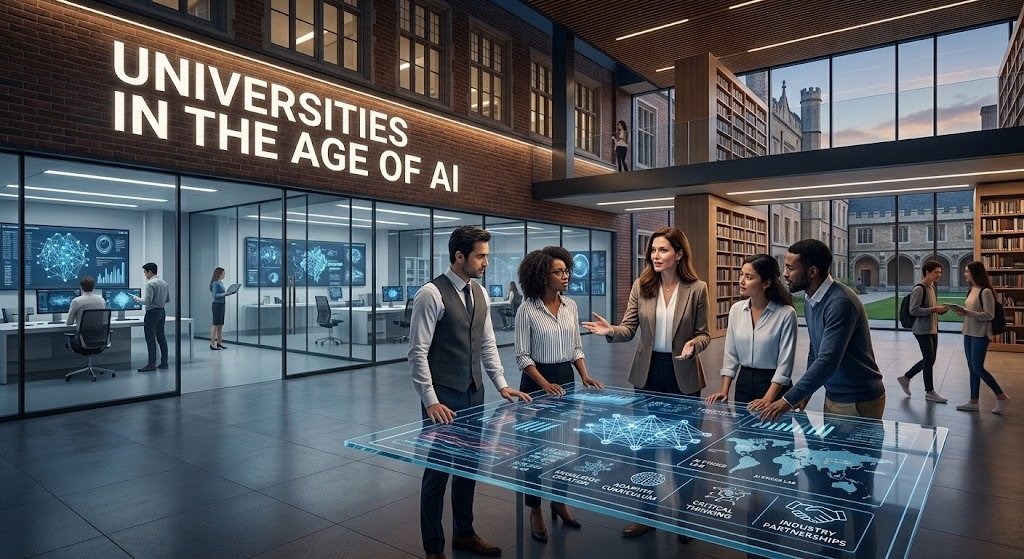
The traditional university education is turning into an obsolete thing in the age of AI. Numerically, universities have witnessed a decline in admission applications, notably in arts subjects. Though the condition in the AI-related disciplines is satisfactory. Basically, students are choosing disciplines according to the market demand.
What is market demand in the age of AI? Given the automation being achieved in all fields, I have found some notable skills that are irreplaceable. In my University education, I studied different technical subjects related to computation and numerical methods. They didn’t promise me employment. Rather, the vast reading inculcated empathy and narrative imagination in me to experience the distinct colors of life and workplace.
Universities can’t afford to be stuck in the past. They must lose their curriculum and allow students to engage in intradisciplinary studies. Subjects of a highly technical nature, such as computation, are at risk of extinction by the AI computing powers. What AI can’t replace is narrative imagination and empathy and the ability to see things critically.
The world is changing at an unprecedented speed. Disruption is inevitable. Learning quickly to adapt is the need of the hour.
The Writer is the Researcher at the Republic Policy