
By Zafar Iqbal
Pakistan expresses that donors at an international conference in Geneva have pledged to provide more than $9bn to enable it to reconstruct following last year’s devastating floods.
Pakistan is hosting the conference in Geneva on Monday with the United Nations as it strives for international assistance to cover around half of a total $16.3bn recovery bill.
Prime Minister Shehbaz Sharif and UN Secretary-General Antonio Guterres kicked off the one-day conference, accompanied by officials from nearly 40 other countries, private donors, and international financial institutions.
The exceptional floods rendered by melting glaciers and record monsoon rains last year impacted more than 33 million Pakistanis, killing more than 1,700 people and driving about nine million others into poverty, according to the United Nations.
Thousands of people live in recessed areas, tents, and makeshift homes in Sindh and Balochistan, the two worst-hit provinces, with static water in many areas.
Pakistani Deputy Foreign Minister Hina Rabbani Khar expressed the final tally came above a target for the international community.
According to her, “Taken as a whole, these commitments total more than $9 billion, and from what we know so far, these are all additional commitments from what was already given in terms of humanitarian assistance, etc., from both bilateral and multilateral partners,” she said, adding that several delegations had also offered up in-kind support.
Earlier, Guterres praised Pakistan and its people for responding to “this epic tragedy with heroic humanity”.
“We must match the heroic response of the people of Pakistan with our efforts and massive investments to strengthen their communities for the future,” he said.
“Pakistan is doubly victimized by climate chaos and a morally bankrupt global financial system,” the UN chief added. “No country deserves to endure what happened to Pakistan.”
Pakistan’s Prime Minister Shehbaz Sharif, right, and United Nations Secretary-General Antonio Guterres at the summit in Geneva [Denis Balibouse/Reuters]
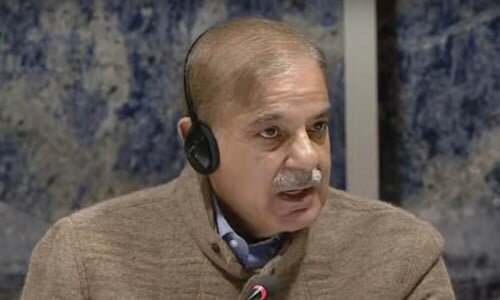
Addressing the summit earlier on Monday, Sharif called for a “new coalition of the willing” among the international community, “one that can save lives and put them on a path to responsible global citizenship”.
“Today’s meeting is an attempt to give my people another chance at getting back on their feet,” he said, adding that his Government needed at least $8bn from outside donors over the next three years to rebuild the country.
“We are racing against time,” he said.
In a column for the British newspaper The Guardian on Friday, Sharif said Pakistan “simply cannot do this alone”.
“These flooded areas now look like a huge series of permanent lakes, transforming forever the terrain and the lives of people living there. No amount of pumps can remove this water in less than a year, and by July 2023, the worry is that these areas may flood again,” he wrote.
According to the Global Climate Risk Index, Pakistan is responsible for less than one per cent of global emissions, but it remains among the top 10 nations vulnerable to climate change.
Islamabad says the Geneva conference is focused on two objectives: the “Resilient Recovery, Rehabilitation, and Reconstruction Framework (4RF)” strategy to secure international support and to find a way to build long-term climate resilience and adaptation against climate change in Pakistan.
Khalil Hashmi, Pakistan’s permanent representative at the UN office in Geneva, said: “The objective is to secure international support for the 4RF, which includes institutional, financial and implementation arrangements for post-flood recovery, rehabilitation and reconstruction. The conference will help us forge long-term partnerships to strengthen Pakistan’s climate resilience and adaptation.”
A general view of the submerged houses in Jaffarabad in Pakistan’s Balochistan province [File: Reuters]
Last year, Pakistan prepared a Post-Disaster Needs Assessment (PDNA) report with the help of the UN and other global bodies, which estimated the country needed $16.3bn to rebuild its economy and infrastructure and called for international assistance.
In December, the UN said despite an appeal for $816m in urgent funds for Pakistan, it received only $262m – a mere 32 per cent of the target amount.
The floods came amid a dire economic crisis in Pakistan, which last month, its foreign reserves depleted to less than $6bn, enough to cover just about a month of imports.
Pakistan also seeks immediate financial assistance from the International Monetary Fund and friendly countries such as Saudi Arabia and China to shore up its faltering economy and prevent a default.
It may be a short-term success. However, it is still an aid even if the pledges are contributed. It is not the first time that we have depended on assistance. However, our fundamental issues are structural and organizational. Pakistan need reforms in its economy. The economy of Pakistan must grow the lands and manufacture the products. Then, it must impart to each individual the skills to boos the service sectors of the economy. Aid is like one step forward and two steps back. https://republicpolicy.com/an-overview-of-the-economy-of-pakistan/
Pakistan needs more internal investment than external investment. It is an overstatement that foreign investment leads the process of internal growth and development. How can an economy develop when foreign investors take more money out than invested money? Therefore, local investment should be encouraged, and policies should be adopted to increase export and decrease imports. Foreign direct investment FDI is not the solution for our economy but Local direct investment LDI. Pakistan should encourage overseas Pakistanis to invest in Pakistan.
Services play a major part in the economy of a country. Pakistan is a country with a youth population, and the skill development of youth is fundamental to the cause of growth and development. The information technology sector is very important for the economy, alongside all other professions of skills and services. Pakistan is a no-objection certificate NOC economy. The procedures are so complicated that even local investors are finding it hard to invest smoothly. The coded law of economy and taxation must incorporate facilitation and service.https://republicpolicy.com/does-foreign-aid-boost-economy/
Apart from all public and private initiatives, it is the political stability and consistency in economic policies alongside the resolve of the Government that will pave the way for sustainable economic revival and, finally, a path toward growth and development.
The Writer is a Chartered Accountant and CEO at republicpolicy.com