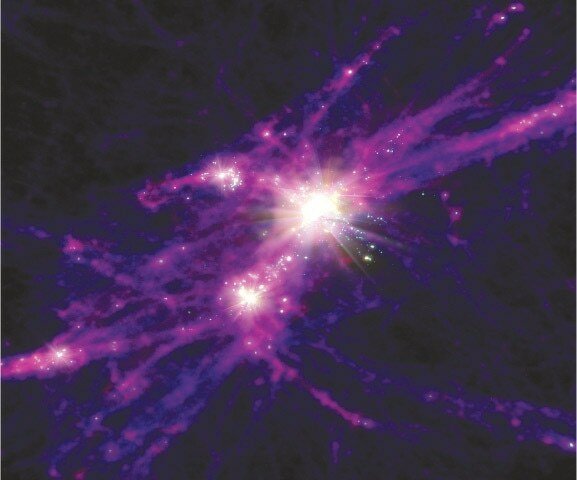

WASHINGTON: The James Webb Space Telescope has provided an astonishing glimpse of the early history of our universe, spotting a collection of galaxies dating to the enigmatic epoch called cosmic dawn.
But the existence of what appear to be massive and mature galaxies during the universe’s infancy defied expectations.
This left scientists scrambling for an explanation while questioning the basic tenets of cosmology, the science of the origin and development of the universe.
A new study may resolve the mystery without ripping up the textbooks. Researchers used sophisticated computer simulations to model how the earliest galaxies evolved.
These indicated that star formation unfolded differently in these galaxies in the first few hundred million years after the Big Bang than in large galaxies like our Milky Way today.
According to the study, these galaxies may have been relatively small, as expected. Still, they might glow as brightly as massive galaxies, giving a deceptive impression of great mass because of the brilliant bursts of star formation.