
Arshad Mahmood Awan
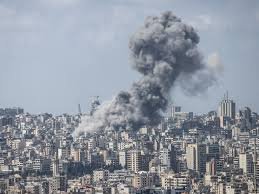
The bombs have not stopped falling, and according to Donald Trump himself, they may not stop for weeks. That single statement, delivered with the casual confidence of a man unbothered by the weight of what he has set in motion, should disturb every thinking person on this planet. An American administration widely regarded as the most impulsive and ideologically reckless in modern history has launched a military campaign against Iran alongside its Israeli partners, and the world is watching with the helpless paralysis of an audience that has forgotten it can leave the theatre.
The Pentagon chief, in a moment of spectacular contradiction, insisted this is not a regime change war. The claim deserves exactly the scrutiny it invites. Washington and Tel Aviv have already overseen the assassination of Ayatollah Ali Khamenei, one of the most consequential acts of targeted political killing in recent memory, and they are now demanding total capitulation from a nation of eighty million people with a deep civilizational memory of resistance. If that is not the definition of regime change pursued through maximum violence, the English language has been permanently disfigured. The gap between what American officials say and what American bombs do has never been wider, and never more dangerous.
For anyone with even a partial knowledge of recent history, the architecture of this war carries an unmistakable familiarity. The 2003 invasion of Iraq established the template with grim precision. A hostile Muslim-majority nation. A dossier of manufactured threats. A casus belli assembled from selectively interpreted intelligence and political theatre. A war machine pointed at a country that had, above all else, refused to be fully obedient. The Pentagon may insist this is not Iraq, but the structural logic is identical: construct a justification, delegitimize the target, then destroy it while claiming self-defense. Iraq was not merely defeated in that war. It was obliterated as a functioning state, its institutions collapsed, its society fractured along sectarian lines that continue to bleed today. The architects of that catastrophe faced no meaningful accountability. Their successors have learned the most dangerous possible lesson from that impunity.
The stated reasons for attacking Iran follow the same pattern of convenient fabrication. Iran’s nuclear programme, described consistently as a phantom threat by independent analysts who have monitored it closely for years, has been presented as an existential danger requiring immediate military resolution. The suppression of internal dissent and the country’s missile capability have been added to the list of justifications, as though the United States itself does not possess the most sophisticated missile arsenal in human history, and as though internal political repression has ever genuinely moved Washington to launch a war against a government it found strategically useful. Most damning of all, Pentagon officials reportedly told Congress in private briefings that there was no credible intelligence suggesting Iran was planning to attack American forces, directly contradicting the narrative of imminent threat that Trump used to justify the opening strikes. The lie was not even particularly elegant.
The real reason to pursue Iran with such ferocity is older, deeper, and more honest than anything offered in official press briefings. For over four decades, since the Islamic Revolution dismantled the Shah’s American-backed government and sent the entire regional order into convulsions, Iran has refused the fundamental demand that Washington makes of nations in its sphere: compliance. It has maintained its independence, developed its own alliances, built its own military doctrine, and projected influence across the region in ways that consistently frustrated American strategic objectives. That stubborn refusal to be managed is the unforgivable crime for which Iran is now paying in blood and fire.
This is not a new impulse. General Wesley Clark, who commanded NATO forces in Europe and cannot be dismissed as a peripheral figure in American military culture, has written that shortly after the September 11 attacks a senior military official told him the United States had decided to take out seven countries: Iraq, Syria, Lebanon, Libya, Somalia, Sudan, and Iran. The list reads today not as prediction but as a checklist being methodically completed. Iraq was destroyed. Libya was dismantled. Syria was fractured. Iran is now fighting what its leadership correctly understands as an existential war. The consistency of the pattern across different administrations, different presidents, and different stated justifications reveals something that no single election or policy shift has ever altered: a deep state commitment to reshaping the Islamic world by force, on American and Israeli terms, regardless of the human cost.
Behind this campaign sits the question of who truly drives American foreign policy when it matters most. The Israeli lobby’s influence over the American political system is not a conspiracy theory. It is a documented, extensively studied reality that even mainstream American scholars have written about with growing candor. The alignment between what Tel Aviv wants and what Washington delivers in the Middle East has been near-total for decades, and the current campaign against Iran is the most dramatic expression of that alignment in history. Two governments, one a nuclear power with hundreds of warheads unacknowledged under a policy of deliberate ambiguity, and the other the only country to have used atomic weapons in warfare, are jointly prosecuting a war against a nation whose nuclear programme has never produced a single weapon. The moral inversion is staggering.
What is equally staggering is the silence of the United States Congress. American law exists. Constitutional provisions exist that are supposed to require legislative authorization for acts of war of this magnitude. Yet the lawmakers who claim to represent the American people have offered no serious challenge, no binding resolution, no genuine exercise of the oversight function that democratic theory insists they possess. Their silence is not passive. It is a form of participation. It tells the executive that there are no domestic brakes, no institutional check, no political price to pay for a war launched on false pretenses against a country that posed no imminent threat.
Iran, despite the painful blows absorbed in these opening days, is still functioning. History suggests it will continue to resist. The tragedy is that the cost of that resistance, measured in Iranian lives, regional stability, and whatever remains of the international rules-based order, will be paid not by the men who made this war in Washington and Tel Aviv, but by millions of ordinary people who never voted for it and cannot stop it.