
Editorial
For decades, the World Economic Forum in Davos was often dismissed as an elite talking shop, rich in ideas but poor in tangible outcomes. The 2026 gathering, however, signaled a decisive shift. Against a backdrop of prolonged conflicts, economic fragmentation, and weakening multilateral institutions, Davos emerged less as a discussion platform and more as an informal hub where global power centers coordinate directly, bypassing traditional channels.
The forum’s prominence reflects the broader strain on the post-World War II order. Geopolitical rivalries, disrupted supply chains, energy insecurity, and declining faith in institutions such as the United Nations have created a vacuum. Davos has stepped into that space, providing a discreet arena where political authority and financial leverage intersect.
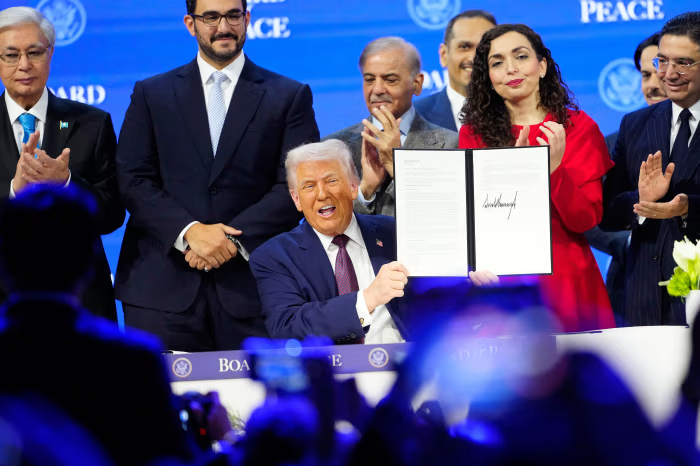
One of the year’s most consequential developments was a framework for Gaza’s post-conflict reconstruction and stabilization. While not a formal treaty, it carried real political and financial weight, underscoring a sobering reality: today, conflict management is increasingly shaped by those with economic influence rather than universal legitimacy. Discussions emphasized reconstruction financing, security containment, and regional economic integration, drawing attention from sovereign wealth funds, development lenders, and private capital.
The forum also showcased a recalibration of transatlantic relations, highlighted by U.S. President Donald Trump’s engagement with NATO and EU leadership. Exchanges were pragmatic, transactional, and driven by national interest rather than ideology. At the same time, Canadian leadership injected moral and economic sobriety, stressing managed adaptation to a fragmented world.
Davos 2026 highlighted deeper structural shifts: geopolitics now drives economic decision-making, the Global South is increasingly assertive, and “minilateralism” — small, issue-focused coalitions — is replacing universal forums. While critics decry its lack of accountability, Davos illustrates that informal consensus, backed by financial and political weight, increasingly shapes the global order. For emerging economies, engagement through such platforms is no longer optional — it is essential.
In short, Davos has evolved from a forum for explanation into a marketplace where the world is quietly reshaped.