
Pakistan’s rural economy is in distress. In the past two years, poverty has tightened its grip on villages, punishing small farmers and landless laborers who already live on the thinnest of margins. An estimated 62% of Pakistanis reside in rural areas, and roughly two-thirds depend—directly or indirectly—on agriculture. When farm incomes collapse, tens of millions feel the shock at once. Recent survey evidence has consistently shown a yawning rural–urban welfare gap; some analyses place rural poverty above 50% while urban poverty is a fraction of that. Behind these stark numbers is a policy story: the state’s retreat from wheat procurement and a naïve reliance on “free-market forces” in a market that is neither free nor competitive.
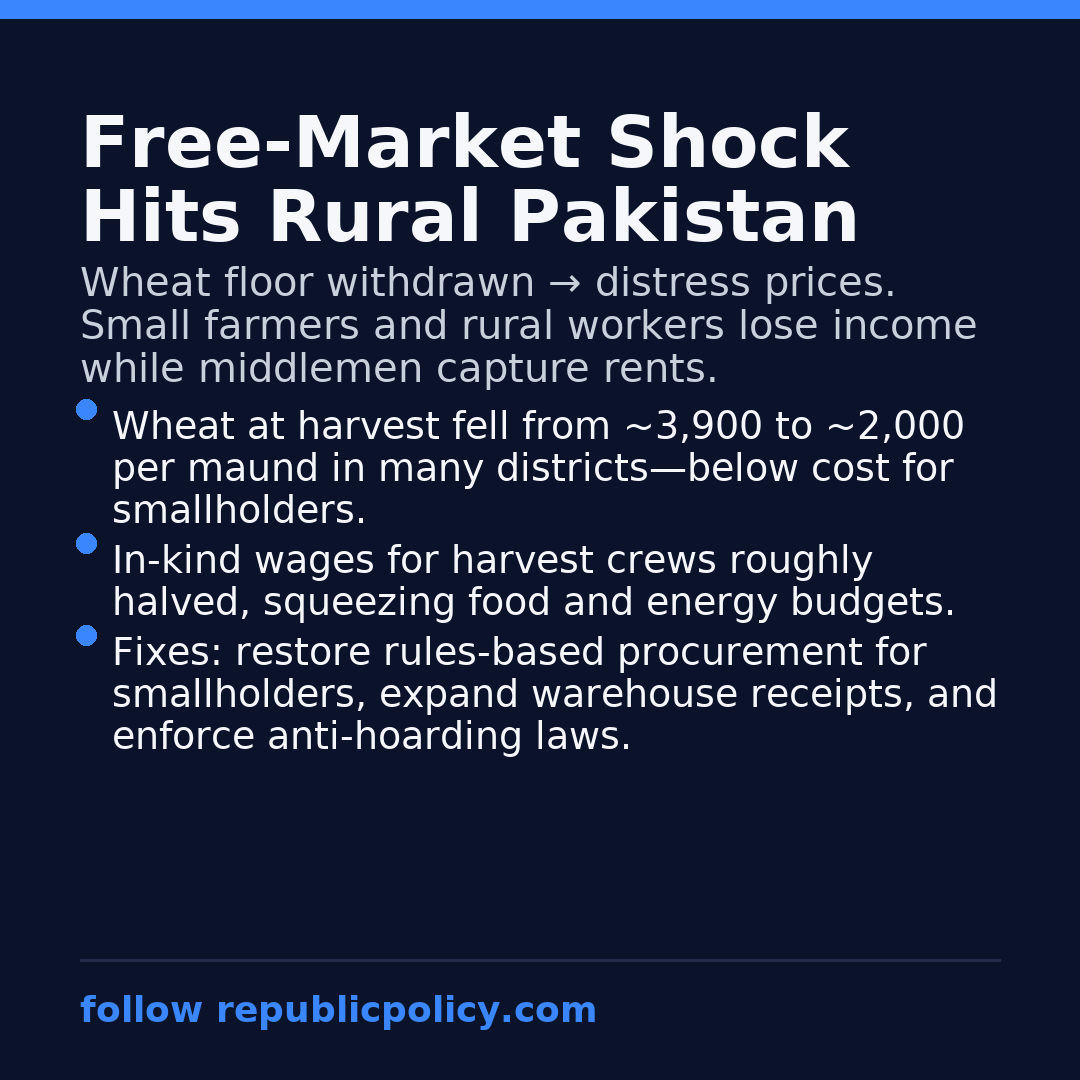
Consider wheat, the spine of Pakistan’s food economy. In 2023, the market cleared near 3,900 per maund. By harvest 2025, prices in many districts slumped toward roughly 2,000 per maund—well below a frequently cited production cost near 3,000. That arithmetic is ruinous for smallholders who cannot store grain or negotiate credit; they sell at harvest into a glutted market to pay debts, wages, and input bills. The result is a forced transfer of value from farmers to traders and stockists who do have storage, liquidity, and the ability to wait for seasonal price recovery.
For landless rural workers, the pain is even sharper. A common arrangement pays harvesting and bundling crews in kind—often four maunds per acre. At 3,900, that yielded around 15,600 in 2023. At 2,000 this season, it nets barely 8,000, even as living costs rise. Families respond by cutting protein, delaying healthcare, and rationing electricity to avoid crossing tariff slabs—choices that fray health, dignity, and long-term human capital. Cheap urban bread is a hollow victory if it is financed by deepening rural deprivation.
This is not how healthy markets behave. A textbook “free market” assumes many buyers and sellers, transparent information, low barriers to entry, and access to storage and finance. Pakistan’s grain economy, by contrast, is marked by oligopsony at harvest, lumpy storage, working-capital constraints for farmers, and episodic import and release decisions that are neither timely nor transparent. In such a setting, withdrawing a state floor without building competitive market institutions does not create efficiency; it creates arbitrage opportunities for the best-capitalized players. Traders, stockists, and millers can accumulate at distress prices and wait for the curve to normalize—often earning outsized returns that no real-sector producer can match.
The damage spreads beyond wheat. Crop choices hinge on expected margins and risk. When wheat looks unsafe, smallholders shift into sesame, canola, or vegetables—only to meet the same structural problem: thin, volatile markets that crash when supply surges. Reports from wholesale yards of vegetables changing hands for pennies per kilogram are not outliers; they are signals of systemic fragility. Without coordinated market development—grading, cold chains, storage, and predictable procurement—diversification simply reallocates risk from one failing market to another.
The equity implications are stark. The current setup moves resources from those with the least ability to absorb shocks to those with the most capacity to capture rents. Urban consumers in affluent neighborhoods may enjoy temporarily cheaper flour, but the social cost is borne by rural Pakistan in the form of malnutrition, school dropouts, debt spirals, and migration. Over time, that cost returns to cities as unemployment, informal settlements, and higher public outlays for relief. What looks like a “cheap food” policy quickly becomes an expensive poverty policy.
What would a rules-based, pro-farmer market look like? First, reinstate a targeted public procurement backstop as a narrow, well-governed floor—not a blank cheque. Limit government purchases to small and medium farmers verified through digital registries, with capped quantities per CNIC. Announce the support price before sowing, stick to it at harvest, and publish daily dashboards of arrivals, lifting, and releases. Pair this with transparent, pre-announced public stock release rules to dampen price spikes without undermining planting incentives. Complement procurement with warehouse-receipt systems so farmers can pledge grain for short-term credit rather than dumping at harvest.
WhatsApp Channel: Republic Policy
Second, broaden price policy beyond wheat. Establish minimum indicative prices for a small basket of strategic kharif and rabi crops—oilseeds, pulses, and fodder—so that portfolio risk is shared and monoculture incentives recede. Back these signals with guaranteed procurement windows from smallholders when market prices collapse, and with time-bound import tariffs or safeguards when global surges threaten domestic planting. Price policy must be complemented by cost policy: targeted input support delivered through farmer cards for fertilizers, certified seed, and micro-irrigation—tied to acreage, not political patronage.
Third, rebuild the state’s poverty radar. Reintroduce or domesticate a Multidimensional Poverty Index (MPI) to capture non-income deprivation—nutrition, schooling, housing, and access to energy and healthcare—at the district and tehsil level. Without a credible dashboard, relief and development money will continue to chase headlines, not need. Link MPI scores to formula-based fiscal transfers and rural development grants focused on electricity reliability, basic health units, girls’ secondary education, and farm-to-market roads.
Fourth, enforce competition. Use hoarding and anti-collusion laws against rent-seeking behavior in grain markets, and raise the probability of detection with electronic movement permits, randomized audits of private stocks, and whistleblower rewards. At the same time, lower the barrier for market entry by expanding certified village-level storage, grading at procurement centers, and e-trading platforms that publish real-time bids. A market with more credible buyers is a market that pays producers fairly.
Fifth, insure against weather and price shocks. Scale up index-based crop insurance, with the state subsidizing premia for smallholders and linking payouts to rainfall, temperature, or area yield indices verified by satellites and field sampling. When risk is pooled, farmers plant with confidence; when risk is privatized onto the poorest, they plant defensively and the entire economy pays in lower output.
Critics will ask about fiscal cost. The honest answer is that Pakistan already pays—just invisibly and inefficiently. We pay through emergency imports at bad prices, through disaster relief after preventable distress, through nutritional losses that suppress productivity, and through rural out-migration that strains urban infrastructure. A narrow, rules-based procurement floor; targeted input support; better data; and real competition enforcement cost less than the status quo and deliver more resilient growth.
At bottom, “free markets” are not a substitute for institutions; they are the product of them. In Pakistan’s grain economy, the state withdrew the referee before the rules existed. The result is not liberty but leverage—wielded by those with storage, capital, and information. Restoring fair play will not only lift farm incomes; it will also stabilize food prices, reduce poverty, and relieve pressure on public finances. That is a triple dividend Pakistan can ill afford to ignore.
This article draws on the analysis of Muhammad Zaman Wattoo (former Secretary Food, Government of Punjab) and is adapted for Republic Policy readers.