
Pakistan’s reported arms agreement with Libya marks a genuinely encouraging and strategically important development. It is not simply a large defence contract; it represents a moment where military credibility, defence-industrial capability, and external demand have converged in a way Pakistan has long sought but rarely achieved. The scale of the deal is significant, but its deeper value lies in what it signals: Pakistan’s defence sector is beginning to convert operational performance into real, bankable export outcomes.
Valued at more than $4 billion, the agreement with the Libyan National Army stands among the largest defence export transactions in Pakistan’s history. It places the country in a relatively exclusive category of states capable of supplying complex conventional military systems across land, air, and sea. More importantly, it suggests that Pakistan is no longer being viewed merely as an aspirational defence exporter. It is being taken seriously as a reliable supplier with proven capabilities.
This credibility did not emerge overnight. It was forged through years of incremental development and, critically, through operational testing under real-world conditions. Pakistan’s performance during the recent summer conflict with India drew significant international attention. Beyond the immediate geopolitical tensions, the conflict served as a live stress test of doctrines, platforms, command-and-control systems, and escalation management. Pakistan’s ability to respond coherently, maintain deterrence stability, and demonstrate effective use of indigenous systems reshaped external perceptions in subtle but important ways.
Major powers, defence analysts, and military observers were not simply watching for escalation risks; they were assessing competence. Pakistan’s performance suggested a level of operational maturity that went beyond rhetoric or parade-ground displays. Indigenous platforms, integrated air defence, and decision-making under pressure all came under scrutiny. The outcome was not just a military signal to India, but a broader message to potential defence partners: Pakistan’s systems work, and its forces know how to use them.
That recalibration of perception has since reflected itself in diplomatic and strategic engagement. Pakistan’s defence posture began to attract renewed interest in regions where military cooperation carries political, security, and commercial weight. Within the Muslim world in particular, Pakistan’s long-standing defence relationships, training roles, and doctrinal influence have created a foundation of trust. The Libya deal appears to be one of the first concrete commercial expressions of that renewed confidence, and it is unlikely to remain an isolated case.
For Pakistan’s armed forces, the benefits are direct and practical. Sustained export orders help justify investment in domestic platforms, strengthen economies of scale, and support a continuous cycle of innovation, testing, and refinement. Defence production becomes more than a budgetary burden; it becomes a revenue-generating asset. This, in turn, reduces long-term dependence on imports and improves self-reliance.
For the defence industry, the deal represents long-awaited validation. Platforms such as the JF-17 Thunder, trainer aircraft like the Super Mushak, and various land and naval systems were designed with export markets in mind. Yet, despite sporadic interest, large and consistent orders remained elusive. A transaction of this magnitude changes the equation. It demonstrates that Pakistan can compete in a crowded and politically sensitive global arms market, not just on price, but on credibility and performance.
The economic implications may be even more consequential. Pakistan’s export base has long been narrow and vulnerable. Traditional sectors, particularly textiles, have struggled to generate sustained growth due to structural inefficiencies, high energy costs, regulatory burdens, and shifting global demand. As a result, export earnings have failed to keep pace with import requirements, placing chronic pressure on foreign exchange reserves.
Defence exports offer a fundamentally different proposition. They are high-value, technology-intensive, and less exposed to the volatility of commodity cycles. Payments are typically structured over multiple years, creating a steadier and more predictable inflow of foreign exchange. For an economy repeatedly trapped in balance-of-payments crises, even a limited number of large defence contracts can provide meaningful relief at the margins.
There is also a strategic multiplier effect. Defence cooperation rarely ends with a single transaction. It often expands into training, maintenance, upgrades, joint production, and long-term logistical support. These extended relationships create durable economic links and deepen diplomatic engagement. If managed carefully, arms exports can anchor broader partnerships, particularly in regions where Pakistan already enjoys political goodwill and defence familiarity.
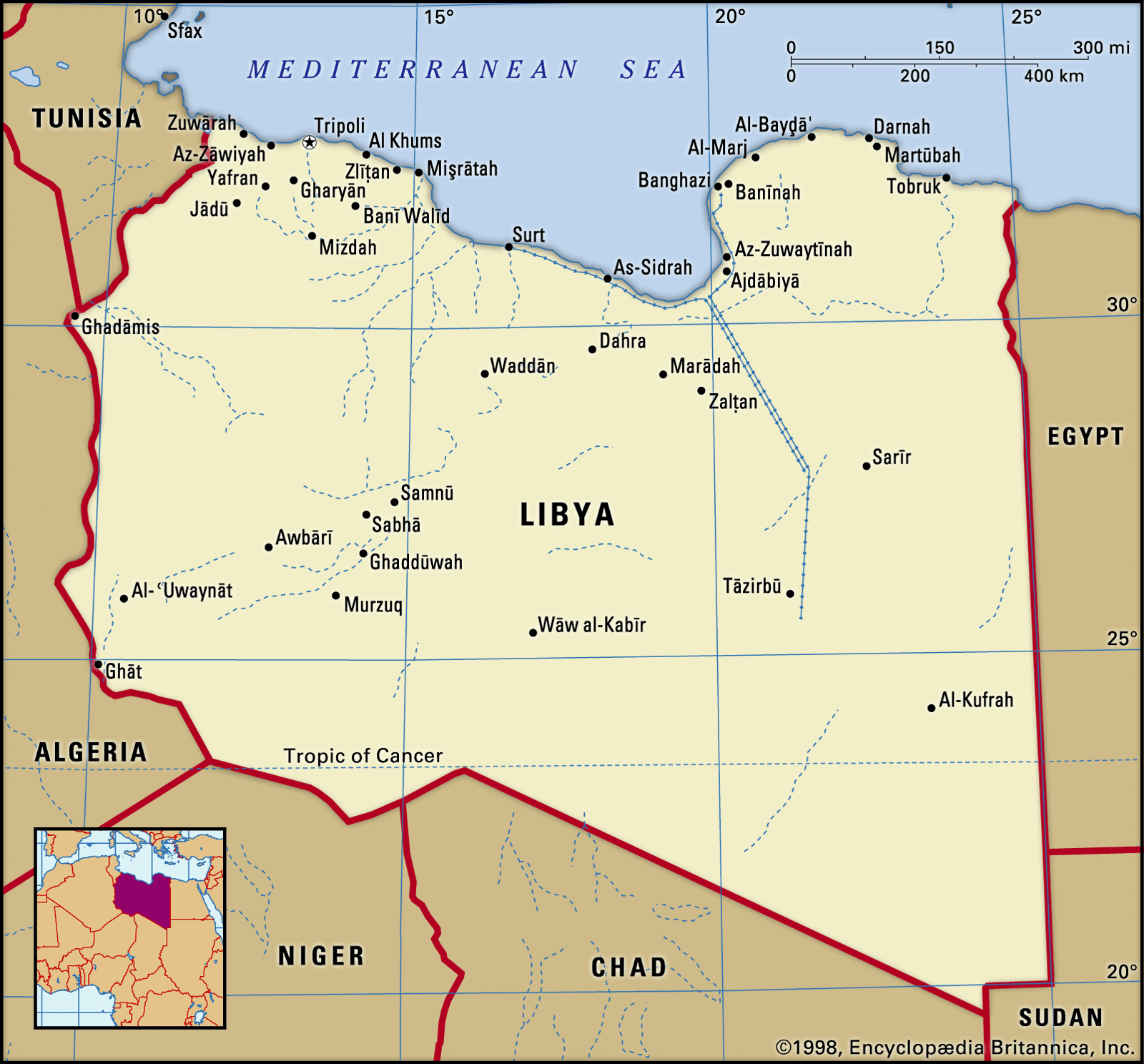
This does not mean the risks should be ignored. Libya remains a fragmented and volatile theatre, subject to international scrutiny, legal complexities, and shifting power dynamics. Defence exports must comply with international norms, sanctions regimes, and ethical considerations. Missteps could carry reputational or diplomatic costs. But these are challenges of execution, not arguments against direction.
What is striking is that Pakistan has, at least for now, aligned three critical elements: military credibility, industrial capacity, and economic necessity. For years, the defence sector argued that exports could become a meaningful pillar of national economic strategy. Until recently, that argument rested largely on potential. This deal provides evidence.
The real test lies ahead. One major transaction does not constitute a sustainable strategy. To convert this breakthrough into a lasting trend, Pakistan will need policy coherence, industrial planning, regulatory discipline, and careful diplomacy. Defence exports should complement, not replace, efforts to revive civilian manufacturing and diversify the export base. Overreliance on any single sector carries its own risks.
Still, in a moment when traditional economic engines are underperforming and fiscal space is limited, this development offers a timely and welcome lift. If Pakistan can consistently translate battlefield credibility into industrial reliability, and industrial reliability into repeat export orders, the implications will extend far beyond the defence sector.
For a country searching for viable, high-value export pathways, that would not just be a commercial success, it would be a strategic transformation worth building on.