
Dr Bilawal Kamran
Israel’s war in Gaza has pushed the Palestinian territory into an economic collapse so severe that the United Nations now warns Gaza’s very survival is at risk. According to a new UN Trade and Development (UNCTAD) report, the level of destruction inflicted over the past two years has dismantled the foundations of life—food systems, housing, healthcare, and public infrastructure—leaving the territory on the edge of what it calls a “human-made abyss.” International intervention, the agency stresses, must be immediate and substantial if Gaza is to remain habitable in the years ahead.
The UN report estimates that rebuilding Gaza will cost more than $70 billion, a process that could take decades even under favourable conditions. UNCTAD argues that the war, combined with years of restrictions on movement, trade, and essential services, has triggered an unprecedented economic collapse. Entire sectors have been wiped out, public institutions have crumbled, and social systems that once held communities together have been dismantled.
Follow Republic Policy YouTube
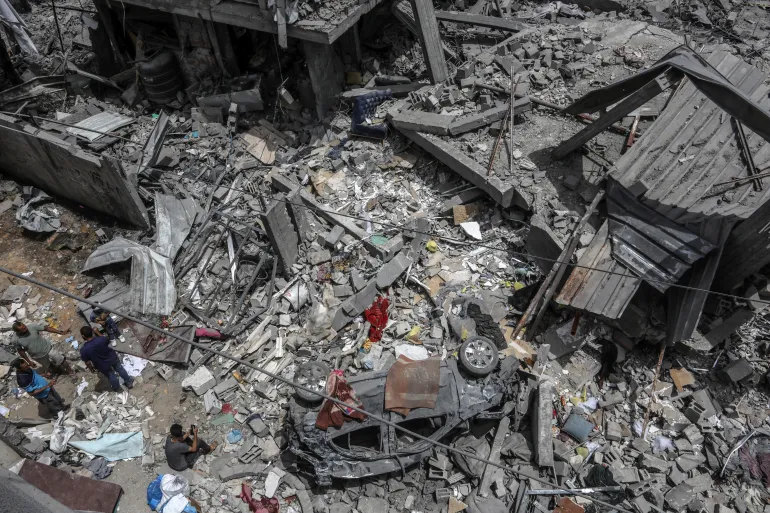
The devastation began after the October 2023 attack by Hamas on southern Israel, which resulted in over 1,200 deaths. Israel’s subsequent assault on Gaza, however, has killed more than 69,000 Palestinians, according to figures from Gaza’s health ministry that the UN considers credible. UNCTAD notes that the scale of destruction on civilian infrastructure is unmatched in recent memory, with entire neighbourhoods levelled and basic facilities rendered unusable.
Follow Republic Policy Twitter
The report describes a chain reaction of crises—economic, humanitarian, environmental, and social—that have pushed Gaza from a struggling economy into what it calls “utter ruin.” Electricity grids, water supplies, sewage networks, hospitals, farms, and schools have been destroyed. The result is a population facing extreme multidimensional impoverishment, where even basic survival has become uncertain.
Follow Republic Policy Facebook
Even optimistic scenarios paint a bleak picture. UNCTAD argues that if Gaza were to receive large-scale international assistance and experience double-digit economic growth for years, it would still take several decades for living standards to return to pre-October 2023 levels. This projection highlights not only the depth of the destruction but also the difficulty of reconstructing a shattered economy under blockade conditions.
To break the cycle of decline, the UN calls for a comprehensive recovery plan. This would include coordinated global assistance, restoration of vital fiscal transfers, and a substantial easing of restrictions on trade, investment, and mobility. UNCTAD also proposes a universal emergency basic income programme for Gaza’s entire population, providing unconditional monthly cash transfers to help families meet immediate survival needs.
Follow Republic Policy Instagram
According to the report, Gaza’s economy contracted by a staggering 87 percent between 2023 and 2024. Its GDP per capita now stands at just $161—one of the lowest figures recorded anywhere in the world. This collapse is not only the result of war but also years of isolation, repeated cycles of conflict, and the near-total destruction of productive capacity.
Follow Republic Policy WhatsApp Channel
Conditions in the West Bank, while less catastrophic, are also rapidly worsening. UNCTAD documents how violence, expanded settlement activity, and growing restrictions on worker mobility have severely damaged the West Bank’s economy. The region is now experiencing its worst economic decline since UNCTAD began keeping records in 1972. With livelihoods disrupted and movement curtailed, many families have been pushed below the poverty line, and businesses are unable to function in an environment of constant insecurity.