The International Monetary Fund (IMF) has significantly downgraded its economic outlook for the United States, warning that the country is likely to be the hardest hit among advanced economies due to rising uncertainty around tariffs and trade tensions. According to the IMF’s latest global economic update, US growth for 2025 is now projected at just 1.8%, a sharp drop from its earlier January forecast of 2.7%.
This revised outlook reflects growing concerns that trade policies—especially the unpredictable direction of tariffs—are creating a cloud of uncertainty over the US economy. Businesses remain cautious, consumers are tightening their belts, and markets are watching developments closely as the election season heats up.
The United States isn’t alone in facing economic headwinds. The IMF also trimmed its growth projections for the UK and several other wealthy nations, citing a mix of inflation, geopolitical instability, and slow post-pandemic recoveries. However, the steep revision for the US stands out as the most dramatic among advanced economies.
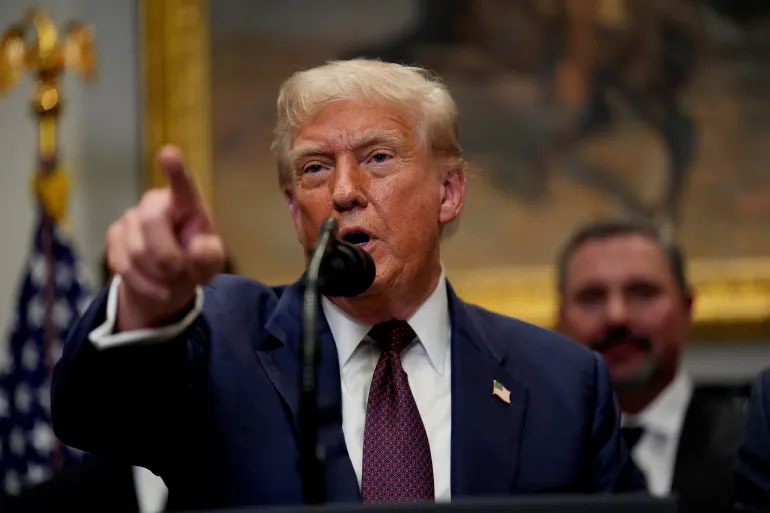
Despite these worrying forecasts, US stock markets showed signs of recovery on Tuesday, rebounding after a sharp dip on Monday. The initial losses were largely attributed to former President Donald Trump’s attack on Federal Reserve Chairman Jerome Powell, whom Trump publicly criticized as a “major loser” for not cutting interest rates amid slowing growth and persistent inflation.
These comments have triggered debate and concern about potential political interference in monetary policy—a topic that IMF officials addressed directly. Pierre-Olivier Gourinchas, the IMF’s Chief Economist, emphasized the importance of central bank independence, saying, “It is absolutely critical for monetary authorities to remain free from political pressure. Central banks will do what is necessary to bring inflation under control, regardless of political commentary.”
The IMF has long championed the autonomy of central banks, especially in times of economic uncertainty. Political attacks on figures like Powell can rattle investor confidence and complicate the Federal Reserve’s efforts to strike a balance between controlling inflation and supporting growth.
While inflation in the US has cooled compared to its peak levels in 2022 and early 2023, it remains above the Federal Reserve’s 2% target. This limits the Fed’s flexibility to lower interest rates quickly, despite pressure from political voices like Trump. The central bank has so far maintained a cautious approach, signaling it will continue to monitor the data before making any major policy shifts.
Meanwhile, across the Atlantic, the UK is also facing a tough economic climate, with the IMF reducing its growth projection amid stagnating wages, high borrowing costs, and continued economic fallout from Brexit. Like the US, the UK is grappling with inflationary pressures that are constraining consumer spending and investor confidence.
In its broader analysis, the IMF pointed out that global economic growth is gradually stabilizing, but the pace remains slow and uneven. Emerging markets in Asia, especially India and parts of Southeast Asia, are seeing more robust growth. However, many major Western economies are underperforming due to high interest rates, political uncertainty, and supply chain challenges lingering from the pandemic and the war in Ukraine.
Overall, the IMF’s message is clear: the global economy is still recovering, but progress is fragile—and for the US, the road ahead looks increasingly bumpy. The combination of trade tensions, political instability, inflation, and interest rate battles is likely to weigh heavily on growth in the coming months.
As election rhetoric heats up and pressure on institutions like the Federal Reserve intensifies, experts warn that maintaining policy stability and central bank independence will be critical to avoiding further economic turbulence. Whether political leaders will allow that to happen, however, remains to be seen.