
Khalid Masood Khan
The dispossession of Palestinians is not accidental. It is not a byproduct of conflict or a consequence of security concerns. It is a deliberate, systematic project pursued through two distinct but complementary methods: genocidal violence in Gaza, and legalised land theft in the West Bank. Together, these twin strategies are designed to achieve the same end, which is the permanent removal of Palestinians from their ancestral homeland.
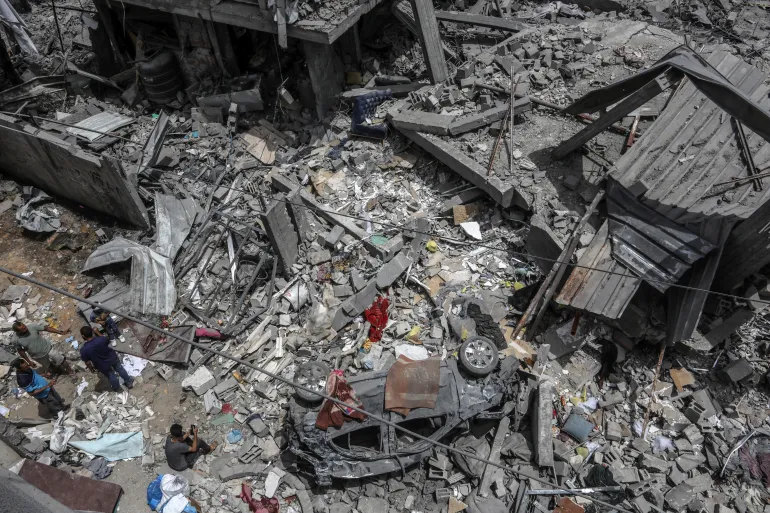
In Gaza, the world has watched in horror as Israeli military operations have reduced entire neighbourhoods to rubble, killed tens of thousands of civilians, and rendered the coastal Strip almost uninhabitable. The intent behind this campaign, as increasingly argued by international legal bodies and human rights organisations, goes beyond military objectives. The ultimate aim appears to be the ethnic cleansing of Gaza, a forced depopulation of a territory whose native inhabitants have lived there for generations. Even after a ceasefire agreement was reached in October, more than 600 Palestinians have been killed, a figure that exposes how fragile and selectively observed that ceasefire has been in practice.
The West Bank tells a different but equally disturbing story. Here, the method is not bombs and bulldozers in the immediate sense, though those are present too. The primary instrument is law, or rather, a deliberate distortion of law to serve colonial ambitions. The Israeli cabinet has recently approved the declaration of large parts of the West Bank as state land, effectively authorising their annexation and opening them up for Jewish settlement expansion. Israel’s extremist finance minister, a man who has publicly described Palestinians as a fictitious people, celebrated this decision as a settlement revolution. The Palestinian presidency called it a serious escalation. Hamas described it as an attempt to steal and Judaise the land. All three descriptions are accurate.
What makes this particular move so strategically significant is the mechanism it exploits. Under the framework Israel has constructed, Palestinians who wish to establish ownership over land that their families have farmed and lived on for centuries must produce documentary evidence dating back a hundred years or more. This is a burden of proof designed to fail. Entire communities have been uprooted, expelled, and scattered across refugee camps in neighbouring countries over multiple generations. The idea that these families would possess colonial-era land deeds is not just unrealistic, it is deliberately unrealistic. The system is engineered to reach a predetermined outcome, which is the transfer of Palestinian land to Israeli state control under a veneer of legal process.
Israeli human rights organisations have themselves warned that if Tel Aviv proceeds with this plan, it will permanently and irreversibly destroy any remaining possibility of a two-state solution. The annexation of large portions of the West Bank does not merely complicate a future Palestinian state, it makes one geometrically and politically impossible. The land that would form the geographic basis of such a state is being carved up and absorbed, piece by piece, behind the procedural cover of cabinet approvals and state land declarations.
This hunger for territory is not confined to the Palestinian territories. Israel has occupied the Syrian Golan Heights since 1967, a seizure that the international community has never recognised as legitimate under international law. In the aftermath of the Assad regime’s collapse, Israel moved quickly to seize additional Syrian land, exploiting a moment of state fragility to expand its footprint further. It continues to occupy various outposts in Lebanon as well. When these facts are placed side by side, a pattern emerges that is impossible to attribute to security concerns alone. The consistent, opportunistic expansion of Israeli-controlled territory across multiple neighbouring states reflects something far more ideologically driven, which is the pursuit of what Zionist expansionists have long called Greater Israel, a territorial vision stretching from the Nile to the Euphrates.
Into this context arrives the meeting of US President Donald Trump’s Board of Peace, originally established to address the crisis in Gaza. The board is due to convene on Thursday, and the Israeli foreign minister is expected to attend. This meeting carries symbolic and substantive weight. If the Board of Peace is to mean anything beyond a branding exercise, it must take clear and unambiguous positions on two fronts. It must call for a genuine and enforced halt to Israeli killings in Gaza, where the ceasefire has been observed more in name than in practice. And it must demand an immediate end to the illegal annexation process underway in the West Bank.
President Trump, whatever his broader foreign policy instincts, has positioned himself as a dealmaker and a force for resolution. If that positioning is to carry any credibility in the region, he must use every available lever of American influence to compel Israel to stop its atrocities in occupied Palestinian territory. The Israeli government responds to American pressure more than to any other external force. The question is whether that pressure will actually be applied, or whether the Board of Peace will become yet another forum that generates communiqués while Palestinian land continues to disappear.
Pakistan has already condemned the latest Israeli move, and it will not be alone at the table. Other Muslim states attending the meeting share both the moral obligation and the political interest to speak clearly from this platform. The temptation in such forums is always to adopt careful diplomatic language that acknowledges concerns without demanding consequences. That temptation must be resisted. The bloodshed in Gaza and the annexation of Palestinian land in the West Bank are not issues that benefit from measured ambiguity. They require unequivocal condemnation and concrete demands for an immediate halt.
Palestinians are running out of land, and they are running out of time. The world is not short of statements expressing concern. What it remains short of is the political will to act on them.