
Mudassir Ahmed
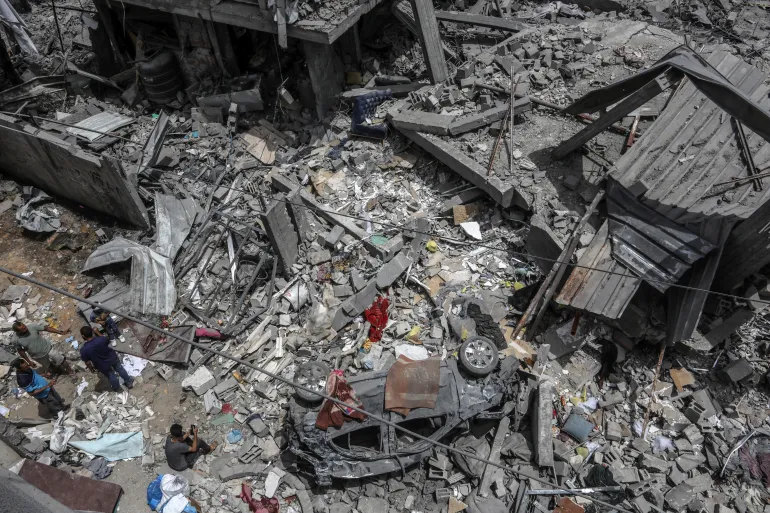
Prime Minister Shehbaz Sharif’s reported invitation from US President Donald Trump to join the proposed “Board of Peace” for Gaza places Pakistan at the crossroads of diplomacy, principle, and geopolitics. At a time when Gaza lies devastated after years of war and an uneasy ceasefire, the formation of an international body to supervise temporary governance and reconstruction carries both promise and peril. For Pakistan, whose foreign policy has long been anchored in support for Palestine and adherence to United Nations resolutions, the decision is not merely procedural—it is deeply political and moral.
Officially, Islamabad has struck a cautious and familiar tone. The Foreign Office has reiterated Pakistan’s commitment to a just and lasting solution to the Palestine issue, continued engagement with international peace efforts, and humanitarian relief for Gaza. This language aligns with Pakistan’s historic stance: support for Palestinian self-determination, opposition to occupation, and insistence on multilateral legitimacy. Yet the very structure and leadership of Trump’s Board of Peace complicate this position.
On the positive side, participation offers Pakistan a seat at a table where critical decisions about Gaza’s future may be shaped. The board’s stated mandate—governance capacity-building, reconstruction, investment, and regional diplomacy—touches issues that will define Gaza for decades. Pakistan, with its experience in post-conflict reconstruction, peacekeeping, and humanitarian assistance, could contribute constructively. Engagement may also allow Islamabad to advocate directly for Palestinian interests, push for civilian protection, and ensure that reconstruction does not become a substitute for political rights.
There is also a broader diplomatic calculus. Trump has personally praised Prime Minister Shehbaz Sharif as a “man of peace,” and closer engagement with Washington could help Pakistan rebalance strained ties with the US. In an era of shifting global alignments, declining Western aid, and mounting economic pressures at home, Islamabad may see strategic value in constructive engagement rather than outright rejection. Jordan’s similar cautious review of the invitation suggests Pakistan is not alone in weighing its options carefully.
However, the risks are equally significant. The Board of Peace is fundamentally a US-led initiative, chaired by Trump himself, and shaped without clear coordination with key stakeholders—including Israel, which has already expressed displeasure. The absence of Palestinians from the senior decision-making bodies is particularly troubling. Any framework that discusses Gaza’s governance without meaningful Palestinian representation risks being seen as neo-administrative control rather than genuine self-rule.
Moreover, some figures associated with the board, notably former British prime minister Tony Blair, carry heavy historical baggage in the Middle East. Blair’s role in the 2003 Iraq invasion has left deep scars across the region. His inclusion may undermine the board’s credibility among Arab publics and Palestinians alike. For Pakistan, association with a body viewed as illegitimate or biased could damage its standing in the Muslim world and weaken its moral authority on Palestine.
There is also the question of intent. Trump’s vision emphasizes economic development and investment, which, while important, cannot substitute for political justice. Gaza’s destruction is not merely a humanitarian or infrastructure crisis; it is the outcome of a prolonged political conflict rooted in occupation, blockade, and denial of rights. A reconstruction-first approach, detached from a clear political roadmap toward Palestinian statehood, risks normalizing the status quo under a different administrative label.
Israel’s reaction further exposes the fragility of the initiative. Prime Minister Benjamin Netanyahu’s office has openly stated that the board’s composition was not coordinated with Israel and contradicts its policies. This raises a fundamental question: how effective can a Gaza governance mechanism be if the occupying power is either sidelined or hostile to its structure? Pakistan must consider whether the board has the political leverage to enforce decisions or whether it will become another well-intentioned but toothless forum.
Financial opacity adds another layer of concern. Reports that countries may be asked to contribute billions to join the panel, even if later softened, suggest that participation may come with economic and political costs. For a country like Pakistan, facing fiscal constraints and domestic challenges, such commitments must be carefully scrutinized.
In the final analysis, Pakistan’s challenge is to balance engagement with principle. Blind participation could entangle Islamabad in a process that undermines Palestinian agency and international law. Total disengagement, on the other hand, could marginalize Pakistan at a moment when its voice might still matter. The wisest course may lie in conditional engagement: seeking clarity on the board’s mandate, insisting on Palestinian representation, anchoring all actions in UN resolutions, and resisting any framework that treats Gaza as a managerial problem rather than a political injustice.
The Gaza tragedy has produced no shortage of initiatives, committees, and plans. What it lacks is sustained political will to address root causes. If Pakistan chooses to engage, it must do so not as a passive participant, but as a principled advocate—one that reminds the world that peace is not built by boards alone, but by justice, accountability, and the consent of the people most affected.