
Editorial
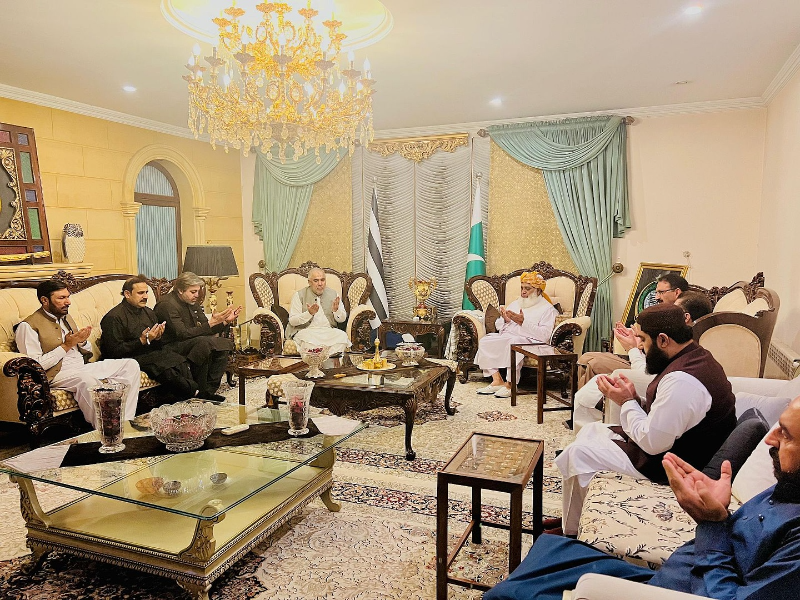
Political consensus is vital for a functional democracy in a federation. The meeting between PTI politicians Asad Qaisar and Ali Muhammad with JUIF leaders, especially Maulana Fazal Ur Rehman, is a welcome step. Political rivalries do not mean personal or vindictive conflicts. Then, it is also a welcome statement by the PPPP senator, Shiern Rehman, that they will only accept the elections with Imran Khan or the PTI. Pakistan is a struggling democracy; therefore, political consensus is critical for democracy, governance, and political stability.
The minimum political consensus for free and fair elections and democracy is critical for political parties in Pakistan for several reasons. Free and fair elections are the cornerstone of democracy, which is the system of government that Pakistan has adopted since its independence. Democracy requires that the people have the right to choose their representatives and hold them accountable through periodic and transparent elections. Without a minimum political consensus on the rules and procedures of the electoral process, the legitimacy and credibility of the elections and the elected government can be undermined. This can also lead to political instability, violence, and public discontent.
Please, subscribe to the website of the republicpolicy.com
Pakistan is a diverse and complex country with multiple ethnic, linguistic, religious, and regional groups. It also faces various internal and external challenges, such as terrorism, economic crisis, social inequality, and regional conflicts. To address these issues effectively, Pakistan needs a solid and stable government that can formulate and implement policies in the national interest. It requires a minimum political consensus among the political parties on the vision and direction of the country, as well as on the role and responsibilities of different institutions, such as the parliament, the judiciary, the military, and the media. Such a consensus is necessary for the political system not to become polarized, dysfunctional, and vulnerable to manipulation.
Political consensus is also vital for cultural stability. Pakistan’s rich and diverse cultural heritage reflects its history and identity. Culture is also a source of social cohesion harmony and a means of expression and creativity. However, culture can also be a source of conflict and division, especially when it is politicized or exploited by extremist groups. To preserve and promote the cultural diversity and unity of Pakistan, there needs to be a minimum political consensus on the values and principles that guide the cultural policies and practices of the country. These include respect for human rights, tolerance for diversity, protection of cultural heritage, and promotion of cultural dialogue.
Lastly, Pakistan is a federation of multiple linguistic, cultural and ethnic communities. Therefore, the political parties must develop a minimum political consensus.
Please, subscribe to the monthly magazines of republic policy.com