
Tahir Masood Chheena
There are moments in diplomacy when a country’s true predicament becomes visible to the world, not through failure but through the very effort of trying to hold contradictory positions together without breaking. Pakistan reached one of those moments at the United Nations Security Council this week, and what it revealed deserves serious examination rather than easy ridicule.
Islamabad found itself supporting two competing resolutions on the same crisis on the same day. The first, brought forward by Bahrain, condemned what it described as Iran’s attacks on Gulf states and Jordan. Pakistan voted in favour. The second, tabled by Russia, lamented the human cost of the ongoing hostilities and called for a halt to military activities. Pakistan voted for that one too. The Bahraini resolution passed. The Russian resolution did not, with Washington’s envoy pointedly accusing Moscow of running cover for Tehran. Pakistan’s UN representative defended this apparent contradiction by saying his country stands in complete solidarity with the Gulf states while also believing that any call to stop the fighting deserves support.
It sounds like diplomatic acrobatics. It is, in fact, a precise reflection of Pakistan’s impossible position in one of the most dangerous geopolitical crises the region has seen in decades.
Let us be clear about what is actually happening. The United States and Israel launched strikes against Iran. That is the origin point of this crisis. Everything that followed, Tehran’s retaliatory attacks, the regional ripple effects, the Security Council chaos, flows from that initial act of aggression. For Pakistan to openly and harshly condemn Iran while staying silent about the military campaign that provoked Iran’s response would be morally bankrupt. Islamabad has criticised the attacks on Iran, but carefully, with measured language, unwilling to go as far as openly denouncing what is, in plain terms, an American-Israeli military misadventure of historic proportions. The caution is deliberate. The rulers in Islamabad understand that burning bridges with Washington carries consequences Pakistan can barely afford.
At the same time, Pakistan cannot ignore the Gulf. These are not abstract diplomatic partners. Saudi Arabia, the UAE, Bahrain, and their neighbours hold Pakistan’s economic lifeline in their hands. Remittances from Pakistani workers in the Gulf sustain millions of families inside Pakistan. Investment from these countries flows into projects that Pakistan’s struggling economy desperately needs. Diplomatic rupture with the Gulf states is not a theoretical risk. It is an existential one. So Pakistan expresses solidarity. It does so loudly, repeatedly, and with genuine strategic intent.
The Saudi dimension adds another layer of complexity that cannot be brushed aside. Pakistan and Saudi Arabia have a mutual defence pact, a formal commitment that places Pakistan’s military credibility on the line when Riyadh feels threatened. The prime minister flew to the kingdom to hold consultations. The chief of defence forces had visited just days earlier. The signal from Islamabad was unambiguous: if Saudi Arabia’s security is threatened, Pakistan is paying attention. When this defence arrangement was originally concluded, many analysts assumed it was designed partly to deter Israeli adventurism against the kingdom. The current crisis, with Israel and America now actively prosecuting a regional military campaign, gives that old assumption an uncomfortable new relevance.
This is the minefield Pakistan is walking. Condemn Iran too aggressively and you betray a Muslim neighbour enduring military assault. Condemn America and Israel too directly and you risk the relationship with Washington and its allies. Stand too firmly with the Gulf without qualification and you appear complicit in a narrative that erases the original aggression. Say too little and you appear cowardly and irrelevant. There is no clean path through this terrain. There is only the least damaging route available.
Pakistan’s prime minister reportedly held discussions with Iranian President Masoud Pezeshkian in recent days. The Iranian president’s message was pointed: the international community must confront the root causes of this war rather than simply managing its symptoms. That framing matters. Tehran is not simply asking for sympathy. It is asking the world to name what started this conflict and who started it. Pakistan, if it wants to play a constructive role, cannot indefinitely avoid engaging with that question.
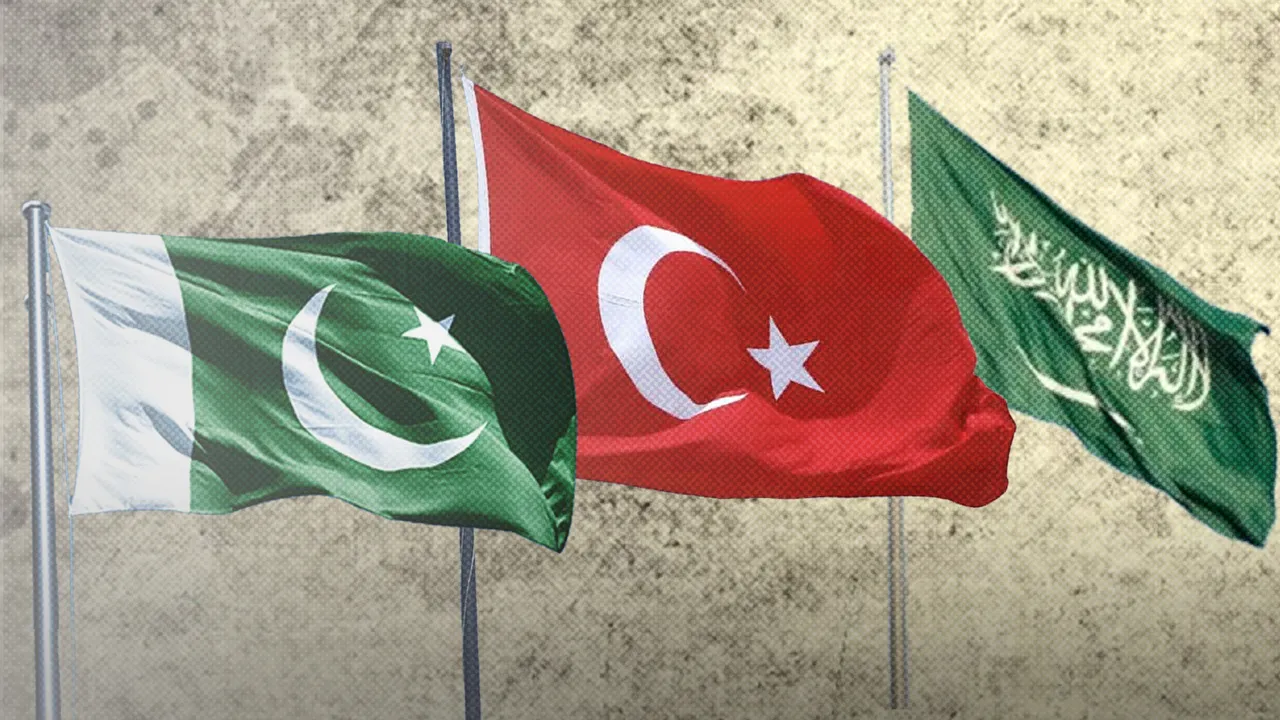
The most productive path forward for Islamabad is not passive balancing but active peacemaking. Working alongside Turkiye and other influential Muslim-majority states, Pakistan has the credibility and the relationships to push for a substantive ceasefire resolution at the Security Council. The two resolutions debated this week failed to deliver that explicitly. Neither demanded a genuine truce. Neither addressed the underlying drivers of the crisis. A resolution that actually matters must do more.
Any peace framework worth taking seriously must rest on three firm pillars. First, there must be unambiguous condemnation of any attempt at regime change in Iran. The sovereignty of states is not a conditional principle. It does not evaporate because Washington decides that a particular government is inconvenient. Second, all attacks on regional states, from whatever direction, must cease immediately and completely. Iranian strikes on Gulf territory and American-Israeli strikes on Iranian territory belong in the same sentence. Selective ceasefire demands are not ceasefire demands. They are instruments of continued war by other means. Third, the United States and Israel must provide credible guarantees that they will not continue violating the sovereign territory of Iran or any other state in the region. Without such guarantees, any pause in hostilities is simply an interval before the next escalation.
Pakistan does not have the power to impose any of this. But it has something almost as valuable in this moment: credibility across multiple divides. It is trusted by the Gulf. It has lines of communication with Iran. It is a member of the Security Council. It works closely with Turkiye. It speaks with authority in the Organisation of Islamic Cooperation. That combination of relationships is rare, and it creates an obligation alongside the opportunity.
The tightrope Pakistan is walking will not get easier. The crisis will deepen before it improves. But the countries that invest in genuine peacemaking now, rather than simply positioning themselves for the aftermath, are the ones that will matter when the guns eventually fall silent. Pakistan must decide whether it wants to be remembered as a country that balanced carefully on the sidelines or one that used its difficult position to push the region back from the edge.