
Mubashar Nadeem
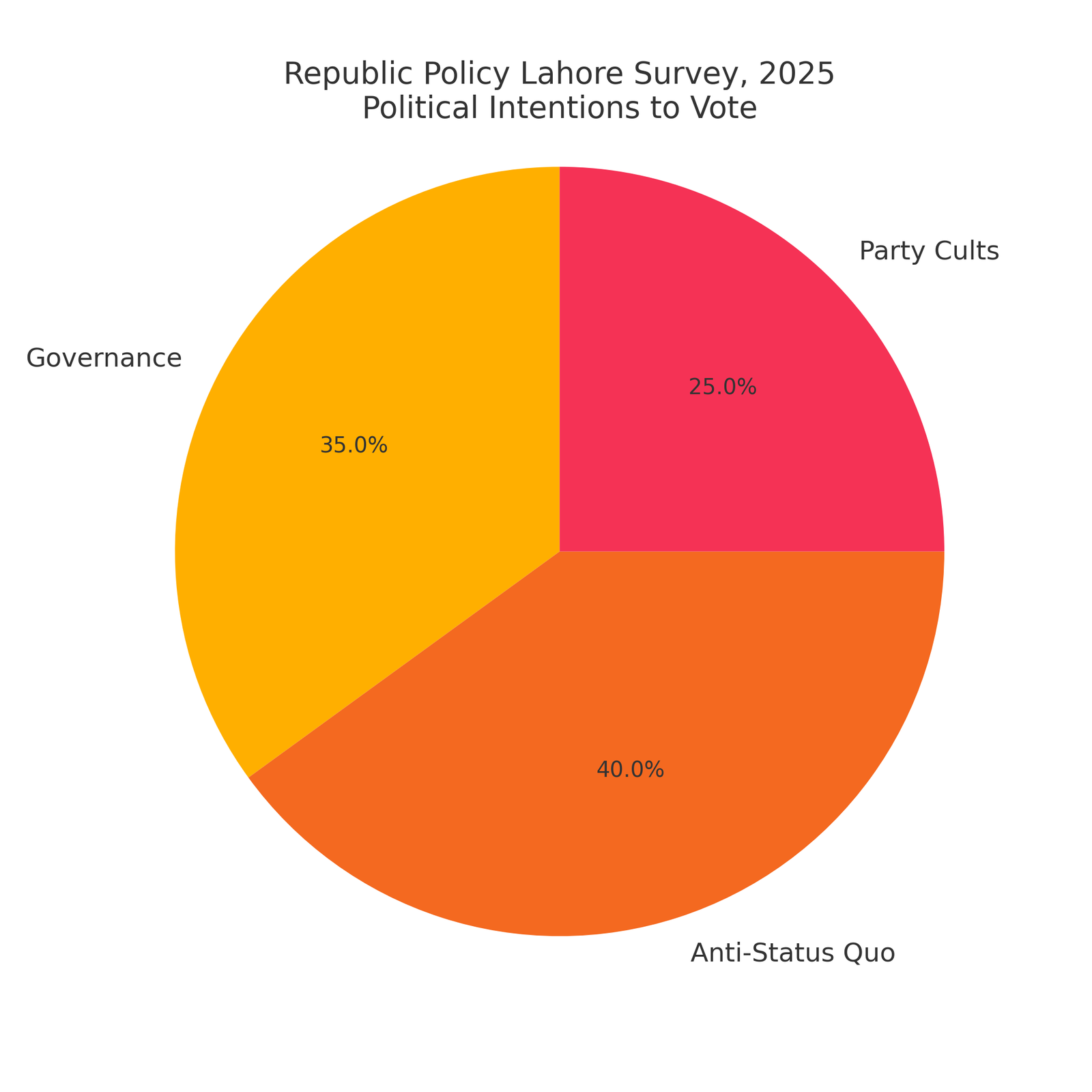
The Republic Policy July Survey 2025 offers one of the clearest pictures yet of Lahore’s changing political dynamics, breaking down the city’s electorate into three primary blocs: Governance-Oriented Voters (35%), Anti-Status Quo Electorate (40%), and Party Cult Loyalists (25%). Conducted across all 274 union councils of Lahore, the survey provides critical insight into why the Pakistan Muslim League-Nawaz (PML-N) — once the city’s dominant political force — now commands just 16% voter support.
Follow Republic Policy Website
The Anti-Status Quo Gap — PML-N’s Weakest Front
The largest voting bloc in Lahore, the Anti-Status Quo electorate, represents 40% of the city’s voters. This segment rejects entrenched power structures, systemic manipulation, and the political interference of non-elected institutions. They seek a Pakistan where civilian supremacy, rule of law, and constitutional integrity are protected, and where political power flows directly from the ballot box.
PML-N has struggled to connect with this group, largely because it is seen as part of — and a beneficiary of — the very status quo these voters want to dismantle. The fallout from the 2024 general elections, marked by widespread accusations of rigging and electoral manipulation, has only deepened this distrust.
This space has instead been captured by the Pakistan Tehreek-e-Insaf (PTI), which has positioned itself as the voice of resistance to institutional overreach. Unless PML-N adopts a credible reform agenda addressing these concerns, it risks remaining locked out of the city’s largest and most mobilized voting segment.
Follow Republic Policy YouTube
Governance Voters — Competitive but Not Dominant
The Governance-Oriented bloc, making up 35% of the electorate, judges political parties on measurable performance — controlling inflation, generating employment, developing infrastructure, improving public service delivery, and strengthening institutions.
PML-N’s historical record in Lahore, particularly in infrastructure and public services, has allowed it to remain competitive in this segment. However, high inflation, economic instability, and rising job insecurity have weakened its appeal. Governance voters are pragmatic — they will switch to whoever they believe can deliver more effectively. PTI’s urban outreach and reformist messaging have also taken a share of this bloc.
While PML-N performs better here than in the anti-status quo segment, it does not dominate. This means the party cannot rely on governance credentials alone to rebuild its majority.
Follow Republic Policy Twitter
Party Cult Loyalists — A Shrinking but Stable Base
Party Cult Loyalists, comprising 25% of Lahore’s electorate, vote based on personal loyalty, kinship networks, caste affiliations, religious identity, or deep-rooted party heritage. For decades, PML-N benefited from this bloc due to the Sharif family’s legacy and extensive Lahore-based political networks.
However, in 2025, this advantage is not as decisive. PTI has cultivated its own strong cult following, especially among younger voters. The size of the bloc itself is smaller than the other two segments, meaning that even total dominance here would not be enough for electoral victory.
Follow Republic Policy Facebook
Strategic Crossroads for PML-N
The Republic Policy Survey data places PML-N at a political crossroads. If it wants to expand beyond 16%, it must bridge the gap with anti-status quo voters — the largest and most energized segment. That means:
Ending political engineering by non-elected institutions.
Empowering the Election Commission to ensure credible elections.
Protecting judicial independence from political influence.
Legislating safeguards to keep the military and bureaucracy out of politics.
The challenge is that PML-N has historically thrived within the very structures these voters oppose, making reform a difficult but necessary choice.
The 2025 Challenge — Between Tradition and Transformation
Winning in Lahore now requires a three-pronged approach:
Deliver concrete governance outcomes to retain performance voters.
Present a genuine democratic reform plan to attract anti-status quo voters.
Maintain and mobilize party cult loyalists while broadening appeal beyond them.
If PML-N chooses to remain a status quo beneficiary, it will likely see its vote share capped, leaving the largest bloc to its rivals. But if it embraces reform, it could re-enter contention in the city that has been its political heartland for decades.
The Republic Policy Survey 2025 makes it clear: Lahore’s electorate is politically aware, segmented, and unwilling to be swayed by one-dimensional campaigns. For PML-N, the path to revival lies in confronting uncomfortable political truths — or risk watching its influence decline in Pakistan’s most politically symbolic city.