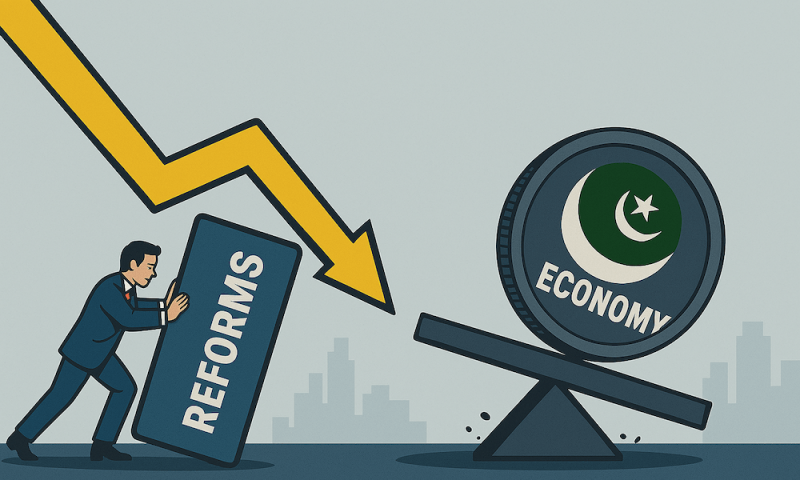

Today, governments and organisations are caught in a quiet but serious mistake. They believe that if everything is measured, everything will improve. Because of this belief, Key Performance Indicators, or KPIs, have stopped being a tool and have started to look like the goal itself. Files, presentations, and dashboards are full of KPIs, as if numbers alone can fix deep problems. In reality, KPIs often distort progress instead of improving it. They push people to chase numbers rather than real results.
The first problem with KPIs is that they slowly replace the real purpose with the measure. Institutions stop asking whether people’s lives improved. They only ask whether targets were met. A teacher focuses on exam results, not learning. Police focus on reported cases, not real safety. A civil servant clears files, not problems. The real mission fades away, and the number becomes everything.
The second problem is that KPIs reward what is visible and ignore what truly matters. Things like mentoring, training, professional judgment, ethics, experience, and prevention are hard to measure. Because they are not counted, they slowly lose value. Staff learn a simple rule. If something is measured, do it. If it is not measured, ignore it. Institutions become good at reports but weak in meaning.
The third problem is wrong incentives. When promotions, rewards, and survival depend on numbers, systems encourage shortcuts. Bad news is delayed. Definitions are changed. Easy targets are chosen. This is not always a moral failure of individuals. It is a natural result of KPI pressure. The indicator improves, but the real problem grows worse.
The fourth harm is short-term thinking. Most KPIs work on yearly or quarterly cycles. They push decisions that show quick results, even if they damage the institution in the long run. Training, reform, succession planning, and cultural change are delayed because their results do not appear quickly on charts. Institutions look better on paper but become hollow inside.
The fifth issue is the loss of inner motivation. Professionals like teachers, doctors, researchers, and civil servants do not work only on orders. They work on responsibility, judgment, and standards. When all decisions are tied to KPIs, their autonomy disappears. They stop asking what is right and start asking what will be counted. Work continues, but commitment and pride vanish.
KPIs also create a false sense of objectivity. Numbers look neutral, but every KPI is a choice. Someone decides what to measure and what to ignore. Someone sets the standard. Once these choices appear on dashboards, they seem unquestionable. Discussion shifts from purpose to percentages. Strategy is replaced by statistics.
Another serious effect is institutional fragmentation. Each department tries to improve its own KPIs, even if the whole system suffers. Parts look efficient, but the system becomes irrational. No single KPI is responsible for major failures. KPIs also reduce risk-taking. Innovation involves failure. Failure is measured, learning is not. As a result, officers choose safe paths, avoid experimentation, and treat average performance as wisdom. Such institutions break first when change comes.
KPIs also expand bureaucracy. New systems are created to measure, verify, and report indicators. More time goes into filling forms and less time into real work. The institution starts serving its indicators instead of serving the public.
This does not mean that measurement is useless. The problem is not data. The problem is the dictatorship of measurement. KPIs work only when they are few, temporary, openly debated, and controlled by human judgment. They should be signals, not destinations. Numbers must be balanced with narratives, reviews, ethics, and professional insight.
Way forward
The way forward is not to abandon KPIs but to put them back in their proper place. Governments should clearly define purpose before measurement. They should ask what problem they want to solve and whom they want to serve. KPIs should be limited in number and revised regularly. Qualitative judgment, field feedback, and professional discretion should carry equal weight. Long-term capacity building must be protected from short-term targets. Most importantly, institutions must value what cannot be easily measured, such as trust, learning, integrity, and wisdom.
KPIs do not fail by accident. They fail by design when they replace purpose. They turn judgment into arithmetic and reform into a show. If governments truly want reform, they must have the courage to value the unseen, because nations are not built by numbers alone. They are built by insight.
The Article is written by Muhammad Zubair, who is a civil servant.