
Mubashar Nadeem
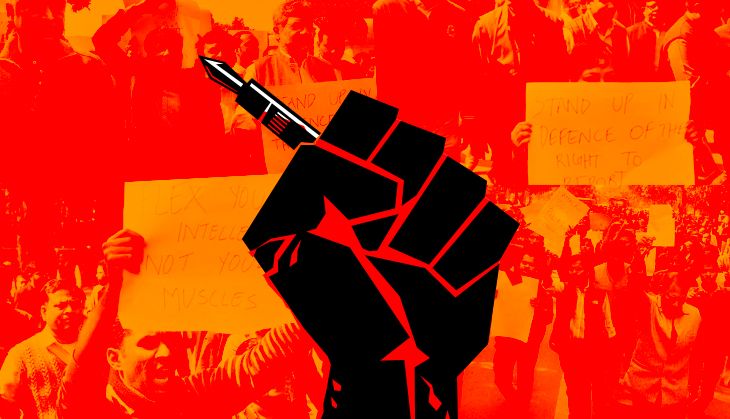
A law designed to combat disinformation is being used to silence the people whose job it is to report it. That, in essence, is what the Senate Subcommittee on Information and Broadcasting revealed at its recent meeting, when it was informed that thirteen First Information Reports had been registered against journalists under the Prevention of Electronic Crimes Amendment Act of 2025. Eleven of those FIRs were cancelled after initial investigation. The government may present this as evidence that the system works. It is, in fact, evidence of something far more troubling: a law so loosely constructed and so readily weaponised that it criminalises journalism first and asks questions later.
PECA 2025 was controversial from the moment it was introduced. Its most contentious provision was the reclassification of the dissemination of “false and fake information” as a cognisable and non-bailable offence. On paper, this may have sounded like a reasonable response to the genuine problem of online disinformation. In practice, it handed the state an instrument of extraordinary and largely unchecked power. The terms “false” and “fake” are not defined with the precision that criminal law demands. They are elastic enough to accommodate almost any interpretation that serves the interests of the authority doing the interpreting. A critical report on a government ministry, an investigative piece on corruption, a commentary that challenges official narratives: all of these can, under the right political climate, be packaged as the spread of false information and pursued through criminal channels.
This is not a hypothetical danger. It is already happening.
The thirteen FIRs registered against journalists are not an administrative footnote. They represent thirteen human beings subjected to the machinery of criminal justice on the strength of complaints that, in eleven cases, turned out to have no substance. Yet the withdrawal of an FIR does not undo the harm that its registration causes. From the moment a criminal case is filed, the accused enters a world of lawyers and court appearances, of financial strain and institutional pressure, of whispered reputations and professional anxieties. For a journalist, the consequences are compounded. The story stops. The source goes silent. The editor becomes nervous. The next investigation is quietly shelved. Not because any conviction follows, but because the threat alone is enough to produce the desired result.
This is the calculated logic of legal intimidation. The process itself becomes the punishment. Arrest, bail hearings, legal notices, and the slow grind of litigation are not merely inconveniences. They are, when deployed against journalists, instruments of control. A reporter who has spent three months fighting a criminal case has not been producing the kind of journalism that makes governments uncomfortable. That is, for those who file such complaints, often the entire point.
What makes the situation worse is the complete absence of accountability on the other side of the equation. If PECA is serious about combating false information, then those who file fabricated or malicious complaints against journalists must face the same legal consequences they sought to impose on others. A law that criminalises expression but leaves abuse of process entirely unpunished is not a law against disinformation. It is a law against inconvenient journalism. The asymmetry is not incidental. It is structural. It tells you everything about who the law was designed to protect and who it was designed to threaten.
There is also the matter of institutional architecture. PECA 2025 created an elaborate new ecosystem of control: a regulatory authority, a complaints council, a tribunal system, and a dedicated investigative agency. Each layer was presented as a safeguard. Together, they function as a parallel justice system operating alongside constitutional structures but with far weaker protections for the accused. Critics warned when the law was being debated that this multiplication of regulatory bodies would create confusion, encourage jurisdictional overreach, and permit arbitrary decision-making. Those warnings have been validated. The fact that the police continued registering PECA cases even after jurisdiction over such matters had been formally transferred elsewhere captures, in one detail, the chaotic and coercive character of the law’s implementation.
Pakistan does not have the luxury of treating press freedom as an abstract principle to be invoked at conferences and ignored in practice. The country is navigating a period of deep institutional strain, economic crisis, and political polarisation. In such conditions, journalism is not merely desirable. It is indispensable. The public’s right to receive accurate, fearless, and independent information is inseparable from any meaningful exercise of democratic participation. When journalists are threatened, harassed, or prosecuted, it is not only their professional interests that are damaged. It is the public’s ability to know what is being done in its name, with its money, and to its future.
The Senate Subcommittee deserves credit for surfacing these figures. But acknowledgment alone is not enough. PECA 2025 requires fundamental revision. The vague and dangerously broad definitions of criminal speech must be replaced with narrow, precise language anchored in international standards for permissible restrictions on expression. Cognisable and non-bailable provisions for speech offences must be reconsidered. Independent oversight of complaints, mandatory preliminary judicial review before any FIR is registered, and meaningful penalties for malicious prosecutions must all be built into the framework.
Freedom of expression is not a privilege granted to the media by the state. It is a right that belongs to every citizen, and the press exercises it on the public’s behalf. When that freedom is systematically eroded through legal intimidation, the damage extends far beyond the newsroom. It reaches into every home where people depend on reliable information to make sense of their lives, hold their representatives to account, and claim their place in a democratic order.
The cancellation of eleven FIRs is not a vindication of the system. It is an indictment of it. Eleven people were dragged through a criminal process for nothing. And an unknown number of journalists, watching that spectacle, chose silence over risk. That is the true cost of PECA 2025, and it is a cost that no democracy can afford to keep paying.