
A new theoretical study may have found a path through one of physics’ most stubborn puzzles: how a universe governed by the relentless increase of entropy still manages to build galaxies, stars, planets, and life.
The work comes from Professor Ginestra Bianconi, a mathematician at Queen Mary University of London, who explored whether a framework known as Gravity from Entropy (GfE) can explain how complexity emerges even as the universe’s total entropy keeps climbing.
The idea that gravity and thermodynamics are intertwined isn’t new. It traces back to the 1970s work of Jacob Bekenstein and Stephen Hawking, who showed that black holes carry entropy and emit thermal radiation, a discovery that reshaped how physicists think about spacetime, information, gravity, and heat. Gravity from Entropy builds directly on that legacy. In this framework, gravity itself emerges from an informational tension between the actual geometry of spacetime and a second, related structure shaped by matter fields and curvature. That tension is captured mathematically through something called the Quantum Geometric Relative Entropy, or QGRE.
Under familiar, low-energy conditions, GfE’s equations simply reproduce Einstein’s General Relativity. But push into more extreme regimes, and the two theories start to diverge. In particular, GfE predicts a dark energy contribution that isn’t fixed but evolves dynamically over time, something that could eventually be tested against real cosmological observations.
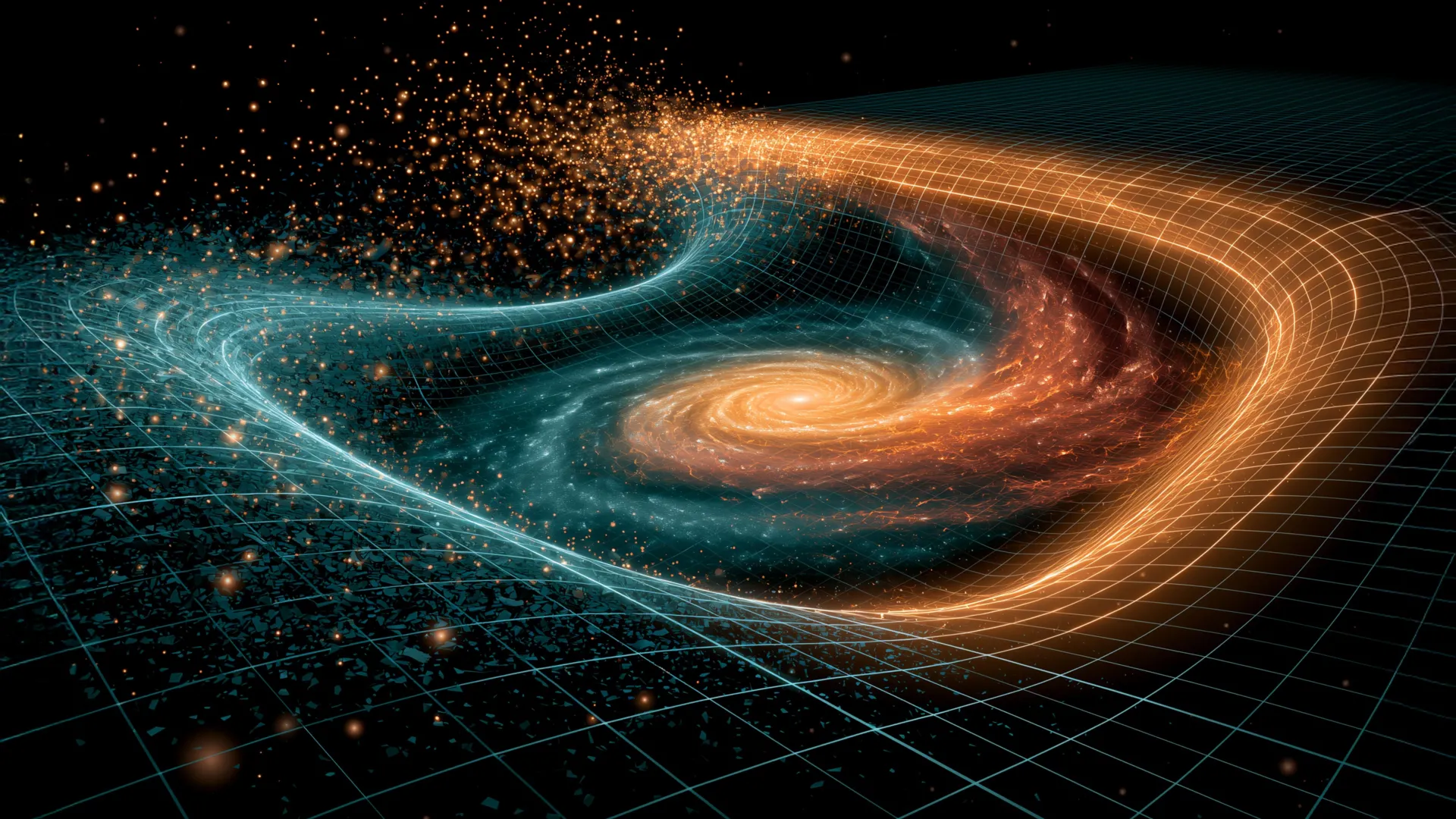
Bianconi examined this behavior using Friedmann-Robertson-Walker spacetimes, the standard mathematical models physicists use to describe a universe expanding uniformly on large scales. What emerged was a strikingly thermodynamic picture: the geometry of spacetime appears to obey a version of the first law of thermodynamics, with the dark energy term acting like internal energy and the QGRE functioning as a local measure of entropy per unit of volume. Effective notions of temperature and pressure fall naturally out of the equations too, suggesting that the quantum state behind gravity may be thermal in nature.
The key to reconciling growing cosmic entropy with the appearance of local order lies in expansion itself. As the universe grows, its volume increases, and within the GfE framework, that growing volume is what drives total entropy upward, even as the entropy packed into any single unit of volume gradually falls. Entropy, in effect, spreads thinner as space stretches, leaving room for pockets of structure and complexity to take shape locally.
The proposal is still at an early theoretical stage, but Bianconi believes it points toward a deeper truth: that gravity and spacetime may have both an informational and a thermodynamic foundation.
“This work reveals how the Gravity from Entropy theory can tackle the challenging question of reconciling the second law of thermodynamics with the emergence of complexity in our universe,” Bianconi said. She added that the results may open new paths for exploring how cosmological irreversibility, the rise of complex structures, and ultimately life itself, connect to the fundamental dynamics of gravity.