
For the first time, two Chinese nationals have won the Fields Medal, mathematics’ most prestigious honor, a milestone celebrated across China as a marker of the country’s growing stature as a science and technology powerhouse.
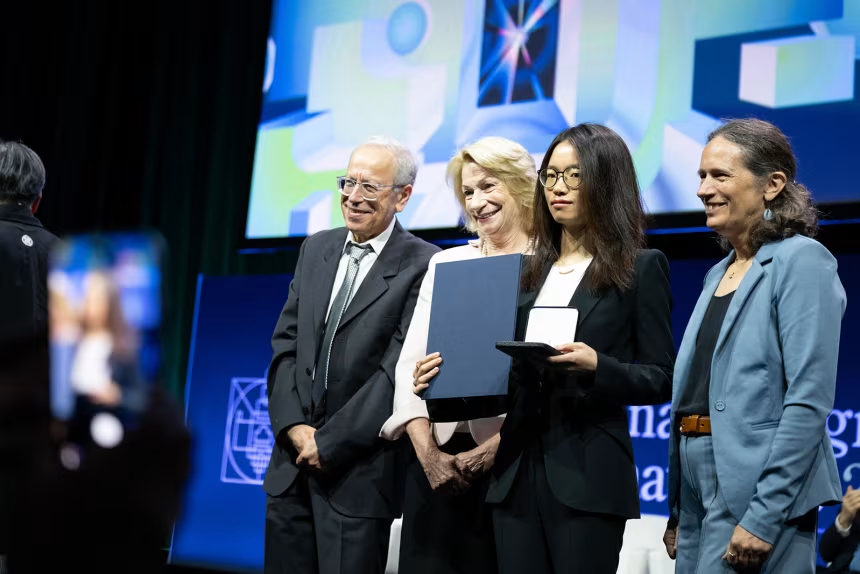
Wang Hong and Deng Yu were named Thursday among four laureates of the prize, awarded every four years by the International Mathematical Union to outstanding mathematicians under 40. The two other winners this year came from Canada and the United States. At 35, Wang becomes only the third woman to win the award in its 90-year history.
News of the win set China’s social media alight, with the top two trending topics on Weibo on Friday morning centered on the achievement, often referred to as the “Nobel Prize of mathematics.” State media and news outlets were quickly filled with coverage of Wang and Deng, even though both pursued their academic careers abroad after studying at Peking University. One widely shared comment called it “a landmark achievement for Chinese mathematics,” describing it as the realization of a dream shared by generations of Chinese mathematicians to build the country into a mathematical powerhouse. Others framed Wang’s win as a breakthrough for women in STEM, with one commentator calling it “a hard slap in the face to those who have long preached that boys are better at mathematics than girls.”
Wang, who grew up in Guilin in southern China and now holds positions at New York University and the Institut des Hautes Études Scientifiques in France, was recognized for resolving a decades-old problem in harmonic analysis and geometric measure theory. Deng, 37, a University of Chicago professor who grew up in the tech hub of Shenzhen, was honored for his progress on partial differential equations.
The wave of national pride reflects the outsized importance placed on academic achievement in China, where top scientists can attain celebrity status and students compete annually in one of the world’s most demanding college entrance examinations. It also reflects Beijing’s long-standing ambition to rank among the world’s leaders in both applied technology and fundamental theoretical science, an ambition that has driven heavy state investment in recruiting talent and funding research. Chinese leaders have tied this pursuit to a broader narrative of national rejuvenation.
One state media commentary captured the sentiment directly, noting that Western academia has long held a stereotype that China excels in competitive and applied mathematics but lacks original breakthroughs in cutting-edge theoretical fields. It said the achievements of Wang and Deng have “finally filled this gap,” setting a new standard for Chinese mathematics and helping dismantle that perception.
Chinese state media described the pair as the first Chinese nationals to win the award. Mathematician Shing-Tung Yau, born in China, won the prize in 1982 but did not hold Chinese citizenship at the time, while Terence Tao, born in Australia and ethnically Chinese, won in 2006. Yau, now a professor at Tsinghua University in Beijing, told a Chinese state-linked outlet that the wins fulfilled a decades-long aspiration within the country’s mathematics community and said he hoped Wang and Deng would eventually return to China to teach. “We very much hope they will come back, because that is important for China,” he said, adding that he hoped scholars trained entirely within China would one day also win the Fields Medal.