
Editorial
Recently, the power division of the Ministry of Energy has announced the Competitive Trading Bilateral Contracts Market (CTBCM), under which the government allows the industry to purchase the electricity from the independent producers directly. According to the official announcement, the policy would reduce the cost, increase exports, attract foreign direct investments (FDIs), and improve the overall efficiency of the system.
First, it is crucial to understand the latest energy mix of Pakistan before we go for the Competitive Markets in the Energy Sector.
In May 2026, Pakistan generated 12, 638 Gwh of electricity, which was 33% higher than the generation of the previous month. Compositely, Pakistan generated 115,266 GWh of power in eleven months of FY2026. In terms of the cost, this year’s per-unit generation cost was 9.09/unit, which was 16.9% higher than the generation cost of the previous year. Primarily, the cost of generation increased due to the decrease in the hydel generation by 13% from the year-on-year basis. Generation from the RLNG also decreased by 31%. To fill this gap, Pakistan had to use the imported coal, with reliance increasing by 115% from the previous year.
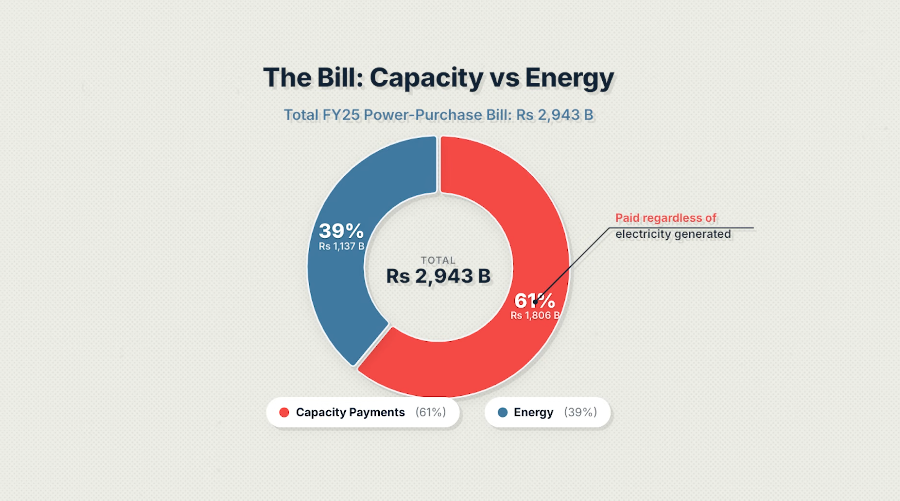
Currently, we have the single buyer model. Government buys electricity from 80 IPPS, GENCOs, WAPDA, and the Pakistan Atomic Commission. This model has several worse impacts on consumers: the government has signed take-or-pay contracts with the IPPs, which are dollar-dominated contracts. In FY25, the government paid Rs. 2,943 billion for the purchase bill, out of which only 39% was intended to pay for the actual generation and 61% for the capacity payments. Taxpayers paid 1806 billion rupees for the unborn units. According to a study, Pakistani consumers bear an average capacity cost around four times more than their counterparts in other markets. The result is visible: in four years, Grid sales have dropped by 11% and solar adoption has increased by 410%. In Pakistan, the distributed solar capacity has increased to 38 GW.
The government is worried about the grid losing attraction to the industrial consumers. In this environment, it has decided to introduce the multi-buyer model. Industries will have the choice to buy power directly from the IPPs. For transmission, they will use only the DISCOs infrastructure. The underlying logic is that market competition will automatically reduce the cost and improve the efficiency. Overall, this new system is a net-positive for the industrial consumers. But its real benefits will be seen after the auction is done.