
Nasir Abbas Nayar
Every social media user feels that they are constantly being prompted to say or share something.
Social media creates within its users an insatiable appetite for every kind of expression and every form of consumption. It encourages users to share every truth about themselves, every interest, activity, thought, opinion, and experience, and, if none of these are available, even their old memories.
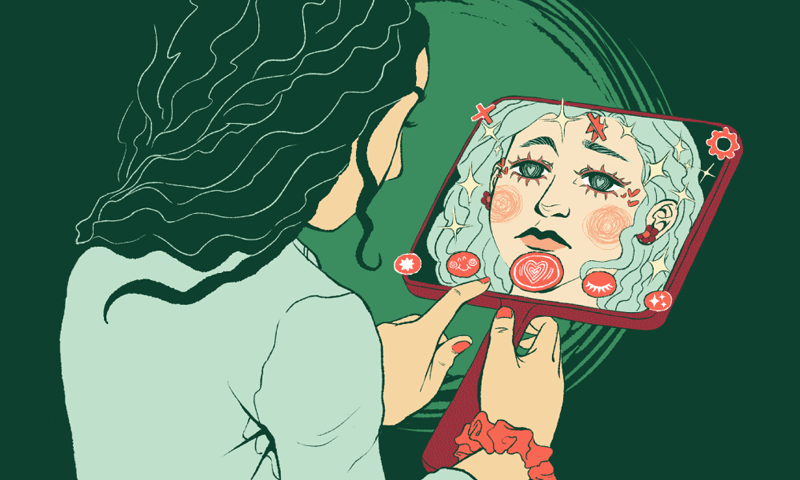
Consequently, the user feels a constant anxiety about sharing something on social media. This is a new kind of anxiety. Existential thinkers, particularly Heidegger, described anxiety as a means of encountering the profound elements of existence. The anxiety produced by social media, however, is a mixture of confused feelings of greed and fear.
There is the greed to keep increasing one’s fame through followers, likes, and comments. And there is the fear that if one does not share anything on social media for two days, one will somehow disappear. This fear of disappearing from the screen expresses itself as a fear of disappearing from the world. This is because, gradually, the social media user begins to affirm their existence and their distinct presence in the world through their continuous presence on the screen.
For such a person, the world is simply whatever appears on the screen, and they begin to find comfort, and in some cases even pleasure, in becoming a citizen of this world—a netizen. This is because they receive immediate attention from others, an experience they encounter only rarely in real life.
In an attempt to overcome the fear of their own disappearance, they begin writing something on the screen or simply sharing their photographs with interesting captions. The reality is that they often write without any genuine inner impulse. They write without any real sense of responsibility to express an opinion on an actual issue.
Most of the time, they do not write; they merely drag words along. Many times, they do not even drag words along; they mumble. They write or mumble merely as an attempt to overcome the fear of disappearing from the screen.
It is precisely this attempt that deprives them of mental freedom. They express themselves under the tyranny of social media.
Not all the thoughts in their mind arise from the concerns and experiences of their own authentic existence. More often than not, the reins of their mind are held by someone else.
The astonishing thing is that they do not feel anxious about the fact that they are being subjected to this tyranny. Faust had mortgaged his soul; this person bargains away the freedom of their mind, without even arguing over the price.
Before entering social media, they possessed a “social self”. Now, a new layer has been added to it: the digital self.
They were deprived of freedom before; now they are even more deprived of it. The irony is that they surrender their freedom with immense happiness.
An excerpt from the preface to the forthcoming book, “You Too Should Take a Tour of This Collection of Troubles”