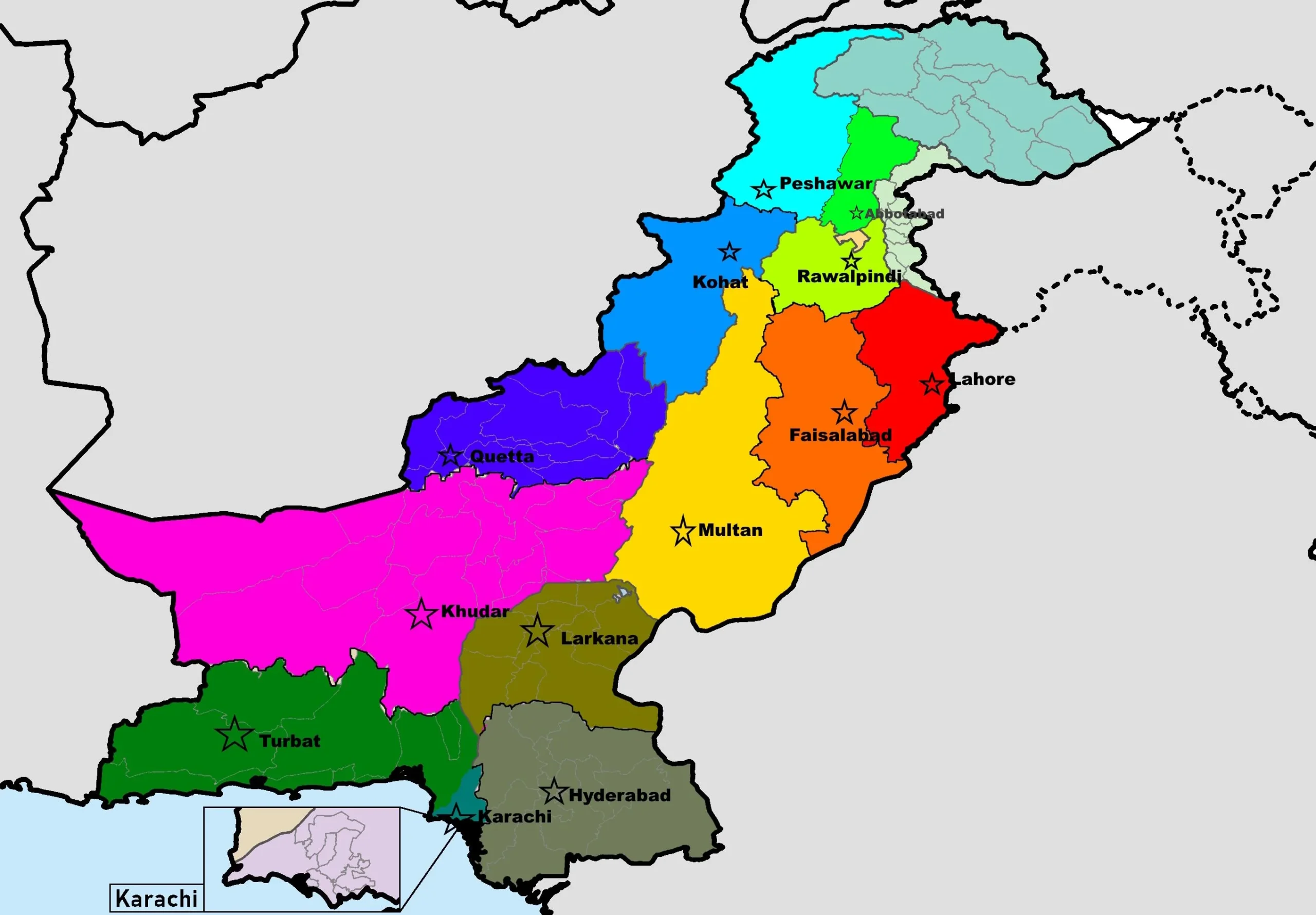

Pakistan has once again entered the familiar debate over provinces, and once again it is asking the wrong question.
The right one is harder: why does Pakistan still govern its economy through boundaries the British drew for reasons that had nothing to do with prosperity, rather than through the cities where its wealth is actually made? Split Punjab into four provinces tomorrow and ask what changes. Does Faisalabad wake up capable of governing itself, its land markets clearing faster, and its entrepreneurs getting easier access to infrastructure and approval? Almost certainly not—the province was never the unit doing the strangling.
We keep treating governments as if their job were to hand out health, education, and infrastructure and stop there. Those things matter, but they don’t explain why some societies get rich and others don’t. A government can build every school and clinic on the list and still leave its people poor if it never builds the environment in which people exchange ideas, take risks, and invest. That environment has a name, and it isn’t the province. It’s the city.
The numbers already say as much. Urban Pakistan produces something like 55 percent of national output even though the official count—the one the state actually plans around—puts only 38 percent of the population as urban. Ten cities generate 95 percent of federal tax revenue; Karachi alone accounts for more than half of that and close to a quarter of GDP, with Lahore and Islamabad trailing behind. A country cannot run itself as an agrarian federation of districts when a handful of cities are quietly paying for the rest of it.
The mismeasurement gets more embarrassing up close. A recent World Bank paper applied the Degree of Urbanization method—the density-based standard most countries now use instead of drawing arbitrary lines on a map—and found that roughly 88 percent of Pakistanis already live somewhere with genuinely urban characteristics, more than double the official figure. Pakistan is one of the last countries still classifying urban space by decree, which means the state is planning, quite literally, for a country that no longer exists.
None of this is new, even if Pakistan has ignored it for decades. Jane Jacobs argued that cities are humanity’s great engine of development because they keep generating “new work” through the friction of strangers bumping into each other’s ideas. Edward Glaeser calls the city mankind’s greatest invention for much the same reason. Geoffrey West did the math and showed that as cities grow, productivity rises faster than population—a doubling in size more than doubles output. Paul Romer’s growth theory puts ideas, not capital, at the center of the story, and Hayek got there decades earlier, arguing that the knowledge a society needs is scattered across millions of minds and cannot be directed from a ministry. Put these thinkers together and one claim survives all of them: a city is a living system, and nobody can predict which street corner produces the next idea worth having.
That should change how we think about the state’s job. If cities behave like complex systems rather than machines, no government can order prosperity into being through a subsidy scheme or a five-year plan. What it can do is build the conditions that let millions of separate decisions add up to something: property rights, streets where people actually meet, transit that gets workers to jobs instead of trapping them in traffic, land markets not strangled by rules written for a different century, and permission systems simple enough that starting a business doesn’t require a favor from someone in an office. This is the part Pakistan keeps getting backwards.
Our cities are administered as if they were still colonial outposts—rural settlements dressed up with a few more buildings, existing mainly to house people and keep them fed. Density, the one thing that makes cities productive, is treated as a threat: sprawl gets subsidized while downtowns are preserved for the comfort of a small official class, a habit reinforced by paying loyal servants and supporters in government plots. The result is expensive, worsening sprawl, and the state’s answer has been flyovers, underpasses, and signal-free corridors—moving cars faster through a city shaped to guarantee they’ll always be stuck. Every serious study of urban productivity says the opposite should be happening.
The consequences follow predictably: decisions that should happen at the city level get made elsewhere, land sits idle while approval crawls through agencies that don’t talk to each other, transit fails to connect because the bodies running it answer to different masters, and public space rots because no single office is responsible for it.
None of this was an accident, which is why it’s proven hard to unwind. The colonial administration wasn’t built to maximize innovation; it was built to keep order, collect revenue, and hold territory, and that logic survives almost intact today. An officer’s career still begins in a district—a rural unit—before working up to province and then center, which means city management sits near the bottom of the hierarchy that runs Pakistan, junior even to the deputy commissioner. Town planners, transit managers, and sanitation engineers: all junior posts, filled by people with limited authority. The system was never built to produce urban expertise, so it hasn’t.
Yet the country these officials govern has become something the org chart doesn’t recognize. Pakistan now has more than two hundred cities above a hundred thousand people, and clusters like Islamabad-Rawalpindi function as single labor markets, whether the map admits it or not. Cities that size need to compete for talent the way firms do, or accountability keeps drifting upward toward Islamabad rather than down to the people who live there.
India offers a useful comparison, mostly because its experiment didn’t fully work. The 74th Constitutional Amendment of 1992 gave urban local bodies constitutional standing and mandated regular elections—a real structural break that has held for thirty years. But fiscal autonomy never fully arrived, and several metropolitan planning committees the amendment called for were never set up. The lesson isn’t that recognition is worthless; it’s that recognition without money and function stalls halfway—and Pakistan hasn’t reached India’s starting line.
Even the electoral system compounds the problem. A metropolitan economy needs leaders answerable to the whole city, not a patchwork of wards each pulling toward its own interest. Plan transit, housing, or economic strategy through a system that rewards every representative for maximizing benefits to one neighborhood, and you get exactly what Pakistan has: nothing coherent.
Which is why the province’s debate misses the point. It’s an argument about slicing up public spending, and it always lands back at the National Finance Commission, fighting over transfers. But wealth was never mainly created by government spending; it comes from what private people do when the conditions are right—invest, build, and take a chance. Cities create growth because they create those conditions; provinces, by themselves, do not. What Pakistan needs is a government that treats cities as the living systems they are, not the districts they were drawn to be—one that sees its role not as directing the outcome from above, but as building the floor millions can stand on to build the rest themselves.
INSPIRED BY THE ARTICLE WRITTEN BY NADEEM-UL-HAQUE