
Three people died and another was critically injured in rain-related incidents across the twin cities on Tuesday, as the Meteorological Department described the downpour as the heaviest in three years.
In one incident, a man was killed and another injured at G-14 when the roof of their makeshift house near Golden Market caved in under the heavy rain. The deceased was identified as 20-year-old Faizan Ashraf, while 65-year-old Raz Mohammad remained in critical condition after being trapped under the debris and rescued. In a separate incident, a 17-year-old, Yahswa Azhar, drowned in rainwater in a nullah near Esa Nagri in I-9/1, prompting a recovery operation by police and rescue teams.
An outer wall of a government boys’ school in G-6, along with a wall of another school in Lakhwal, collapsed during the rain, though no injuries were reported. A nullah in E-11 overflowed after receiving roughly 150mm of rain, flooding nearby roads and building basements, while a protective wall in D-12 also collapsed without injury. Heavy rain was also recorded in Ghauri Town Phase II, and the water level at Rawal Dam rose to 1,751.90 feet, prompting authorities to open its spillways and put rescue teams and police on alert.
Islamabad’s deputy commissioner said low-lying areas were being continuously monitored, noting that record rainfall in E-11 caused the local nullah to exceed capacity, while a nullah in Ghauri Town was blocked by dumped construction slabs. He said the society administration’s negligence had disrupted water flow, leading to flooded homes and streets, and warned that the CDA would take strict action against those responsible for blocking drainage channels. Traffic was disrupted at several points due to water accumulation on major roads.
Rawalpindi
An education department employee died from electric shock during the heavy rain in Arya Mohallah. Police said 50-year-old Sohail Asghar had moved his family to the third floor of his home as rainwater flooded the ground floor, then returned downstairs to retrieve his pet dog. While attempting to switch on a UPS unit in a ground-floor room, he suffered a fatal electric shock.
Leh Nullah rose to 29.5 feet at Kattarian Bridge and 20 feet at Gowalmandi Bridge, prompting the local administration to activate flood-warning sirens so residents near the nullah could move to safety. The Pakistan Army, district administration, WASA, Rescue 1122, Civil Defence, and health departments were all placed on alert. “The army was not called but put on alert to deal with any emergency,” Deputy Commissioner (retired) Capt Nadeem Nasir told Dawn, adding that the morning’s heavy rain forced him to declare a public holiday. The rain stopped after three hours, and by afternoon, Leh Nullah’s water level had dropped to 10 feet at Kattarian and seven feet at Gowalmandi. Rawal Dam, filled by early morning, had its spillways opened that afternoon.
The Met Department recorded 201mm of rain at Shamsabad, 191mm at Chaklala, 187mm at New Kattarian, 87mm at Pirwadhai, and 78mm at Kutchery in Rawalpindi, while Islamabad recorded 157mm at Golra, 152mm at Zero Point, 105mm at Saidpur Village, 72mm at Bokra, and 18mm at the airport, with more rain forecast through Wednesday evening. A Met official said Tuesday’s rainfall was both the heaviest of the current monsoon season and the highest recorded in three years, attributing it to moist currents approaching the country’s upper regions alongside a westerly trough over the north. Rain, wind, and thundershowers, with isolated heavy falls, are expected across Upper Khyber Pakhtunkhwa, the Potohar region, Islamabad, Gilgit-Baltistan, Kashmir, and adjoining hilly areas, with hot, humid conditions elsewhere in the plains.
The Met Office also warned of possible landslides in Dir, Swat, Kohistan, Battagram, Buner, Abbottabad, Mansehra, Haripur, Murree, Galliyat, Gilgit-Baltistan, and Kashmir, alongside urban flooding risk in low-lying parts of Mardan, Swabi, Peshawar, Islamabad/Rawalpindi, Gujranwala, and Gujrat.
Widespread Flooding Across the City
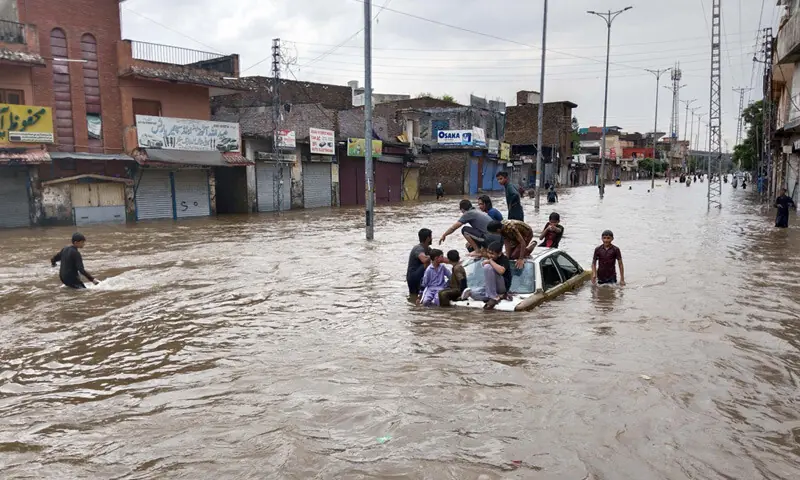
Flooding hit localities including Shah Khalid Colony and Faisal Colony along Old Airport Road; sources alleged authorities diverted water into adjoining drains specifically to protect the road, which is also used for VVIP movement. Areas including Dhoke Juma, Fazalabad, Arya Mohallah, Nadeem Colony, Javed Colony, Muslim Colony, Dhoke Ratta, Ganjmandi, Jamia Masjid Road, Bani Chowk, Sadiqabad, Satellite Town, Commercial Market, College Road, Bohar Bazaar, Naya Mohallah, Iqbal Road, Raja Bazaar, Kohati Bazaar, Mochi Bazaar, Mohanpura, Nanakpura, Arjan Nagar, Amarpura, the Service Road along Murree Road, Khayaban-i-Sir Syed, and Rawal Road were submerged under two to three feet of water.
The Raja Bazaar model market was inundated, as was the Rawalpindi Tehsil office on Jinnah Road, commonly known as City Saddar Road. The officer ward at Benazir Bhutto Hospital (BBH) and the basement of Holy Family Hospital (HFH) also flooded. “The water entered five rooms of the officer ward and patients were shifted to other wards. The telephone exchange was also inundated with rainwater,” a BBH official told Dawn. An HFH official said the gynae and paediatric departments, located in the basement, had to have their equipment moved to upper floors.
Sustained heavy rain sent two to five feet of water into homes, warehouses, and shops across several residential and commercial areas of Rawalpindi city and cantonment, causing millions of rupees in losses. Beyond the usual flood-prone areas, several neighbourhoods typically considered safe also saw unprecedented flooding this time. Residents of Street 10/3 in Faisal Colony were particularly hard-hit, with heavy water flow damaging furniture and household belongings in multiple homes.
Abdullah Siddiqui, a resident near Butt Market, said the area had seen heavier rain before but never flooding like this. He described water that in the past would recede within minutes of rain stopping, but this time continued flowing through the street “like a huge canal” for more than six hours after the rain ended, calling it an unusual and alarming situation. Residents have called on authorities to investigate why the water failed to drain for so long afterward.
Several vehicles were damaged on the Ganjmandi and Kashmiri Bazaar Leh Nullah bridges. Most areas of Rawalpindi experienced a prolonged power outage, and internet service was also suspended for a time. Traffic was halted on major roads, including Murree Road and the Islamabad Expressway, due to water accumulation.
Rescue 1122 evacuated 60 people across several areas, including 30 passengers from Rahimabad bridge, eight from Kuri Road, eight from Dhoke Kala Khan, and six women from Darulaman.