
Pakistan’s urban air pollution crisis is increasingly a structural challenge rather than a seasonal environmental problem. According to the material presented, transport is the dominant source of particulate pollution in several major cities, although the causes differ considerably from one urban centre to another.
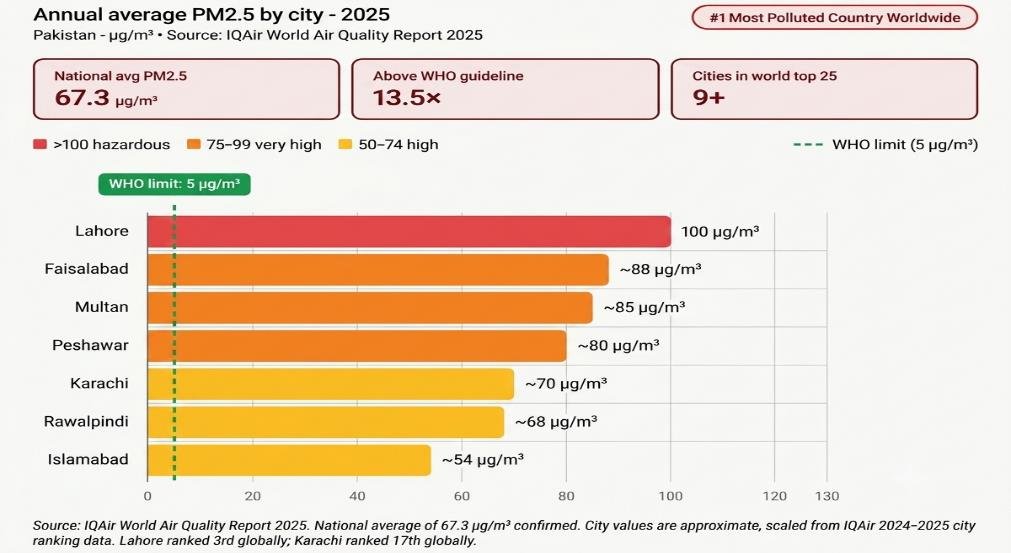
The figures cited show the severity of the problem. Pakistan recorded extremely high average PM2.5 concentrations in 2025, while Lahore, Faisalabad, Multan and Peshawar were among the world’s most polluted cities. The consequences extend directly to public health, with air pollution associated with premature deaths, respiratory illnesses and reduced life expectancy.
The experience of Punjab during the 2024 smog season illustrated the human cost of deteriorating air quality. The provincial government declared a health emergency, while nearly 1.93 million respiratory cases were recorded within a month. Children are particularly vulnerable, with millions exposed to hazardous air on a daily basis.
The central issue, however, is that Pakistan’s cities do not share an identical pollution profile. Data presented by the Pakistan Air Quality Initiative indicate that transport accounts for around 35 per cent of PM2.5 pollution in Lahore, 53pc in Rawalpindi-Islamabad and 51pc in Peshawar. Karachi presents a different picture, with industry and port-related activities accounting for about 49pc.
This variation means that a single national formula cannot adequately address urban air pollution. Each city requires policies designed around its particular sources of emissions.
Transport remains especially important because Pakistan’s urban mobility system is heavily dependent on roads and private vehicles. Two- and three-wheelers are a major concern because older and two-stroke engines can produce disproportionately high particulate emissions. The problem is particularly visible in cities such as Peshawar, where large numbers of unregistered two-stroke rickshaws remain on the roads.
Rapid growth in motorcycle ownership is adding another layer to the challenge. Following the disruption caused by the 2022 floods, two-wheeler sales recovered strongly in 2024. Without cleaner engines, effective emission controls and alternatives to private transport, continued growth in vehicle numbers is likely to increase pressure on already polluted urban environments.
International experience suggests that structural interventions produce more durable improvements than temporary restrictions imposed during severe smog episodes. Cities that have invested in cleaner transport, stronger emission standards and sustained pollution-control measures have generally achieved better results than those relying primarily on emergency responses.
Pakistan already has useful foundations on which to build. Peshawar’s bus rapid transit system carries more than 345,000 passengers daily, while Lahore’s Metrobus and Orange Line together serve more than 250,000 passengers. The Rawalpindi-Islamabad Metrobus carries around 135,000 commuters a day and is being complemented by electric buses.
Expanding these networks, improving connectivity and making public transport a practical alternative to private vehicles could therefore become one of the most effective components of an urban clean-air strategy. Transport planning should increasingly prioritise mass transit and pedestrian mobility rather than relying primarily on flyovers, underpasses and additional road capacity.
Cleaner fuels are another part of the solution, but fuel standards alone cannot solve the problem. Pakistan has moved towards Euro-5 fuel and plans to reach Euro-6 standards by 2030. Their effectiveness, however, depends on whether vehicles themselves meet appropriate emission and fitness requirements.
The weakness of inspection infrastructure remains a significant obstacle. Punjab, according to the figures presented, has only 32 inspection stations for more than 24 million vehicles. A credible system of compulsory emission testing and vehicle fitness certification could therefore produce substantial gains.
Fleet renewal should accompany stronger enforcement. Punjab has already prohibited vehicles without fitness certificates and introduced environmental traffic squads. A transparent scrappage programme targeting the oldest and highest-emitting vehicles could reinforce these measures.
Electrification offers another important opportunity, particularly for motorcycles and rickshaws. The National Electric Vehicle Policy 2025–30 aims for electric vehicles to account for 30pc of new vehicle sales by 2030, backed by more than Rs100 billion in incentives. The material states that subsidies have already supported more than 116,000 electric motorcycles and 3,000 electric rickshaws, while Punjab plans to distribute another 100,000 electric motorcycles in its second phase.
Rail transport should also form part of the wider strategy. Increasing the movement of passengers and freight by rail, including through improvements to the ML-1 corridor, could reduce dependence on heavy diesel vehicles travelling through and between major urban centres.
At the city level, transport demand itself must also be managed. Paid parking, properly organised parking facilities and congestion charges in major urban centres could discourage unnecessary private vehicle use while creating stronger incentives to shift towards public transport.
The broader lesson is straightforward: Pakistan cannot treat polluted air as an emergency that appears every winter and disappears when the smog season ends.
The causes are embedded in how cities transport people, regulate vehicles, manage industry, plan development and enforce environmental standards. They are also different from city to city. Lahore cannot simply adopt Karachi’s solution, just as Peshawar’s pollution problem cannot be addressed through measures designed for Islamabad.
Pakistan therefore needs city-specific clean-air strategies built around mass transit, strict vehicle-emission enforcement, cleaner fuels, fleet renewal, electrification, rail development and better urban planning. For cities where industrial activity, brick kilns or other forms of combustion are major contributors, those sources must receive equally targeted attention.
Clean air should no longer be treated as a seasonal response to smog. It must become a permanent public-health, urban-planning and national development priority.