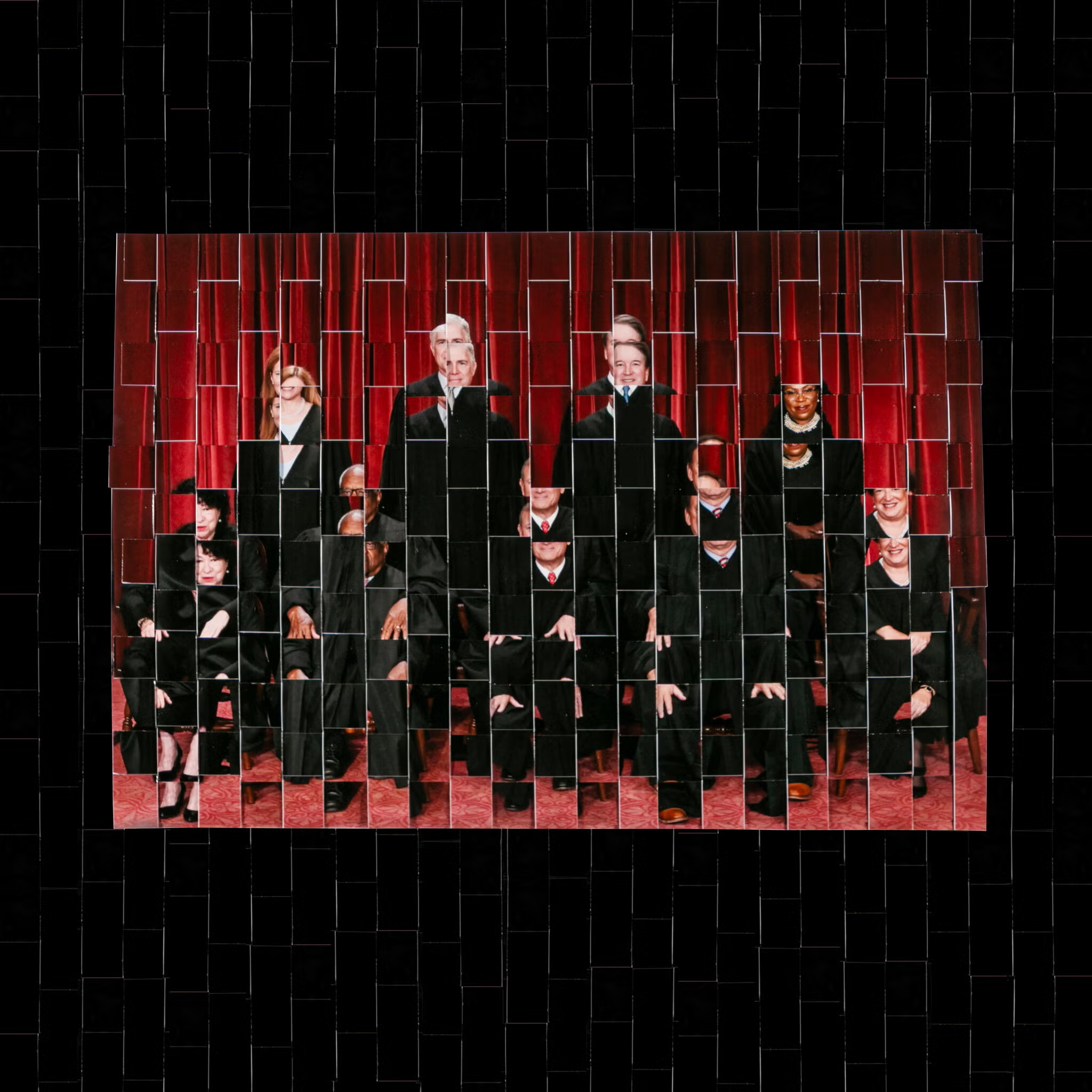

As Chief Justice John Roberts begins his 22nd Supreme Court term, much of the conservative legal agenda associated with his court has already reshaped major areas of American constitutional law. Yet one consequential issue remains unsettled: the constitutional relationship between religion and the state.
The court has already transformed several areas of law. Affirmative action has been struck down, Roe v. Wade has been overturned, protections under the Voting Rights Act have been weakened, and the authority and independence of federal administrative agencies have been curtailed. The court has also embraced historically grounded interpretations in major Second Amendment cases, limiting some forms of firearms regulation.
Against this backdrop, the court’s approach to religion represents another substantial constitutional shift — but one whose boundaries are still being defined.
From Church-State Separation to Equal Access
Over the past decade, the Supreme Court has increasingly held that governments cannot exclude religious institutions from public benefit programmes simply because they are religious.
A significant step came in 2017, when the court ruled that Missouri could not prevent a church-operated school from participating in a state programme that provided funding for resurfacing playgrounds. Missouri had relied on a provision in its state constitution prohibiting public financial assistance to churches.
Chief Justice Roberts, writing for the court, characterised the church’s exclusion from an otherwise generally available public benefit as constitutionally unacceptable.
The decision helped establish an increasingly important principle: when governments make benefits available to secular private institutions, excluding comparable religious institutions may violate constitutional protections for religious exercise.
The Principle Expands to Religious Education
The court extended that reasoning further in 2022 in Carson v. Makin.
Maine provided tuition assistance to families living in areas without public secondary schools, allowing them to use public funding at qualifying private institutions. Religious schools, however, were excluded from receiving those funds.
The Supreme Court ruled that the exclusion was unconstitutional.
For Roberts, the principles developed in the court’s earlier religious-benefits cases were sufficient to decide the dispute. The ruling therefore extended the constitutional doctrine from access to a relatively limited public benefit, such as playground resurfacing, to government-supported private education.
The result has been a substantial redefinition of the constitutional boundary between public funding and religious institutions.
Colorado Case Could Define the Next Boundary
The court’s forthcoming consideration of Colorado’s universal preschool programme raises a different question.
Colorado has operated a programme since 2023 providing free prekindergarten education to four-year-old children. Families can select participating public, secular private or religious preschools, provided those institutions comply with standards established under state law.
Among those requirements is a nondiscrimination rule governing student admissions. Participating institutions may not discriminate on grounds including race, ethnicity, religious affiliation, sexual orientation, gender identity, housing status, income or disability.
Around 2,000 public and private institutions participate, including numerous religious schools.
The constitutional dispute therefore moves beyond whether religious institutions must receive equal access to generally available public programmes. Instead, it raises the question of whether religious institutions participating in such programmes may claim exemptions from requirements that also apply to secular participants.
Equality or Preferential Treatment?
That distinction could become one of the Roberts Court’s next major tests of religious liberty.
Previous decisions established that religious status alone generally cannot justify excluding an institution from a public benefit available to comparable secular organisations. The Colorado dispute potentially asks how far that principle extends once a religious institution enters a publicly funded programme.
If participation on equal terms is constitutionally required, must religious schools also follow generally applicable programme conditions? Or can constitutional protections for religious exercise require exemptions from particular rules that conflict with religious beliefs?
The answer could help determine whether the court’s religion jurisprudence remains centred on equal treatment between religious and secular institutions or develops further toward constitutionally required accommodations for religious institutions.
After years of decisions that have substantially altered the legal relationship between government and religion, the Roberts Court has already travelled considerable constitutional ground. The Colorado case suggests that the boundaries of that transformation remain unfinished.