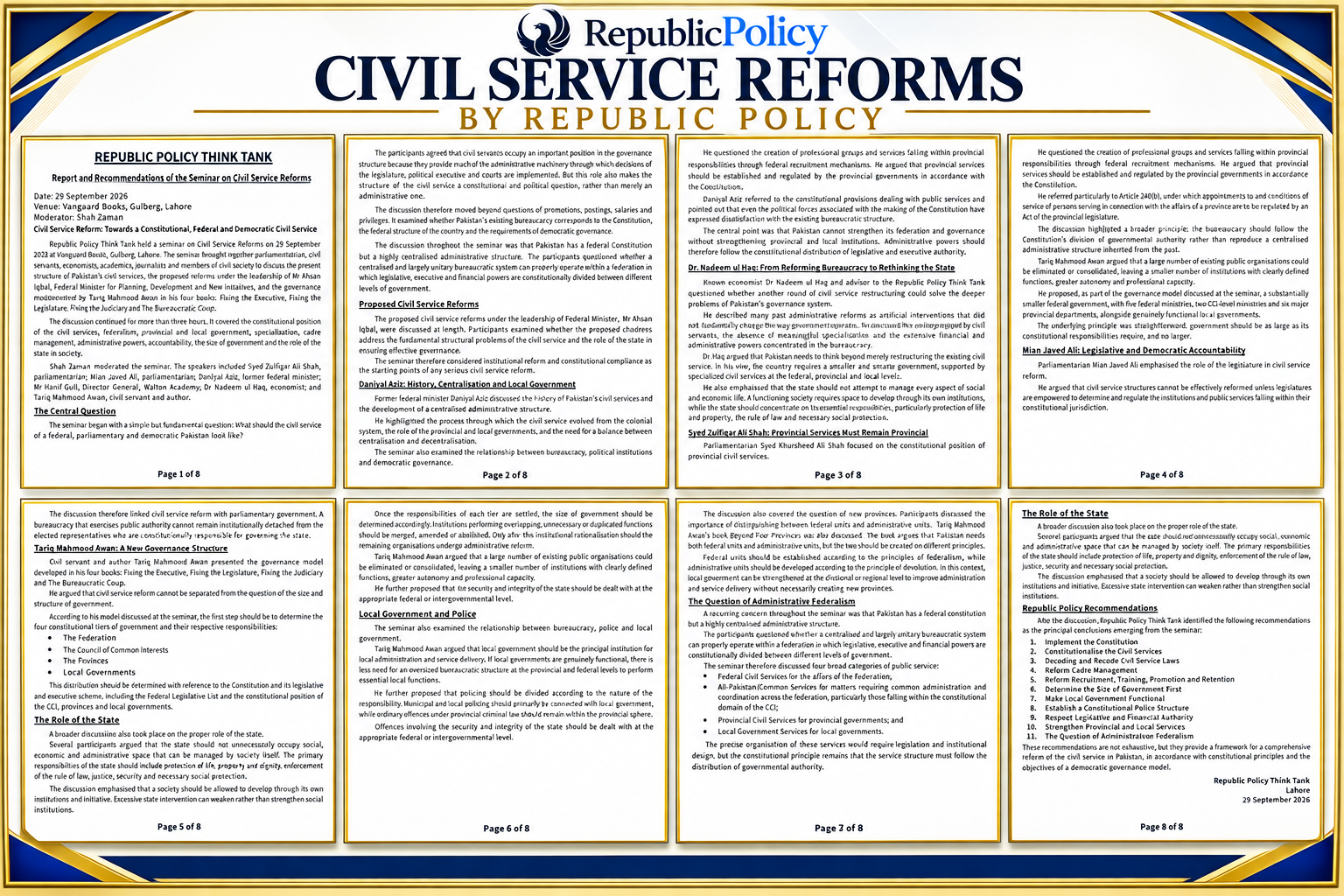

REPUBLIC POLICY THINK TANK
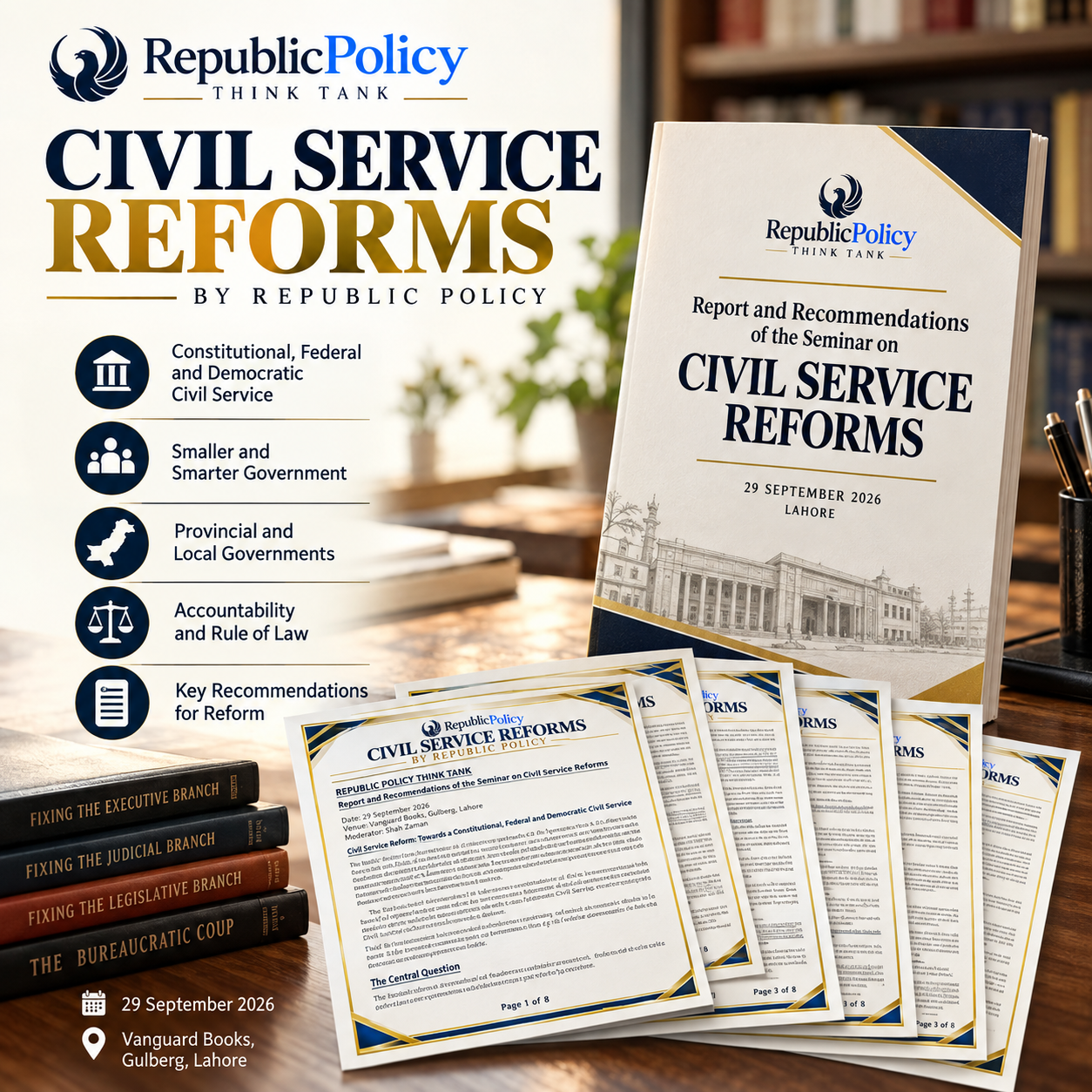
Report and Recommendations of the Seminar on Civil Service Reforms
Date: 29 September 2026
Venue: Vanguard Books, Gulberg, Lahore
Moderator: Shah Zaman
Civil Service Reform: Towards a Constitutional, Federal and Democratic Civil Service
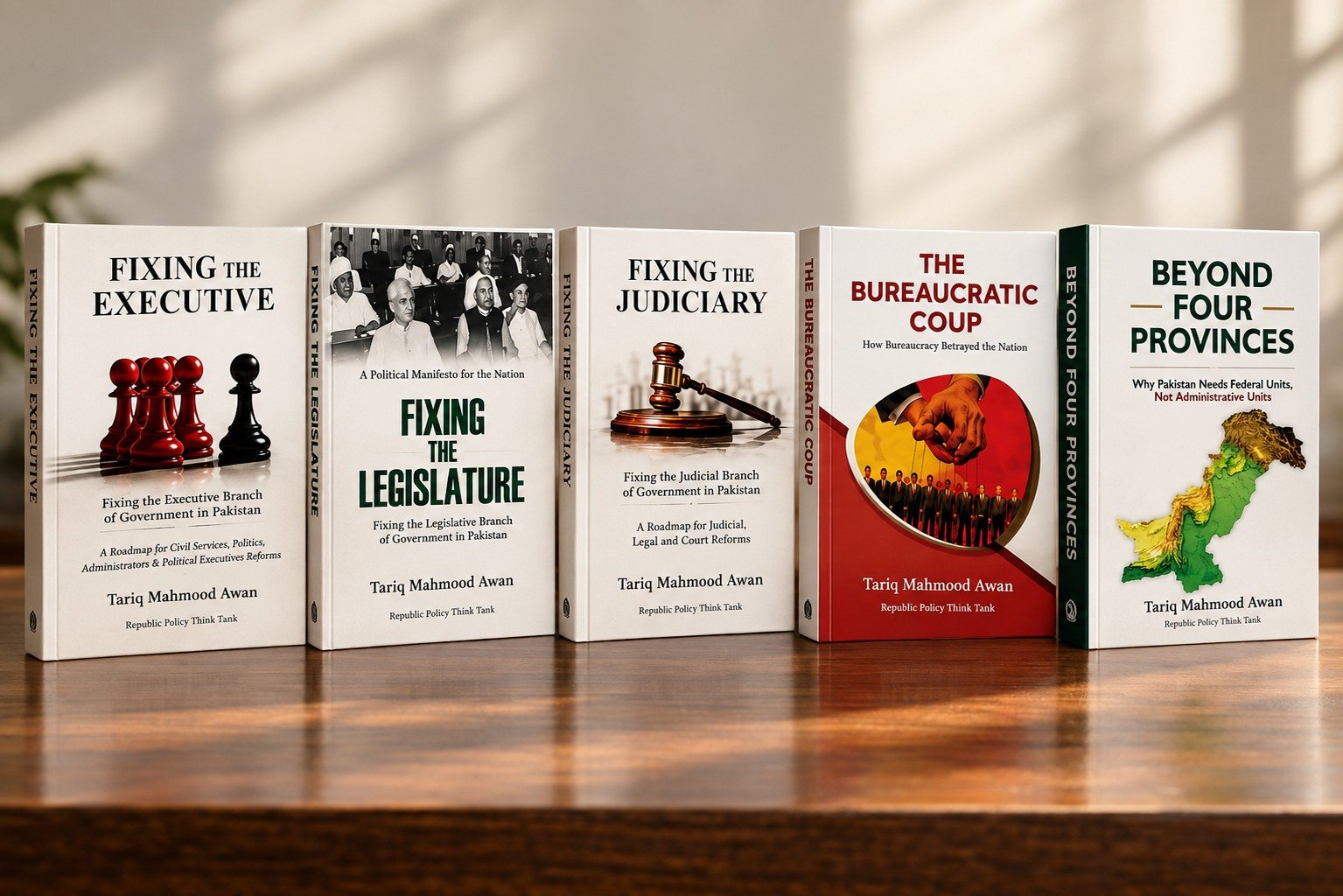
Republic Policy Think Tank held a seminar on Civil Service Reforms on 29 September 2026 at Vanguard Books, Gulberg, Lahore. The seminar brought together parliamentarians, civil servants, economists, academics, journalists and members of civil society to discuss the present structure of Pakistan’s civil services, the proposed reforms under the leadership of Mr Ahsan Iqbal, Federal Minister for Planning, Development and New Initiatives, and the governance model documented by Tariq Mahmood Awan in his four books: Fixing the Executive, Fixing the Legislature, Fixing the Judiciary and The Bureaucratic Coup.
The discussion continued for more than three hours. It covered the constitutional position of the civil services, federalism, provincial and local government, specialisation, cadre management, administrative powers, accountability, the size of government and the role of the state in society.
Shah Zaman moderated the seminar. The speakers included Syed Zulfiqar Ali Shah, parliamentarian; Mian Javed Ali, parliamentarian; Daniyal Aziz, former federal minister; Mr Arif Gull, Director General, Walton Academy; Dr Nadeem ul Haq, economist; and Tariq Mahmood Awan, civil servant and author.
The Central Question
The seminar began with a simple but fundamental question: What should the civil service of a federal, parliamentary and democratic Pakistan look like?
The participants agreed that civil servants occupy an important position in the governance structure because they provide much of the administrative machinery through which decisions of the legislature, political executive and courts are implemented. But this role also makes the structure of the civil service a constitutional and political question, rather than merely an administrative one.
The discussion therefore moved beyond questions of promotions, postings, salaries and privileges. It examined whether Pakistan’s existing bureaucracy corresponds to the Constitution, the federal structure of the country and the requirements of democratic governance.
The discussion throughout the seminar was that Pakistan has a federal Constitution but a highly centralised administrative structure. The participants questioned whether a centralised and largely unitary bureaucratic system can properly operate within a federation in which legislative, executive and financial powers are constitutionally divided between different levels of government.
Proposed Civil Service Reforms
The proposed civil service reforms under the leadership of Federal Minister, Mr Ahsan Iqbal, were discussed at length. Participants examined whether the proposed changes address the fundamental structural problems of the civil service and the role of the state in ensuring effective governance.
The seminar therefore considered institutional reform and constitutional compliance as the starting points of any serious civil service reform.
Daniyal Aziz: History, Centralisation and Local Government
Former federal minister Daniyal Aziz discussed the history of Pakistan’s civil services and the development of a centralised administrative structure.
He highlighted the process through which the civil service evolved from the colonial system, the role of the provincial and local governments, and the need for a balance between centralisation and decentralisation.
The seminar also examined the relationship between bureaucracy, political institutions and democratic governance.
He questioned the creation of professional groups and services falling within provincial responsibilities through federal recruitment mechanisms. He argued that provincial services should be established and regulated by the provincial governments in accordance with the Constitution.
Daniyal Aziz referred to the constitutional provisions dealing with public services and pointed out that even the political forces associated with the making of the Constitution have expressed dissatisfaction with the existing bureaucratic structure.
The central point was that Pakistan cannot strengthen its federation and governance without strengthening provincial and local institutions. Administrative powers should therefore follow the constitutional distribution of legislative and executive authority.
Dr Nadeem ul Haq: From Reforming Bureaucracy to Rethinking the State
Known economist Dr Nadeem ul Haq and advisor to the Republic Policy Think Tank questioned whether another round of civil service restructuring could solve the deeper problems of Pakistan’s governance system.
He described many past administrative reforms as artificial interventions that did not fundamentally change the way government operates. He discussed the rent-seeking and gatekeeping role of bureaucracy and the extensive financial and administrative powers concentrated in the bureaucracy.
Dr Haq argued that Pakistan needs to think beyond merely restructuring the existing civil service. In his view, the country requires a smaller and smarter government, supported by specialised civil services at the federal, provincial and local levels.
He also emphasised that the state should not attempt to manage every aspect of social and economic life. A functioning society requires space to develop through its own institutions, while the state should concentrate on its essential responsibilities, particularly protection of life and property, the rule of law and necessary social protection.
Syed Zulfiqar Ali Shah: Provincial Services Must Remain Provincial
Parliamentarian Syed Khursheed Ali Shah focused on the constitutional position of provincial civil services.
He questioned the creation of professional groups and services falling within provincial responsibilities through federal recruitment mechanisms. He argued that provincial services should be established and regulated by the provincial governments in accordance with the Constitution.
He referred particularly to Article 240(b), under which appointments to and conditions of service of persons serving in connection with the affairs of a province are to be regulated by an Act of the provincial legislature.
The discussion highlighted a broader principle: the bureaucracy should follow the Constitution’s division of governmental authority rather than reproduce a centralised administrative structure inherited from the past.
Tariq Mahmood Awan argued that a large number of existing public organisations could be eliminated or consolidated, leaving a smaller number of institutions with clearly defined functions, greater autonomy and professional capacity.
He proposed, as part of the governance model discussed at the seminar, a substantially smaller federal government, with five federal ministries, two CCI-level ministries and six major provincial departments, alongside genuinely functional local governments.
The underlying principle was straightforward: government should be as large as its constitutional responsibilities require, and no larger.
Mian Javed Ali: Legislative and Democratic Accountability
Parliamentarian Mian Javed Ali emphasised the role of the legislature in civil service reform.
He argued that civil service structures cannot be effectively reformed unless legislatures are empowered to determine and regulate the institutions and public services falling within their constitutional jurisdiction.
The discussion therefore linked civil service reform with parliamentary government. A bureaucracy that exercises public authority cannot remain institutionally detached from the elected representatives who have constitutionally responsibility for governing the state.
Tariq Mahmood Awan: A New Governance Structure
Civil servant and author Tariq Mahmood Awan presented the governance model developed in his four books: Fixing the Executive, Fixing the Legislature, Fixing the Judiciary and The Bureaucratic Coup.
He argued that civil service reform cannot be separated from the question of the size and structure of government.
According to his model discussed at the seminar, the first step should be to determine the four constitutional tiers of government and their respective responsibilities:
- The Federation
- The Council of Common Interests
- The Provinces
- Local Governments
This distribution should be determined with reference to the Constitution and its legislative and executive scheme, including the Federal Legislative List and the constitutional position of the CCI, provinces and local governments.
The Role of the State
A broader discussion also took place on the proper role of the state.
Several participants argued that the state should not unnecessarily occupy social, economic and administrative space that can be managed by society itself. The primary responsibilities of the state should include protection of life, property and dignity, enforcement of the rule of law, justice, security and necessary social protection.
The discussion emphasised that a society should be allowed to develop through its own institutions and initiative. Excessive state intervention can weaken rather than strengthen social institutions.
Once the responsibilities of each tier are settled, the size of government should be determined accordingly. Institutions performing overlapping, unnecessary or duplicated functions should be merged, amended or abolished. Only after this institutional rationalisation should the remaining organisations undergo administrative reform.
Tariq Mahmood Awan argued that a large number of existing public organisations could be eliminated or consolidated, leaving a smaller number of institutions with clearly defined functions, greater autonomy and professional capacity.
He further proposed that job security and integrity of the state should be dealt with at the appropriate federal or intergovernmental level.
Local Government and Police
The seminar also examined the relationship between bureaucracy, police and local government.
Tariq Mahmood Awan argued that local government should be the principal institution for local administration and service delivery. If local governments are genuinely functional, there is less need for an oversized bureaucratic structure at the provincial and federal levels to perform essential local functions.
He further proposed that policing should be divided according to the nature of the responsibility. Municipal and local policing should primarily be connected with local government, while ordinary offences under provincial criminal law should remain within the provincial sphere.
Offences involving the security and integrity of the state should be dealt with at the appropriate federal or intergovernmental level.
The discussion also covered the question of new provinces. Participants discussed the importance of distinguishing between federal units and administrative units. Tariq Mahmood Awan’s book Beyond Four Provinces was also discussed. The book argues that Pakistan needs both federal units and administrative units, but the two should be created on different principles.
Federal units should be established according to the principles of federalism, while administrative units should be developed according to the principle of devolution. In this context, local government can be strengthened at the divisional or regional level to improve administration and service delivery without necessarily creating new provinces.
The Question of Administrative Federalism
A recurring concern throughout the seminar was that Pakistan has a federal Constitution but a highly centralised administrative structure.
The participants questioned whether a centralised and largely unitary bureaucratic system can properly operate within a federation in which legislative, executive and financial powers are constitutionally divided between different levels of government.
The seminar therefore discussed four broad categories of public service:
- Federal Civil Services for the affairs of the Federation;
- All-Pakistan/Common Services for matters requiring common administration and coordination across the federation, particularly those falling within the constitutional domain of the CCI;
- Provincial Civil Services for provincial governments; and
- Local Government Services for local governments.
The precise organisation of these services would require legislation and institutional design, but the constitutional principle remains that the service structure must follow the distribution of governmental authority.
The Role of the State
A broader discussion also took place on the proper role of the state.
Several participants argued that the state should not unnecessarily occupy social, economic and administrative space that can be managed by society itself. The primary responsibilities of the state should include protection of life, property and dignity, enforcement of the rule of law, justice, security and necessary social protection.
The discussion emphasised that a society should be allowed to develop through its own institutions and initiative. Excessive state intervention can weaken rather than strengthen social institutions.
Republic Policy Recommendations
At the discussion, Republic Policy Think Tank identified the following recommendations as the principal conclusions emerging from the seminar:
- Implement the Constitution
- Constitutionalise the Civil Services
- Decoding and Recode Civil Service Laws
- Reform Cadre Management
- Reform Recruitment, Training, Promotion and Retention
- Determine the Size of Government First
- Make Local Government Functional
- Establish a Constitutional Police Structure
- Respect Legislative and Fiscal Authority
- Strengthen Provincial and Local Services
- The Question of Administrative Federalism
These recommendations are not exhaustive, but they provide a framework for a comprehensive reform of the civil service in Pakistan, in accordance with constitutional principles and the objectives of a democratic governance model.
Republic Policy Think Tank
Lahore
29 September 2026