


Tahir Maqsood Chheena
Prime Minister Shehbaz Sharif has taken a welcome step. His decision to gather Pakistan’s scattered business regulations into a single regulatory registry, and to push for greater uniformity across the country, addresses a problem that has quietly strangled enterprise for decades. It deserves appreciation. It also deserves scrutiny, because Pakistan has heard promising announcements before.
For years, businesses have been forced to work through overlapping requirements, conflicting procedures and regulations enforced by departments that often seem unaware of what other departments are doing. One authority demands a document that another has already verified. One office approves what another later questions. The entrepreneur pays for this confusion in time, money and patience. A unified regulatory framework, if properly implemented, could remove one of the most stubborn and unnecessary barriers to doing business in Pakistan.
The scale of the exercise is encouraging. The Cabinet’s Regulatory Reforms Committee has approved 557 reforms across seven areas, and the government estimates they could save businesses Rs460 billion a year. The prime minister has also ordered nationwide implementation of the Easy Business Act, closer coordination with the provinces, and a registry that brings existing rules, regulations and requirements into one system. These are sensible measures. Regulatory complexity carries a real economic cost, even when it never appears as a line in a tax bill.
Pakistan has never suffered from a shortage of rules. It suffers from too many of them, spread across too many offices. Businesses must deal with federal, provincial and local authorities, each with its own licences, approvals, registrations and procedures. These often overlap. Sometimes they contradict each other. The result is uncertainty, and uncertainty is expensive. It consumes management time, raises compliance costs and opens the door to arbitrary interpretation by officials who hold the power to delay or deny.
Small businesses suffer most. A large corporation can hire lawyers, consultants and liaison officers to manage the maze. A small trader, a young manufacturer or a startup founder cannot. For them, every unclear rule is a risk, and every extra approval is a cost they can barely afford. Regulatory confusion, in this sense, is not neutral. It quietly favours the powerful over the enterprising.
Greater uniformity could therefore deliver benefits well beyond the government’s projected savings. An investor needs to know four simple things: which rules apply, which authority enforces them, how long approvals should take, and whether those rules will still be in force next year. A comprehensive registry could answer all four. But only if it becomes the authoritative and regularly updated source of regulatory truth. If it turns into yet another government portal, launched with fanfare and then left to decay, it will add to the clutter rather than remove it.
The effort to harmonise systems across provinces also has merit, but it must be handled with care. Pakistan is a federation. The Constitution assigns distinct responsibilities to the federal, provincial and local governments, and regulatory reform must respect those boundaries. Federalism, however, does not mean that a business should face incompatible procedures every time it crosses a provincial border. Common standards, interoperable digital systems and coordinated procedures can reduce duplication while leaving legitimate provincial authority intact. The distinction matters. Harmonisation strengthens a federation. Centralisation weakens it. The Special Investment Facilitation Council’s proposed engagement with the provinces should focus on practical coordination, not on pulling provincial powers back to Islamabad.
The most important part of the prime minister’s instructions concerns implementation and independent validation. This is where Pakistan’s reform efforts usually fail. The country has produced many reform packages that looked impressive in presentations and disappointing on the ground. Announcements are easy. Delivery is hard.
The claim of Rs460 billion in annual savings is substantial. It should now become a measurable benchmark rather than a headline figure. Third-party validation must establish how that number was calculated, and later, whether businesses actually feel the difference. If the savings exist only on paper, the reform has failed, whatever the official reports say.
The same discipline should apply to the Business Facilitation Centres. Processing thousands of applications sounds impressive, but volume is not the real measure of success. What matters is how long each approval takes, how many approvals are no longer needed, how much compliance costs have fallen, how often applications are rejected, and what businesses themselves say about the experience. These are the numbers that tell the truth.
Ministries must also be held to the deadlines the prime minister has already set. Progress should be published at regular intervals, so that delays and institutional resistance cannot quietly vanish inside the bureaucracy. Every reform creates losers within the system, usually the officials whose discretion it removes. They will not surrender that discretion willingly. Transparency is the only reliable defence against their resistance.
The private sector, too, must remain involved throughout, not consulted once and then forgotten. Businesses are best placed to identify where reforms are working and where friction remains. Their feedback should shape each stage of implementation.
The government has identified a genuine problem and, on paper, proposed a credible solution. Bringing scattered regulations into one accessible system, removing contradictions and coordinating procedures across jurisdictions could materially improve Pakistan’s business environment.
For once, the right hand and the left hand of the state are being asked to read from the same rulebook. The real test is whether the bureaucracy will actually open it.
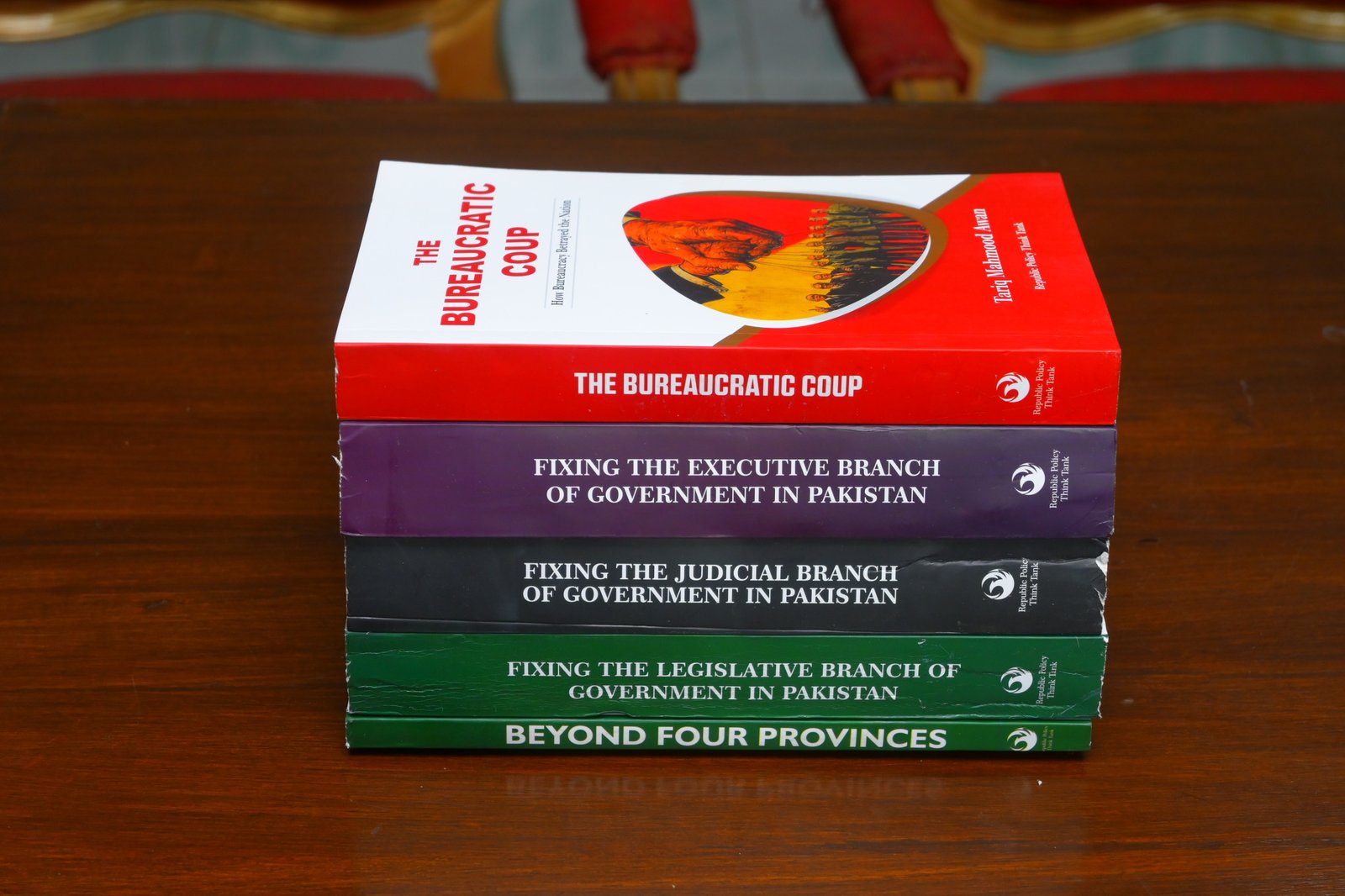
The best-selling books of Republic Policy Think Tank, including the landmark book The Bureaucratic Coup, are available at Vanguard Books, Liberty Books, Readings, Kitab Sarai, Sang-e-Meel, Saeed Book Bank Islamabad, National Book Foundation, and others across Pakistan. Contact for home delivery: 0300 9552542.