


By Naeem Afzal
Pakistan is, in practice, a bureaucratic state. It has been one since 1947. It inherited the administrative machinery of the British Raj and never reshaped it to fit its own Constitution. Constitutions came and went. The bureaucracy stayed. This is the starting point of a striking letter that Tariq Mahmood Awan, civil servant and author, has addressed to the Prime Minister, calling for the abolition of the Central Superior Services examination as anti-federal and anti-governance. His argument deserves a serious national hearing.
Awan begins with language, because in public law a name is never innocent. It declares a theory of the state. Article 1 of the Constitution declares Pakistan a Federal Republic. The Constitution speaks of the Federation, the Federal Government and the Federal Public Service Commission. It does not speak of a “centre”. The word central belongs to the unitary state, where power sits at the top and is delegated downward for convenience. In a federation, power is not delegated. It is distributed by the Constitution itself, and each unit holds its share by right, not by grace.
The word superior fares no better. Superior to whom? A unitary state may divide its administration into superior and subordinate tiers. A federation cannot. The Federal and Provincial Governments are each supreme in their own sphere. When a service calling itself superior occupies provincial posts, it declares the provinces subordinate. The Constitution permits no such declaration. Even the word services, Awan argues, belongs to a vanished age, when one generalist officer could collect revenue, run the secretariat and frame policy. Modern governance is specialised. Health, energy, finance, regulation and digital administration each need their own expertise and their own careers. Read word by word, he concludes, the term is unconstitutional in its first word, anti-federal in its second and obsolete in its third.
The constitutional argument is sharper still. Article 240 requires that appointments to, and conditions of service of, persons in the service of Pakistan be determined by or under an Act of Parliament for federal services, and by or under an Act of the Provincial Assembly for provincial ones. The command is clear: services and posts must rest on legislation. Yet not one of the occupational groups recruited through the CSS has been created by a dedicated Act of Parliament. They were created, merged and renamed through executive orders and notifications. The Civil Servants Act of 1973 governs terms and conditions. It does not create services, establish cadres or fix schedules of posts. This leaves an unanswered question. If a service has not been created by law, on what constitutional authority does the government recruit to it? Recruitment presupposes a lawful service. Without one, it rests on discretion.
Then comes jurisdiction. Article 242 allows Parliament and each Provincial Assembly to establish a Public Service Commission for their own affairs. The design is federal and symmetrical. Read with Articles 97, 137 and 142, federal and provincial executive authority is confined to its own legislative field. The FPSC, therefore, has no constitutional jurisdiction over provincial posts. Yet every year it recruits Assistant Commissioners and Assistant Superintendents of Police, both provincial positions. What the Constitution forbids directly, Awan reminds us, cannot be done indirectly.
His examination of individual groups is equally pointed. The Pakistan Audit and Accounts Service both keeps accounts and audits them, which violates the first principle of audit everywhere: the auditor must be a third party. No one can be his own accountant and his own auditor. The Auditor-General, a constitutional office, should be free to engage qualified professional firms under its supervision. Railways fall in Part II of the Federal Legislative List, under the Council of Common Interests, where provinces sit as equal partners, so a railway service cannot be treated as the private domain of one ministry. The Office Management Group was built for a sprawling federal secretariat, but after the Eighteenth Amendment the Federation should be compact, centred on a handful of specialised ministries such as foreign affairs, defence, finance and revenue, communications, and law and justice.
The Postal Service could be merged into communications, corporatised or outsourced. Cantonments fall within defence and need no separate civil service. Inland Revenue, Customs and Commerce could become a single service for a single revenue and finance ministry. The Information Group, serving a small organisation, needs no generalist examination at all. The principle is simple. A ministry may have its own service. Any other organisation should recruit its own specialised staff.
Most important, Awan argues, is the Council of Common Interests. Article 154 requires it to have a permanent secretariat, and the eighteen subjects of Part II demand dedicated administration. That secretariat should be staffed by a true All-Pakistan Service, created by an Act of Parliament and owned jointly by the Federation and the provinces. Its absence explains why federalism struggles to take root year after year.
There is also the question of whether the CSS is competitive at all. Only 7.5 per cent of posts are filled on open merit. The rest are divided by provincial quota, with further reservations for women, minorities and persons with disabilities, alongside a quota for military officers inducted without the same examination. Awan does not oppose representation, which the Constitution itself recognises. His point is that what remains is a generalist allocation system, not a search for specialised talent. A general examination cannot meet the demands of specialisation. The size of government should determine the size of the civil service. In Pakistan, the reverse is true.
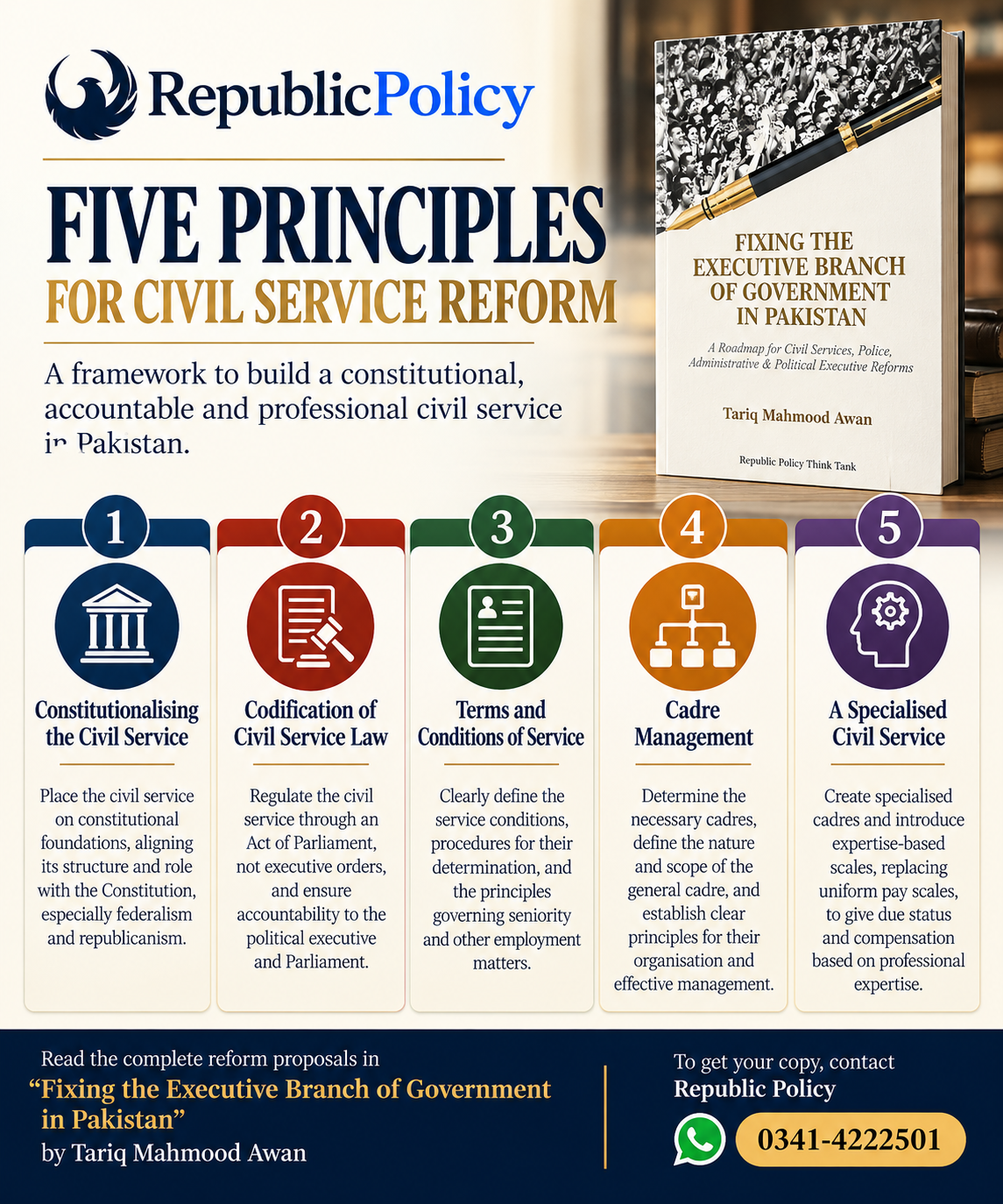
His prescription follows directly from the Constitution. Retire the word central from the vocabulary of the Federation. Create every service by an Act of the competent legislature, as Article 240 commands. Let the FPSC recruit for the Federation and the provincial commissions recruit for the provinces, as Article 242 commands. Give the Council of Common Interests its permanent secretariat and a genuine All-Pakistan Service. Let every ministry and organisation recruit the specialists it actually needs.
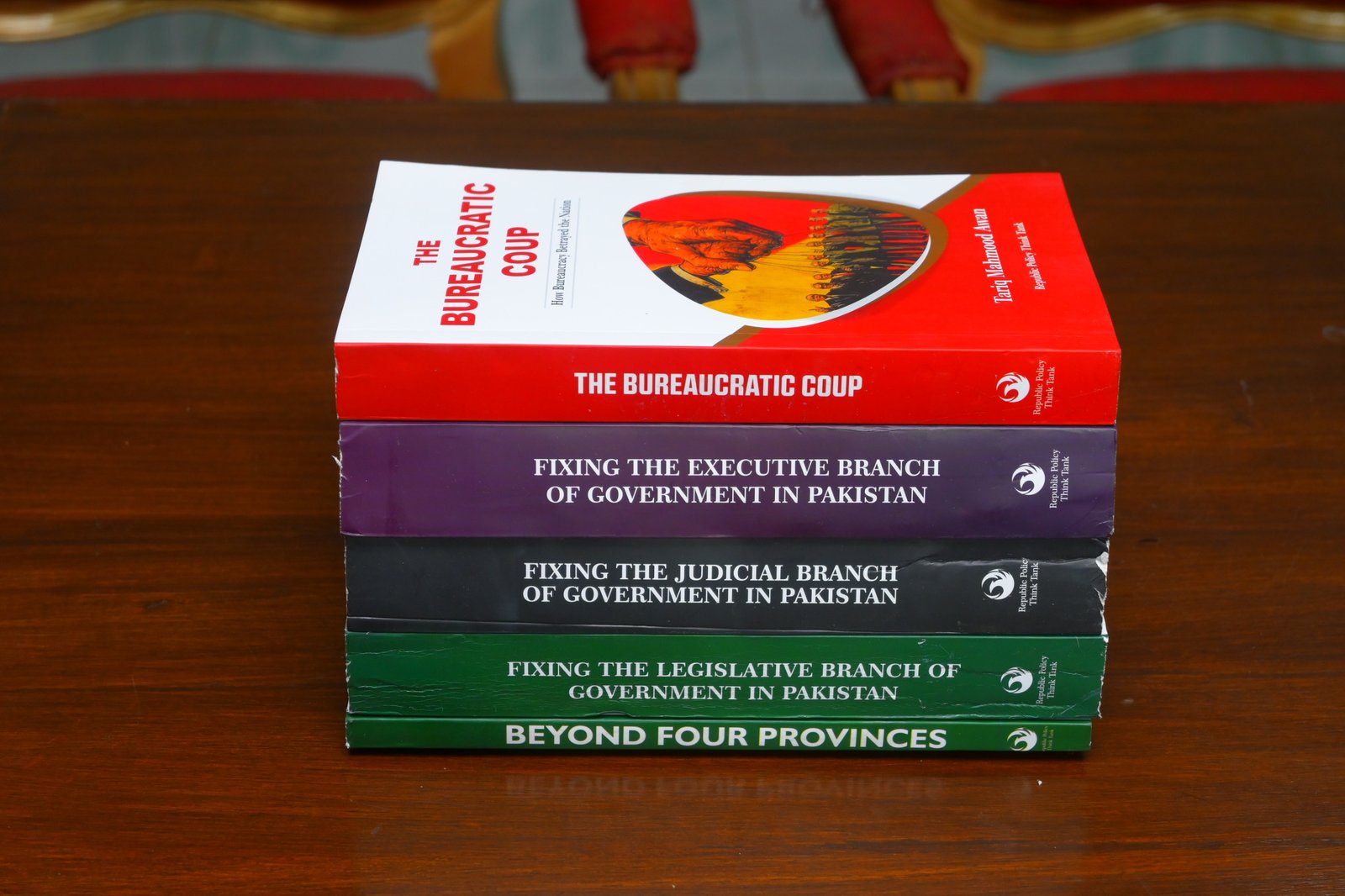
Awan has developed this model at length in four books: The Bureaucratic Coup, Fixing the Executive, Fixing the Legislature and Fixing the Judiciary. His letter ends with a line that should trouble anyone who takes the Constitution seriously. The Constitution has already spoken. It is now for the government to obey it.
The best-selling books of Republic Policy Think Tank, including the landmark book The Bureaucratic Coup, are available at Vanguard Books, Liberty Books, Readings, Kitab Sarai, Sang-e-Meel, Saeed Book Bank Islamabad, National Book Foundation, and others across Pakistan. Contact for home delivery: 0300 9552542.