
Zafar Iqbal
Pakistan has a new National Housing Policy 2026. It is long, earnest and full of good intentions. Yet it never pauses to ask the two questions that should sit at the heart of any housing policy. What exactly should the state do in housing? And why are our cities not allowed to grow upward? Until these questions are answered honestly, no policy, however polished, will change much on the ground.
Start with the constitution. After the 18th Amendment, housing, land, urban planning and building control became provincial subjects. The federal government no longer holds the money, the laws or the enforcement machinery in these areas. A federal housing policy without any of these tools is not really a policy at all. It is a letter of advice, addressed to provinces that are free to ignore it. Islamabad can encourage and suggest, but it cannot direct a development authority in Lahore or a building control agency in Karachi.
This does not mean the federal government has nothing to do. Its proper role is narrow, but it is real and it matters. It can reform foreclosure laws so that banks are willing to lend for housing. It can simplify property transactions, which today are slow, costly and open to fraud. It can produce reliable census figures and honest price data, without which nobody can plan sensibly. And it can release the huge stretches of urban land held by federal ministries, Pakistan Railways and cantonment boards. These are federal levers. Pulling them would do more for housing than any number of national vision statements.
The deeper problem is one the policy refuses to admit. Pakistan does not suffer from too little government in housing. It suffers from too much. For decades, bureaucratic controls over zoning, land use and building have strangled the natural growth of our cities. Every extra floor needs a permission. Every change of land use carries a fee. Every approval passes through layers of officials. The result is predictable: housing is scarce, expensive and slow to build.
Consider, too, the strange position of the state itself. The government is the largest real estate player in the country. Development authorities, defence housing schemes and employee housing societies all acquire, develop and allot land on a massive scale. Plots are handed out as rewards and compensation to officials and officers. The state, in other words, regulates a market in which it is also the biggest dealer. This is a plain conflict of interest. The new policy does not even mention it.
The policy also declares adequate and affordable housing to be a legal right. The phrase sounds noble. But the policy neither defines affordability nor sets aside money to deliver it. A right without a definition and without funding is empty posturing. Affordability is not a house that a court can order the government to build. It is the gap between the price of a home and the income of the family that needs it. That gap shrinks only when supply grows and costs fall. No court ruling can do that.
Then comes the language of compact, mixed-use, high-rise cities. These are fashionable words, and they are the right goal. But the policy refuses to touch the rules that block such cities. Floor-area ratios remain tight. Height limits stay in place. Conversion fees for commercial or vertical use remain heavy. Worse, density is pushed onto katchi abadis and poor neighbourhoods, while the low-density bungalow sectors of the privileged remain fully protected. The burden of reform falls on those with the least power to resist it.
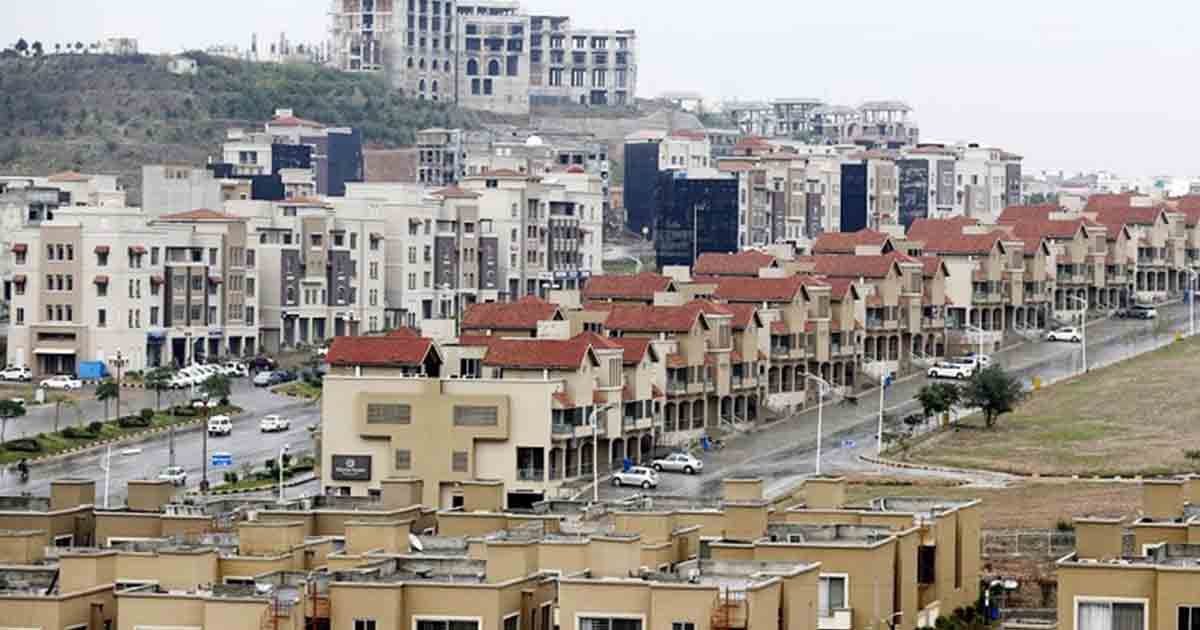
Blocking vertical growth while allowing endless sprawl is the worst possible combination. When cities cannot build up, they spread out. Land at the edge becomes more expensive. The cost of land cannot be shared across more floors, so every unit costs more. Roads, water lines and sewers must stretch further and further. And the poor, priced out of the formal market, are pushed into the informal city, where they live without titles, services or security.
Even the central number in the debate deserves scrutiny. The policy repeats the claim of a housing shortage of 10 to 13 million units. This figure is inflated and comes without any clear source. Census data tells a different story: around 82 percent of Pakistani households own their homes. The country’s real housing problems lie elsewhere. They are overcrowding, poor construction quality, weak municipal services and outdated rental laws that discourage landlords and leave tenants unprotected. These are problems of quality and governance, not of missing roofs.
A serious housing policy would begin by asking what the state should stop doing. It would free cities to grow vertically, end the state’s role as land dealer, fix rental law and collect honest data. Pakistan’s new policy does none of this. It asks for more government, when the real need is better and leaner government.
The best-selling books of Republic Policy Think Tank, including the landmark book The Bureaucratic Coup, are available at Vanguard Books, Liberty Books, Readings, Kitab Sarai, Sang-e-Meel, Saeed Book Bank Islamabad, National Book Foundation, and others across Pakistan. Contact for home delivery: 0300 9552542.