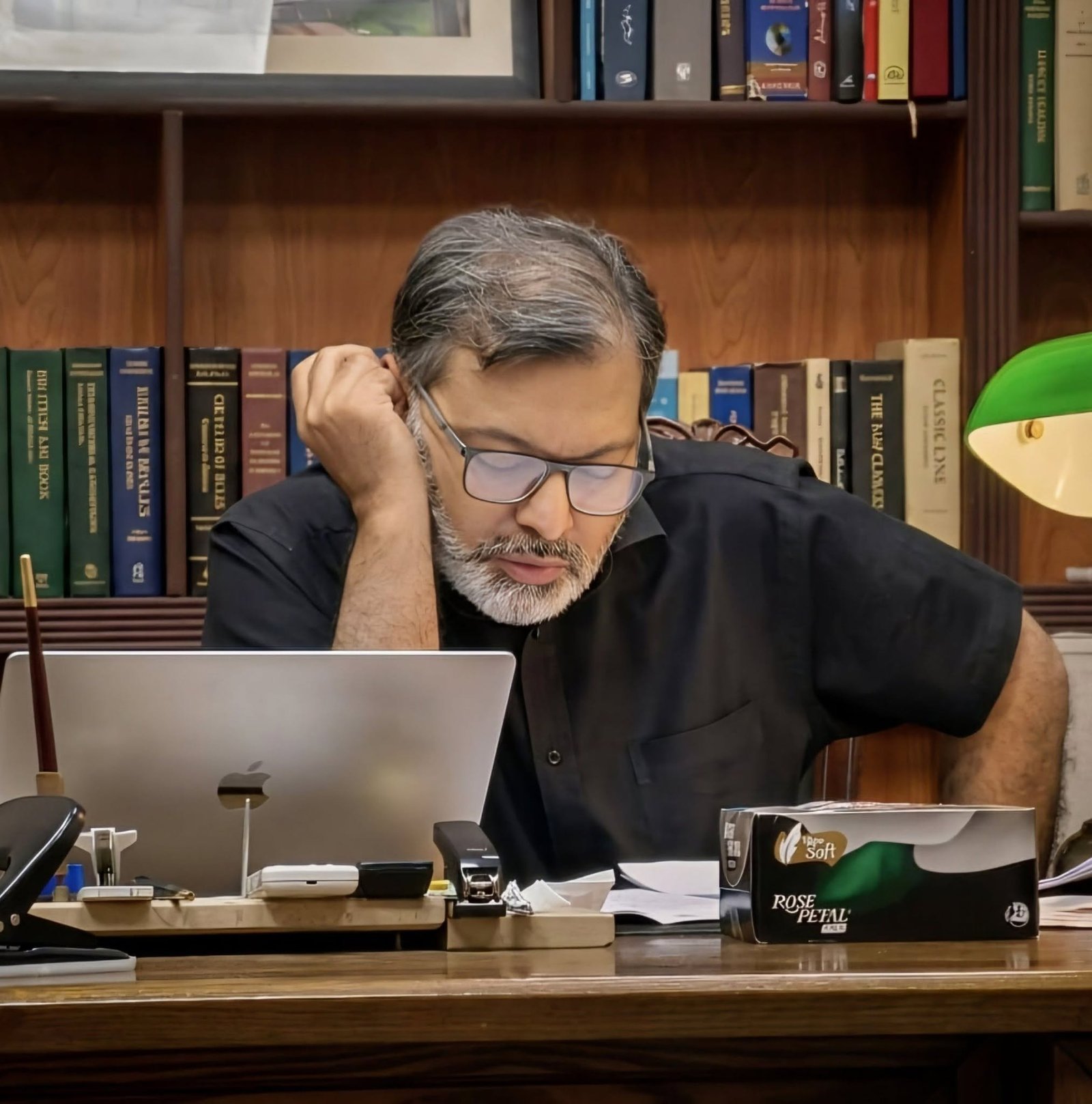

Muhammad Zubair Civil Servant
No one can look at another human being without the bias of his own eyes. Our desires, fears, affections and grievances enter every act of observation. So whenever we claim to know someone, we must first ask how much we know of that person and how much we know only of our own assumptions about him.
This is where self-scrutiny becomes central to inner discipline. To reach the truth of another, we must recognise what our own vision has mixed into it. Often the veil we believe covers another’s face is in fact drawn across our own eye.
That veil is woven both by ignorance and by the arrogance of knowledge. A bitter experience with someone should not be allowed to swallow his whole character. He carries within him struggles and possibilities of change that remain hidden from us.
Literature helps us search for this hidden life. In its truthful form, it opens the relationship between the outer and the inner man, between act and motive, between choice and compulsion. Literary reading, human understanding and inner discipline thus gather around a single question: how do we move beyond the images we have made and see another as he truly is?
The French thinker Simone Weil, in Waiting for God, gives attention a profound meaning. For her, attention requires the willingness to hold back our immediate reaction and allow the reality before us the time to reveal itself. We carry our knowledge with us, but we must not let it rise so high that the very thing we wish to understand is overawed, even erased, before it.
When we listen to others, we often diagnose them before they have finished speaking. We pronounce our verdicts quickly. This one is too sensitive. That one always complains. Another will never admit his fault.
In Weil, attention carries a kind of humility. It is the acceptance that reality is larger than our present understanding. To call a suffering person “needy” is only a general label for his condition. What is his particular sorrow? What shames him? What does he long to say but cannot? To reach these things, we must step back from our own conjectures. Pity alone does not guarantee such attention. Sometimes, in the heat of sympathy, we begin to speak on behalf of others. Attention demands that they be given the chance to name the meaning of their own experience.
Literary study can become the practice of this willingness. Spending time with a character, we may be forced to revise our first opinion. What once seemed conclusive proof of his nature takes on a different meaning in the light of later events. The power of realism lies in this discovery: it reveals a connection between circumstance, human response, motive and relationship in which life can be recognised with all its entanglements. Imagination is needed too. Merely recording events never opens the inner life of man. The writer must show where an event comes from, into whom it descends, how it settles there, and what shape it takes in later conduct.
E. M. Forster’s distinction between flat and round characters becomes meaningful here. A flat character is usually built around a single quality or idea. A round character holds the capacity to surprise us, and the surprise, on reflection, feels convincing. This is not a division between good and bad people. A complex character may be deeply cruel. The real difference lies in the structure of the character and the breadth of human experience the writing brings to light.
Trouble begins in life when we treat people as flat characters. He is a hypocrite. She is an angel. He is a traitor. A single word becomes the answer to every question.
There is psychological comfort in such brevity. Once our verdict on someone is settled, we no longer need to examine our likes, hatreds and loyalties again and again. It is enough to dismiss any evidence against it as suspect. The harshness of a favourite becomes foresight, and the caution of an opponent becomes cowardice. Our own man’s error seems the product of circumstance, while in another’s we see his very nature. Our judgements of others thus reveal our own emotional needs.
Iris Murdoch, in The Sovereignty of Good, illustrates this inner change through the example of a mother-in-law. She finds her daughter-in-law vulgar, overfamiliar and lacking in dignity. Then she reconsiders her impression. Perhaps her conventional taste, her sense of class and her jealousy have clouded her sight. With this self-examination, the young woman begins to appear different. Where once she saw only rudeness, she now sees refinement and grace.
We must also hold our inner attitudes toward others to account, even when we never voice them. Literature can make us feel this responsibility more intensely. Macbeth’s crimes are plain, yet Shakespeare draws us into his fear, the torment of his conscience, and his horror at his own deeds. Hamlet’s intelligence and moral unrest move us, but his treatment of Ophelia and the killing of Polonius force our sympathy to face hard questions. We stay close to the character and still hold him to account. Life demands the same capacity: to understand another’s anguish in its proper context.
Yet piling up contradictory traits is not deep characterisation. To show a tyrant loving his children gains meaning only when we also see how he makes peace with the destruction of other people’s children. Where does his tenderness stop? What name does he give to his cruelty? Where does he feel the hollowness of his excuse, and where does he come to believe it himself?
This division within the individual also works in collective life. Family, party, sect and nation are woven into our memories and identity. A question raised about a figure tied to them can feel like an attack on our own existence. Facing historical evidence then ceases to be a matter of information alone. It may require us to reinterpret our loyalty. Devotion searches for excuses for the hero’s lapses, and hatred finds hidden motives in the opponent’s virtues. In both cases, we wish to preserve not a human being but an idol, one that will never shake our certainty.
Accepting human complexity does not erase moral distinction. One nation’s hero may be another’s villain, but that does not make all his deeds equally justified. We must still ask what he did and to whom, how much freedom of choice he had, and who bore the burden of his decisions. Understanding someone’s motives does not automatically justify his actions. A deeper understanding helps us judge where there was compulsion, where there was self-interest, and where he simply chose the easier road.
Life is harder than our moral expectations in another sense too. Virtue is not always rewarded and cruelty not always punished as we would wish. Poetic justice is a meaningful literary device, but insisting that every story end that way can conceal many truths of experience. Truthful literature makes room for this disorder as well. At times, living with the longing for justice means more than the comfort of receiving it, and the unrest it creates joins the great questions of our lives, much like the questions of philosophy.
Understanding a person also means recognising the limits of our knowledge. Someone who has been kind to us may have brought pain to another. Conflicting testimonies about a person reveal different dimensions of his life, and no single witness can grasp them all. So when we ask what kind of man someone is, it helps to ask as well: in what matter, toward whom, and at what time? These questions make our judgement more precise and its limits clearer.
Here Weil’s attention, literary reading and inner discipline draw close together. All three call us to recognise the intrusion of the self and to accept another being with full seriousness.
In the end, we may call ourselves true realists only when the fault of the one we admire, or the virtue of the one we oppose, comes to light, and we are ready to surrender some cherished belief of our own.
The best-selling books of Republic Policy Think Tank, including the landmark book The Bureaucratic Coup, are available at Vanguard Books, Liberty Books, Readings, Kitab Sarai, Sang-e-Meel, Saeed Book Bank Islamabad, National Book Foundation, and others across Pakistan. Contact for home delivery: 0300 9552542.