
Naimat Ullah Khan
“Changing boundaries does not necessarily change the structures of power, without institutional reform, decentralisation may simply reproduce elite domination at a smaller scale.”
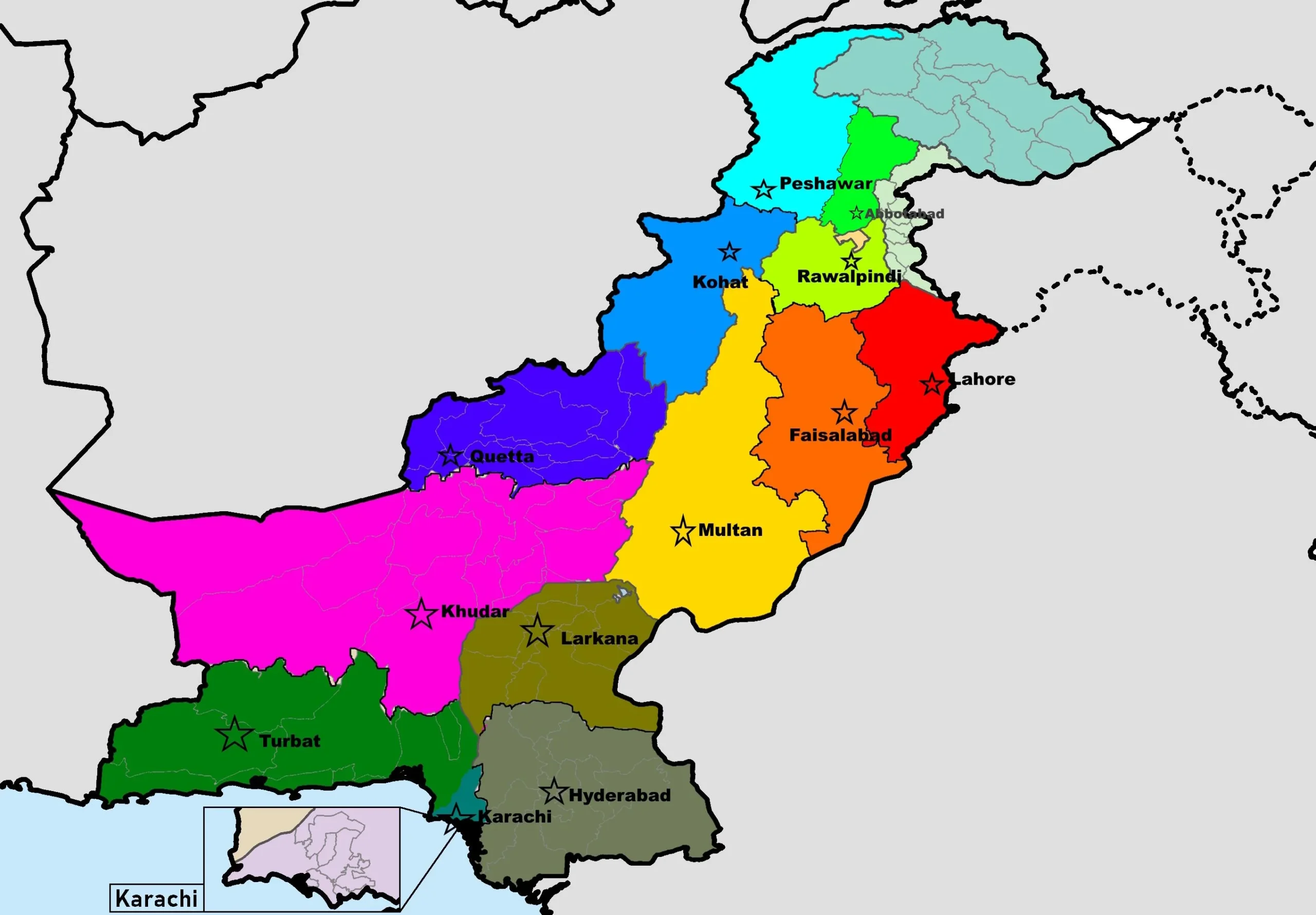
The revival of debate around new provinces in Pakistan has brought back an important question of state reform into the national discourse. In response to centralisation, administrative inefficiency and deteriorating governance, political leaders have suggested smaller provinces, and proposals to reorganise the country’s administrative structure have gained new attention in recent months. It is a legitimate debate, particularly in a country where regional grievances, unequal access to public services, and the concentration of political authority have been present for decades. Yet, beneath this seeming simplicity of redrawing provincial boundaries, lies the sociological question, can the redrawing of territorial boundaries transform a system of power without transforming the institutional relationships through which that power is exercised?
There is some merit in the argument for smaller provinces. Large administrative units can make government less accessible, reduce regional representation and complicate the distribution of public resources. The longstanding demands for South Punjab, Bahawalpur and Hazara point to concerns about political marginalisation, regional identity and unequal access to decision-making, among other things. Such grievances should not be dismissed as mere electoral calculations or expressions of ethnic particularism. They arise for many residents as a result of their lived experiences of being far from administrative hubs, having little political clout, and feeling that their demands are not being met. However, recognising these complaints does not mean that we should presume that establishing additional provinces will immediately address them. The inclination to confuse institutional transition with territorial reorganization is the first conceptual flaw in the current discussion. Although they are related, the two are not interchangeable.
A new province does not, by itself, modify the incentives, unofficial networks, or institutional processes controlling the exercise of political and administrative authority, rather, it modifies the physical limits within which such authority operates. The size or number of Pakistan’s provinces alone cannot adequately explain the country’s governance issues. They must also be analyzed in terms of the state’s political economy, power dynamics, bureaucratic accountability, and the interplay between official institutions and unofficial influence networks. Take into consideration, for example, the enduring impact of vested interests, personalized political networks, biradari ties, and patronage in political-administrative processes. Administrative restructuring by itself cannot ensure a different result in situations where hiring, appointments, resource distribution, and access to public institutions are susceptible to political meddling or unofficial commitments.
A new province may inherit the same institutional flaws that weakened governance in the previous system if the mechanisms that replicate these behaviors are largely unaltered. The core logic of administration is remarkably familiar, even though the administrative map may alter. This is not a claim that every administrative failure is the result of patronage or that all political networks are intrinsically illegitimate. Instead, it is an issue of institutional design, what safeguards guaranty that public authority is used in accordance with clear regulations, professional competence, and the public interest rather than selective commitments and personal allegiances? Territorial restructuring runs the risk of being misinterpreted as a replacement for the more challenging task of institutional transformation unless this issue is made a prominent part of the reform agenda.
The sociology of power and elite theory raise a second, equally important issue. Without necessarily democratizing it, the establishment of a new province may decentralize power from an existing provincial center. To put it another way, the transfer of authority to regular individuals differs from the transfer of power between geographical units. Imagine a political structure where local populace perceive authority primarily through institutions over which they have little control, with authority centralized at the federal level and mediated through provincial elites. A new layer or a new regional center of authority may be added to the hierarchy if a new province is formed.
A provincial elite that had previously grumbled about being left out might now have more influence over political representation, public appointments, development expenditures, and administrative agendas. Regional representation and access could benefit from that adjustment. It does not, however, always result in more egalitarian governance or greater accountability within the newly formed province. This is the potential for elite reproduction through territorial decentralization, which is the transfer of political power without a commensurate change in the social structures that support its concentration. Geographically, a province may shrink while maintaining its political hierarchy. Even though they are now governed by a closer provincial capital, those who were previously far from one may still have little real influence over decisions that impact their daily lives. Proposals for Hazara and South Punjab are subject to the same analytical question.
The question is not whether some political families, parties, or local leaders should be assumed to be incapable of reforming. Such assertions would need proof and run the risk of turning a structural argument into a partisan charge. Whether a proposed province’s institutional arrangements would avoid the accumulation of power among already powerful political, landed, commercial, and bureaucratic networks is a more fruitful inquiry. What safeguards would prevent politically disadvantaged populations, smaller communities, and marginalized people from being subjugated by a new regional establishment? When Pakistan’s patron-client political relationships are taken into account, these issues become more apparent. Political support and personal allegiance can serve as a means of gaining access to public resources, employment opportunities, protection, or other benefits under a patronage-based society.
These connections frequently function in tandem with official institutions, influencing how people interact with the government. The establishment of new provinces might just create more venues for patronage if these unofficial agreements continue to have an impact beyond territorial reform. Therefore, the issue is not that new provincial elites will unavoidably replicate the old order, but rather that the incentives to do so might endure the reform itself in the absence of institutional safeguards. The necessity of this differentiation is further supported by Pakistan’s larger experience with government. The nation’s structural governance issues include ineffective public administration, partial devolution, elite capture, and patronage-based politics, according to a World Bank evaluation of institutions and governance. Boundary adjustments are not the only solution to these issues. Rather than viewing the establishment of provinces as the primary tool of change, the revitalized discussion has also shown a significant alternative: bolstering local governments and transferring power to districts and municipalities. Both strategies merit careful thought, but none should be assessed just based on the quantity of administrative divisions established. Therefore, a more precise diagnosis is the first step toward a workable reform strategy.
An institutional impact assessment outlining how a new province will enhance public accountability, fiscal capacity, bureaucratic performance, and service delivery should be the first step in any proposal. Second, local governments need to be given significant legal power, steady funding, and administrative independence, all of which are backed by open audits and enforceable accountability. If not, a province may receive decentralized authority from the federal government, which would then be recentralized inside the provincial secretariat. Third, open, rule-based processes that minimize arbitrary political meddling are necessary for civil-service appointments, transfers, and promotions. Accessible information and impartial scrutiny should apply to public procurement, development spending, and government employment distribution.
Fourth, public hearings, efficient complaint procedures, operational elected local bodies, and information access are all necessary institutional tools for citizens to evaluate the performance of the government. Lastly, any proposed territorial reorganization must result from a transparent evaluation of administrative and financial viability, informed public consultation, and a process that is lawfully permissible. According to Article 239(4) of the Pakistani Constitution, a constitutional modification that affects a province’s boundaries must be approved by two-thirds of the assembly’s total membership. In every situation, none of these improvements eliminate the need to establish new provinces. Smaller provinces could increase political visibility for neglected areas, boost representation, and shorten administrative distances.
However, these advantages rely on how authority is distributed among the new units, how public institutions are shielded from prosecution, and whether or if regular people have more robust accountability systems. The question is not just whether Pakistan needs more provinces, rather, it is whether the government can establish institutional frameworks that enable any province to better serve its citizens. The sociology of power, who exercises it, who gains from it, and who has the institutional capacity to hold it accountable, is ultimately what drives the formation of new provinces. While territorial reform may play a significant role in state rebuilding, it cannot take the place of changing the political and administrative structures that lead to unequal access, unaccountable authority, and ongoing governance shortcomings. Pakistan may transfer the geography of power while essentially preserving its social roots if it modifies its provincial boundaries without addressing these ties. The true test of reform is whether or not Pakistan’s citizens gain more control over the institutions that run their lives, not how many provinces the country establishes.
Naimat Ullah Khan, a sociologist, independent researcher and political columnist writing on political sociology, ethnic nationalism, federalism and state-society relations in Pakistan. My research addresses questions of state legitimacy, ethnic identity, political mobilisation and centre-periphery relations. I have written scholarly research and analytical commentaries for leading national publications like Dawn and The Express Tribune. My current research is on how to re-imagine the Social Contract in Pakistan, and emergence and transformation of Baloch and Pashtun Neo-Ethnonationalism, especially in relation to political identity, state restructuring and ethnic mobilisation.