
Prime Minister says Pakistan has added 22,000 megawatts of rooftop solar capacity in two years; endorses global ‘35 by 35’ electrification pledge; seeks affordable technology and concessional financing for energy transition
ANTALYA, Türkiye: Prime Minister Shehbaz Sharif has presented Pakistan’s rapid expansion of rooftop solar energy as an example of citizen-led climate action at the 31st United Nations Climate Change Conference (COP31), calling for stronger international cooperation, affordable technology and substantial climate financing to sustain the global transition towards clean energy.
Addressing a high-level dialogue titled 35 by 35: Powering the Future, the prime minister said Pakistan had added nearly 22 gigawatts of rooftop solar capacity in just two years, describing the development as an extraordinary transformation driven largely by ordinary citizens seeking affordable electricity and greater energy security.
“In just two years, Pakistan has added nearly 22 gigawatts of rooftop solar capacity — a quiet revolution by ordinary citizens seeking affordable power and a cleaner, more predictable future,” he said.
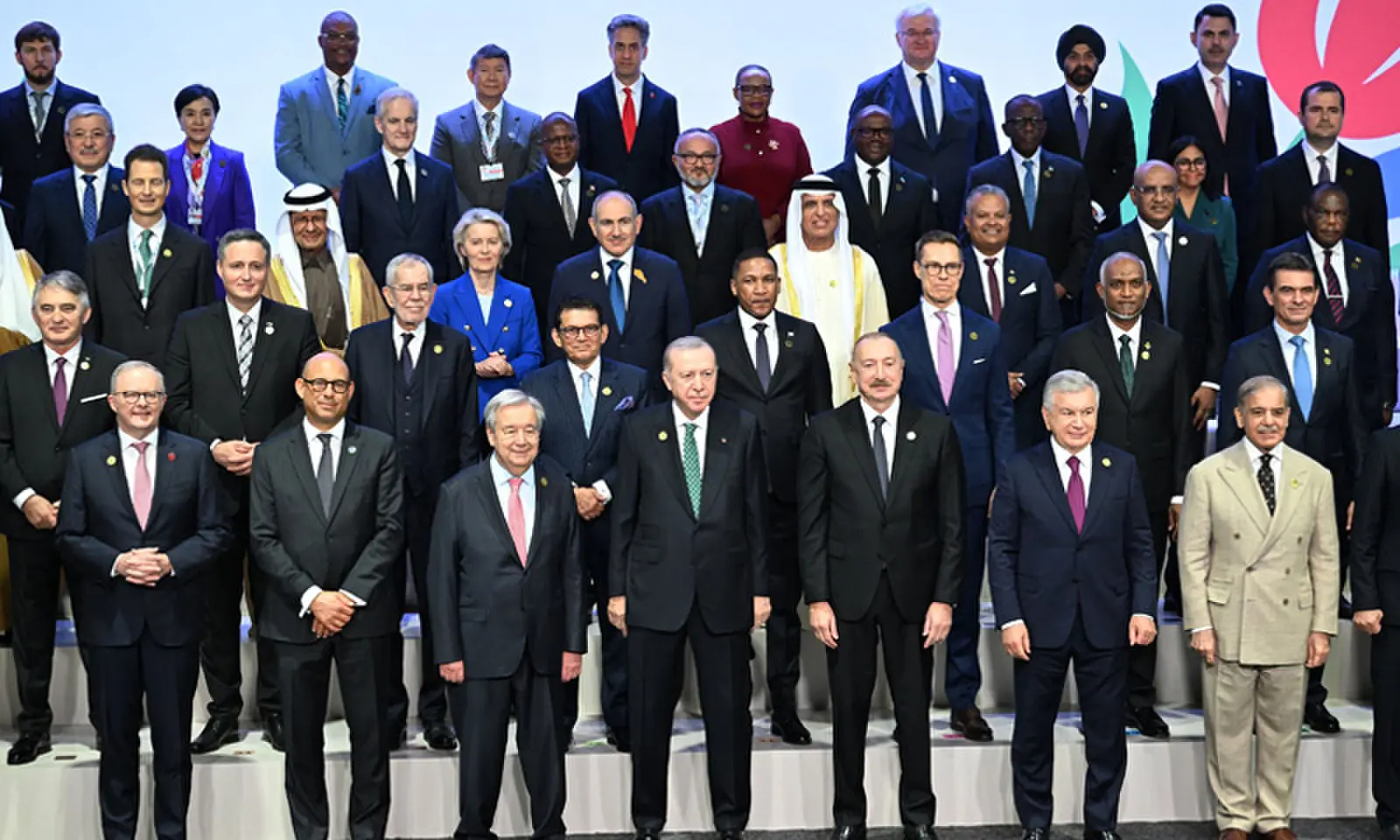
The prime minister’s remarks came as leaders and representatives from nearly 200 countries gathered in the Turkish Mediterranean city of Antalya to discuss collective responses to climate change and accelerate the transition towards a low-carbon global economy. The summit is taking place against a backdrop of persistent greenhouse gas emissions, geopolitical conflicts, inflationary pressures and competing economic priorities.
Pakistan endorses the ‘35 by 35’ global pledge
During his address, Shehbaz Sharif reaffirmed Pakistan’s support for the 35 by 35 Global Electrification Pledge, an international initiative aimed at increasing electricity’s share of total final energy consumption to approximately 35 per cent by 2035.
The initiative reflects a broader global effort to expand electrification across economic sectors, reduce dependence on fossil fuels and support the transition towards cleaner energy systems.
The prime minister said Pakistan’s experience demonstrated the potential of renewable energy to transform national energy systems, particularly when citizens were able to adopt affordable alternatives to conventional electricity sources.
He also referred to the recent inauguration of a key milestone in the construction of Chashma-5, Pakistan’s seventh nuclear power plant. The placement of the reactor building’s dome marked an important stage in the project, which is expected to add 1,200 megawatts of electricity to the national grid.
Highlighting the government’s efforts to diversify the energy mix, he described nuclear power as another component of Pakistan’s transition towards cleaner electricity generation.
Electric vehicles become part of Pakistan’s transition
The prime minister also outlined Pakistan’s emerging electric vehicle policy, saying the country’s newly drafted automotive policy was designed to accelerate the adoption of electric mobility.
He reiterated the national objective of ensuring that 30 per cent of new vehicles sold in Pakistan are electric by 2030. According to him, the government intends to support this transition through incentives, including lower tariffs.
Shehbaz Sharif further stated that all future government buses and motorcycles would be electric, presenting the policy as part of a wider effort to reduce emissions and transform the country’s transport sector.
He noted that, for the first time, electric motorcycles accounted for more than one in every ten motorcycles sold in Pakistan during the current year.
“The momentum is real and it is accelerating,” he said, while emphasising that the transition could not be sustained without adequate financial support.
$188 billion financing requirement
A central theme of the prime minister’s address was the enormous financial requirement associated with Pakistan’s energy transition.
Shehbaz Sharif said Pakistan would need approximately $138 billion by 2035 to develop low-carbon electricity infrastructure, with an additional $50 billion required to replace coal-based power generation with solar energy.
He argued that developing countries could not independently finance the scale of transformation required to meet international climate objectives. International financial institutions and developed economies, therefore, needed to provide greater support through concessional financing, affordable capital and technology transfer.
“The 35 by 35 clean energy goal can only be achieved if finance flows at the speed of ambition through concessional capital and the transfer of affordable technology,” he said.
The prime minister called for a global approach that would reconcile economic development with environmental protection, arguing that the transition towards cleaner energy should not impose additional economic hardship on ordinary citizens.
“Let us resolve to power our economies without impoverishing our people and light up our homes without darkening our planet,” he said.
He also thanked Turkish President Recep Tayyip Erdogan for convening the high-level dialogue and for Türkiye’s role in hosting the climate conference.
Pakistan Pavilion to host 54 events
According to the Prime Minister’s Office, a dedicated Pakistan Pavilion has been established at the COP31 venue, where 54 events will be organised on a range of climate-related themes.
The pavilion is intended to provide a platform for presenting Pakistan’s climate priorities, policy initiatives and experiences in addressing environmental challenges.
The Prime Minister’s Office said Shehbaz Sharif would also use his address at the Antalya Leaders’ Summit to highlight the country’s climate vulnerabilities, ongoing initiatives and the urgent need for enhanced international cooperation to mitigate the adverse effects of climate change.
The prime minister was received at the conference venue by Turkish President Recep Tayyip Erdogan and United Nations Secretary-General António Guterres upon his arrival.
Shehbaz meets Iranian president amid regional tensions
On the sidelines of the conference, the prime minister held a series of meetings with international leaders and representatives of multilateral institutions, discussing bilateral relations, regional security and international cooperation.
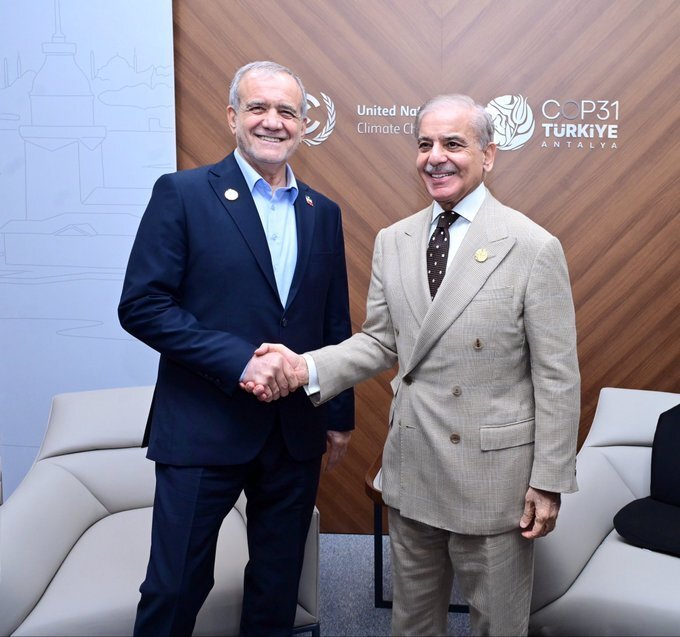
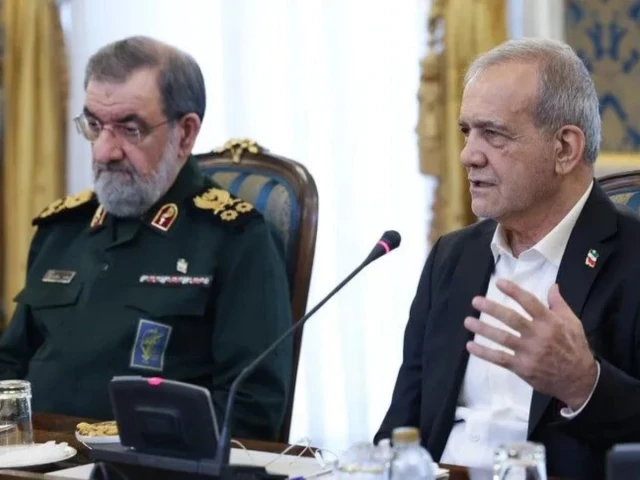
In a separate meeting with Iranian President Masoud Pezeshkian, Shehbaz Sharif discussed bilateral relations, opportunities to strengthen cooperation and the evolving regional situation.
In a message posted on social media platform X, the prime minister described the Iranian president as his brother and reaffirmed the deep-rooted relations between the two neighbouring countries.
He also conveyed Pakistan’s serious concern over the prolonged conflict in the Middle East, emphasising the importance of dialogue, restraint and diplomatic engagement.
“Dialogue, restraint, de-escalation and sustained diplomacy are the only path to lasting peace,” he said.
The prime minister added that Pakistan would continue its constructive diplomatic efforts for regional and international peace and stability, building on the understandings reached under the Islamabad Memorandum of Understanding.
Pakistan and Kuwait review defence cooperation
Shehbaz Sharif also met Kuwaiti Prime Minister Ahmad Al-Abdullah Al-Ahmad Al-Sabah to review longstanding bilateral relations and explore opportunities for stronger cooperation.
According to the Prime Minister’s Office, the two leaders discussed trade, investment, energy, development cooperation and people-to-people exchanges.
They also welcomed the recent ratification of the Pakistan-Kuwait defence agreement, expressing hope that it would provide further impetus to cooperation between the two countries.
The discussions also covered international developments and challenges to regional peace and security.
Solidarity with Palestine reaffirmed
In another important engagement, the prime minister met Palestinian Prime Minister Mohammad Mustafa and reiterated Pakistan’s unwavering solidarity with the Palestinian people.
He reaffirmed Pakistan’s support for the Palestinian position and expressed concern over the injustices and suffering endured by Palestinians.
Mohammad Mustafa thanked the government and people of Pakistan for raising their voices internationally against these injustices and supporting the Palestinian cause.
Shehbaz Sharif’s other informal engagements included meetings with Bangladesh’s Prime Minister Tarique Rahman, Saudi Energy Minister Prince Abdulaziz bin Salman, Saudi Minister of State for Foreign Affairs Adel bin Ahmed Al-Jubeir and Syrian President Ahmed al-Sharaa.
He also met Organisation of Islamic Cooperation chief Ismail Ould Cheikh Ahmed, World Bank President Ajay Banga and Türkiye’s First Lady Emine Erdogan.
The prime minister’s participation at COP31 thus combined Pakistan’s climate diplomacy with a broader diplomatic engagement on regional security, economic cooperation and international relations. His address placed particular emphasis on the country’s expanding renewable energy capacity while underscoring a central challenge facing developing economies: translating climate ambitions into sustainable outcomes requires not only domestic policy commitments but also predictable international financing and access to affordable technology.