
Desk
The encounter between Greek political philosophy and medieval Islamic thought was not simply an exercise in preserving ancient knowledge. Alfarabi, Ibn Bajja and Averroes transformed Plato’s political vision to confront the intellectual, religious and institutional realities of their own societies, demonstrating that political philosophy survives not through imitation but through reinterpretation.
The history of political thought is often presented as a sequence of intellectual traditions, each emerging within a particular civilisation and developing independently of others. Yet some of its most significant achievements have taken place at the intersection of cultures. The journey of Plato’s Republic into the medieval Islamic world offers a remarkable example of this intellectual exchange. In Abbasid Baghdad and Almohad Cordoba, Plato was not merely read, translated or preserved. His political philosophy was reconsidered, challenged and reconstructed by Muslim thinkers seeking answers to the questions of their own time.
The work of Alfarabi, Ibn Bajja and Averroes reveals something more consequential than the transmission of Greek philosophy into Islamic scholarship. It demonstrates how an inherited political tradition can be adapted to a different religious, social and institutional environment without surrendering its central philosophical questions. What is the purpose of political authority? What makes a society virtuous? What relationship should exist between philosophy, religion and political leadership? And can an ideal political order survive when confronted with the practical realities of human society?
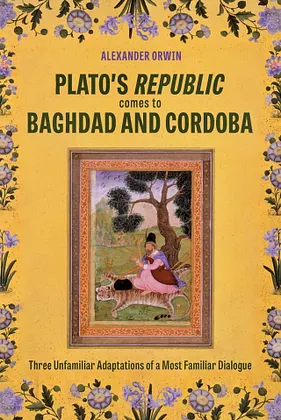
Alexander Orwin’s forthcoming book, Plato’s Republic Comes to Baghdad and Cordoba: Three Unfamiliar Adaptations of a Most Familiar Dialogue, explores these questions through three distinct intellectual journeys. Its central contribution is to examine not simply how Plato’s ideas reached the medieval Islamic world, but how Muslim philosophers transformed those ideas into political arguments relevant to their own circumstances.
Beyond the preservation of Greek philosophy
The translation movement of the Abbasid period played a decisive role in making Greek intellectual traditions accessible to Muslim scholars. Philosophy, medicine, mathematics and other disciplines travelled across linguistic and cultural boundaries, becoming part of a wider intellectual conversation. However, the significance of this encounter cannot be understood through translation alone.
An intellectual tradition does not become part of another civilisation merely because its texts are translated. It must also be interpreted in relation to the receiving society’s political institutions, religious commitments and intellectual priorities. This is precisely what happened to Plato’s political philosophy.
The Republic presents an ambitious vision of political order, organised around justice, philosophical knowledge, education and the rule of philosopher-kings. Its ideal city rests on a particular understanding of social hierarchy, the guardians, communal arrangements and the relationship between knowledge and authority. These ideas could not simply be transferred into medieval Muslim societies without raising difficult questions.
Muslim philosophers therefore faced a fundamental intellectual challenge: how could Plato’s conception of the virtuous city be reconciled with societies organised around Islamic law, religious authority, established institutions and different social arrangements?
Their responses were not identical. Indeed, the differences between Alfarabi, Ibn Bajja and Averroes are what make their engagement with Plato particularly significant.
Alfarabi: Making Plato relevant to an Islamic political order
Alfarabi’s engagement with the Republic represents an effort to make Platonic political philosophy more accommodating to the realities of his intellectual and political environment. Rather than reproducing Plato’s city in its original form, he modifies important features of its organisation and leadership.
In his reconstruction, the city becomes larger, and its guardians are transformed into warriors capable of offensive warfare. Private property and family structures are retained rather than subjected to the radical communal arrangements associated with Plato’s ideal city. Political leadership is also broadened: philosopher-kings share authority with warriors, Islamic legal institutions and judges.
These changes are philosophically important. They suggest that Alfarabi was not simply interested in establishing whether Plato’s ideal city could be reproduced. He was concerned with how its underlying principles could be translated into a political order that made sense within his own civilisation.
His approach raises a question that remains relevant to contemporary political thought: should political institutions be designed around abstract ideals, or should philosophical principles be adapted to the historical and institutional circumstances of a society?
Alfarabi’s answer appears to favour adaptation. His treatment of Plato’s Cave is also significant. The journey towards philosophical enlightenment becomes easier to navigate, suggesting an effort to make philosophical truth more accessible. Similarly, his reinterpretation of Plato’s defective political regimes brings the ancient discussion closer to the political realities familiar to his contemporaries.
Alfarabi’s achievement lies in demonstrating that the intellectual value of a political theory does not depend on preserving every detail of its original institutional design. Its principles can survive through transformation.
Ibn Bajja: Philosophy beyond the ideal city
Ibn Bajja takes a substantially different direction. Rather than attempting to reconstruct Plato’s political city, he effectively abandons the city as the central organising framework of his interpretation.
His concern shifts towards the relationship between philosophy and political life. The question is no longer primarily how to establish a virtuous city, but how individuals committed to philosophical understanding can exist within societies that may not be organised according to philosophical principles.
This represents a significant shift in political thinking. The ideal political community is no longer the indispensable setting for intellectual and moral fulfilment. Instead, philosophical life becomes the principal concern, even when the surrounding political environment does not support it.
Ibn Bajja’s approach also connects Plato’s theory of intellect with questions concerning the afterlife. In doing so, he expands the discussion beyond the institutional arrangements of the ideal city and towards the intellectual destiny of human beings.
His interpretation raises a difficult but enduring question: what happens when the political community falls short of the standards demanded by reason and virtue? Must the philosopher attempt to reform the political order, withdraw from its limitations, or seek a different relationship with society?
Ibn Bajja’s response offers a distinctive perspective on the tension between intellectual excellence and political reality. His approach suggests that the pursuit of philosophical truth cannot always depend on the existence of an ideal political system.
Averroes: Reforming the city through education and institutions
Averroes returns more directly to the Platonic city, but his engagement is neither a simple reproduction of Plato nor an uncomplicated continuation of Alfarabi.
His treatment of education and social reform is, in certain respects, even stricter than Plato’s. He takes seriously the institutional foundations of a virtuous political order and the need to shape citizens through education, discipline and social organisation.
Yet Averroes ultimately embraces a political arrangement closer to Alfarabi’s reconstruction, one that can be reconciled with Muslim institutions. His engagement with Plato therefore combines philosophical ambition with an awareness of the institutional realities of his own society.
One of the most important dimensions of this interpretation is Averroes’s discussion of political regimes. Plato’s classification of different forms of government becomes a framework through which Averroes can examine the political crisis of his own time.
This is where the philosophical encounter becomes especially revealing. Plato’s ancient analysis is no longer merely a historical account of Greek political arrangements. It becomes an instrument for understanding contemporary political decline, institutional weakness and the conditions necessary for political reform.
Averroes demonstrates that classical political philosophy can retain its analytical value across centuries, provided that its questions are reconsidered in relation to changing political circumstances.
Three philosophers, three approaches to political reality
The differences between these thinkers reveal three distinct ways of engaging with an inherited political ideal.
Alfarabi adapts Plato’s city to make its principles compatible with the institutional and religious environment of the Islamic world. Ibn Bajja moves away from the city and concentrates on the relationship between philosophical life and imperfect political societies. Averroes returns to the city, emphasising education, social reform and the relevance of Platonic political analysis to contemporary crises.
Their approaches are not merely different interpretations of a Greek text. They represent competing answers to the relationship between political ideals and practical institutions.
This distinction is particularly important because it challenges the assumption that intellectual influence necessarily produces intellectual conformity. The three philosophers recognised Plato’s importance without treating his conclusions as beyond reconsideration. Their engagement was critical, creative and historically situated.
The broader lesson is that political philosophy is not a collection of permanent institutional blueprints. It is a continuing process of examining the foundations of authority, justice, knowledge and social organisation. The same philosophical question may produce different answers when confronted with different historical circumstances.
A lesson for contemporary political thought
The journey of Plato’s Republic through the Islamic intellectual world carries a wider lesson for societies confronting questions of political reform. Institutions cannot be understood independently of the intellectual traditions, social arrangements and historical experiences within which they operate. Nor can successful political reform be achieved simply by importing institutional models from another society.
Alfarabi, Ibn Bajja and Averroes demonstrate that intellectual borrowing requires critical engagement. They neither rejected Greek philosophy because of its foreign origins nor accepted it without modification. Instead, they examined its principles, identified the questions relevant to their own circumstances and developed different approaches to reconciling philosophical ideals with political realities.
This is a particularly valuable lesson in an age when political systems frequently borrow constitutional arrangements, administrative structures and governance models from elsewhere. The challenge is not merely to adopt institutions that have worked in other historical contexts. It is to understand the principles behind them and determine how those principles can operate within a different political and social environment.
The story of Plato in Baghdad and Cordoba is therefore not simply about the preservation of classical learning. It is about the capacity of a civilisation to engage with ideas beyond its own intellectual boundaries and transform them into original contributions.
Alexander Orwin’s forthcoming study, to be published by the University of Rochester Press as the fourth volume in its Rochester Studies in Medieval Political Thought series, offers an opportunity to revisit this neglected dimension of intellectual history. Its examination of Alfarabi, Ibn Bajja and Averroes reminds us that the Islamic philosophical tradition was not merely a custodian of Greek thought. It was an active participant in the development of political philosophy.
Ultimately, the most important lesson of these three journeys through Plato’s Republic is that ideas achieve lasting influence not when they are preserved unchanged, but when successive generations have the intellectual courage to question, reinterpret and apply them. Plato’s city travelled from ancient Greece to the Islamic world, but it did not arrive unchanged. In Baghdad and Cordoba, it became part of a new political conversation—one whose questions about justice, leadership, education and the relationship between reason and authority remain relevant today.