
Muddasir Ammar
In a groundbreaking scientific revelation, researchers claim to have unearthed material that can be traced back to sources beyond our solar system, marking a monumental milestone in the annals of scientific exploration.
The vanguard of this discovery is none other than Professor Avi Loeb, a distinguished physicist from Harvard known for his zealous pursuit of extraterrestrial intelligence. He and his team have been engaged in an exhaustive analysis of peculiar metallic remnants retrieved from the depths of the Pacific Ocean. These remnants, recently recovered in June, have opened up a realm of possibilities that stretch far beyond our cosmic neighborhood.
Early evaluations of these metal fragments strongly suggest an otherworldly origin – one that lies within the vast expanse of interstellar space. It’s a claim that sends shivers down the spine of anyone with an inkling of curiosity about the cosmos.
The genesis of these otherworldly fragments can be traced back to a meteor-like entity that met its fiery demise off the coast of Papua New Guinea back in 2014. While such celestial disintegration events are not uncommon, the implications of this particular discovery are far from ordinary.
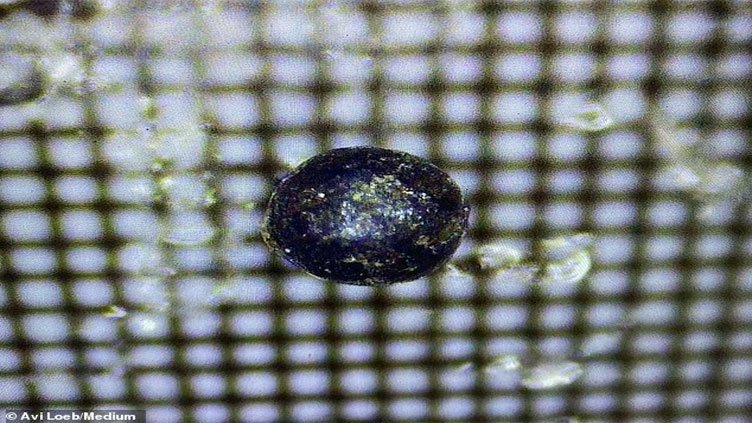
In their quest, the scientific expedition led by Professor Loeb’s team stumbled upon approximately 700 minuscule metallic spheres, each harboring secrets that defy easy explanations. Out of these, 57 spheres underwent rigorous scrutiny in the laboratory, revealing chemical compositions that defy the boundaries of natural and human-made alloys.
Yet, amidst this captivating revelation, one critical question remains conspicuously unanswered: are these spheres the handiwork of an advanced civilization from distant galaxies or the product of natural cosmic phenomena? This enigma now stands as the lodestar guiding Professor Loeb’s ongoing research endeavors.
For Professor Loeb, a luminary in his field, this discovery is nothing short of historic. It represents a watershed moment in human scientific inquiry, marking the first instance where humanity has laid claim to materials originating from an immense cosmic entity hailing from realms outside our solar sanctuary. His enthusiasm, palpable in his words, underscores the magnitude of this revelation.
Professor Loeb further shared, “I was thrilled when Stein Jacobsen reported to me about it based on the results in his laboratory. Stein is a highly conservative and professional geochemist with a worldwide reputation. He had no bias or agenda whatsoever and expected to find familiar spherules with solar system composition.”
This discovery, poised at the intersection of cosmic curiosity and scientific rigor, holds the promise of unraveling the cosmic tapestry that stretches beyond our familiar celestial boundaries. The tantalizing prospect of uncovering our place in a universe teeming with celestial mysteries beckons, and Professor Loeb’s relentless pursuit of knowledge continues to push the boundaries of human understanding. As we await further revelations, we stand at the threshold of a new era in our quest to comprehend the cosmos.
“But the data showed something new, never reported in the scientific literature. Science is guided by evidence.”
These words, uttered by the renowned Harvard physicist Professor Avi Loeb, encapsulate the essence of scientific discovery. In the ever-expanding universe of human knowledge, where the boundaries of the known are constantly pushed, new revelations often emerge from the depths of meticulous research.
Professor Loeb’s quest for the extraordinary has led him to a revelation that defies convention. It’s a tale that transcends the ordinary and propels us into the realms of the unknown. As the saying goes, “Truth is stranger than fiction,” and in the world of science, these words resonate profoundly.
In a candid conversation with DailyMail.com, Professor Loeb has shed light on the trajectory of his research and the tantalizing questions that lie ahead. At the heart of this scientific odyssey is the enigma of the fragments – minuscule, metallic spheres that emerged from the depths of the Pacific Ocean during an expedition in June.
These fragments, colloquially known as spherules, have set the scientific community ablaze with curiosity. Initial analyses, as Professor Loeb reveals, suggest an origin that transcends the boundaries of our solar system. It’s a revelation that forces us to confront the possibility of materials that have journeyed through the cosmic expanse for millennia, far removed from the familiar confines of our celestial neighborhood.
Don’t forget to Subscribe our channel & Press Bell Icon.
However, as with all scientific endeavors, questions abound. Are these spherules simply remnants of a celestial wanderer, fragments of a space rock on a cosmic journey? Or do they bear the imprint of something far more intriguing – the debris of alien technology that has silently traversed the cosmos, unbeknownst to humanity?
In the grand tapestry of cosmic inquiry, these are questions that beckon the curious minds of scientists and stargazers alike. For now, the focus of Professor Loeb’s research is clear: to ascertain definitively whether these enigmatic spherules originated beyond the borders of our solar system.
As Professor Loeb aptly puts it, “The success of the expedition illustrates the value of taking risks in science despite all odds as an opportunity for discovering new knowledge.” It is a sentiment that underscores the spirit of exploration that drives scientific inquiry – the willingness to venture into the unknown, to challenge conventional wisdom, and to embrace the risks that accompany the quest for truth.
The revelations brought to light by Professor Loeb and his team have not gone unnoticed. Their findings, though yet to undergo the rigorous process of peer review, have ignited a spark of intrigue within the scientific community. It is a testament to the power of discovery, to the allure of the mysterious, and to the unyielding commitment of scientists to unravel the secrets of the cosmos.

Check out our monthly English and Urdu magazines on Homepage
Within the annals of Professor Loeb’s study lies another revelation – the peculiar nesting of these spherules. They appear to cradle one another, as if liquid drops once enveloped smaller spherules that solidified in the cosmic expanse. It’s a tantalizing clue that hints at processes beyond our current understanding.
Moreover, the textures adorning the surfaces of these spherical enigmas offer further insight. They speak of rapid cooling, of an event in the cosmic timeline that transpired with remarkable speed. It’s a testament to the dynamism of the universe, where processes unfold in ways that challenge our preconceived notions.
As the scientific community awaits the next phase of Professor Loeb’s research – the rigorous scrutiny of his findings through peer review – the world watches with bated breath. It’s a moment that encapsulates the essence of scientific discovery, where the pursuit of knowledge transcends borders and boundaries, and where the quest for truth knows no bounds.
In these spherules, we find a reflection of our collective curiosity, a reminder that the cosmos is a vast expanse teeming with mysteries waiting to be unraveled. As we journey deeper into the cosmos, guided by evidence and driven by our insatiable thirst for knowledge, we are reminded that the universe is far stranger, far more wondrous, than we could ever imagine.
The quest for knowledge knows no bounds, and Professor Avi Loeb’s revelation opens new cosmic horizons for humanity to explore. With the recovery of interstellar fragments, the scientific community stands on the precipice of a profound journey into the mysteries of our universe. As we peer into the abyss of the cosmos, one fact remains clear: the thirst for discovery drives us onward, and the cosmos has more secrets yet to unveil.
Subscribe our website for latest updates:
https://republicpolicy.com/shop/
Read More