
By Dr Shahid
In the world of celestial phenomena, few events capture our imagination quite like a supernova. These brilliant and cataclysmic explosions of dying stars have been the subject of fascination and study for centuries. Among them, SN1987A stands as an exceptional spectacle, a cosmic event that graced our night sky in 1987, marking the closest and brightest supernova ever witnessed from our little blue planet.
On a recent cosmic odyssey, astronomers have uncovered new revelations about this aging superstar. A breathtaking series of images now paints a vivid picture of SN1987A’s journey from life to death and the dazzling aftermath. Positioned at a staggering distance of 170,000 light-years from Earth, this celestial performance continues to dazzle scientists and stargazers alike.
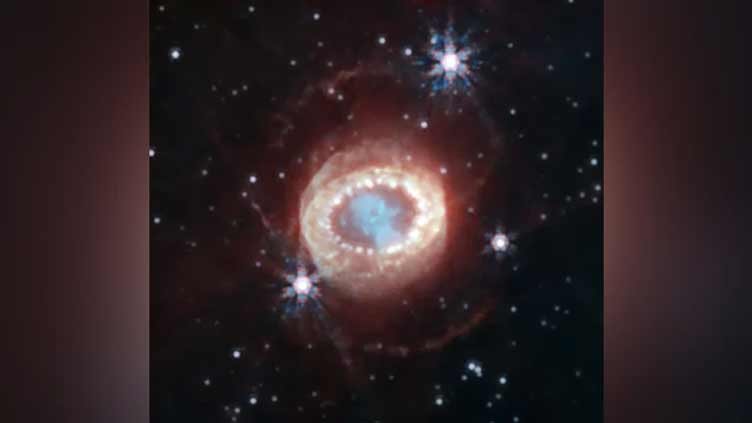
In this captivating visual display, SN1987A appears as a celestial necklace adorned with a shimmering trail of emitted materials, composed of gas, dust, and, notably, two previously undiscovered pearls. These pearls, hidden from our view until now, have unveiled themselves to the European Hubble Space Telescope.
This newfound revelation is not merely a feast for the eyes; it’s a window into the intricate and awe-inspiring life cycles of stars, as well as their dramatic finales. SN1987A, nestled in the Southern hemisphere of the night sky, has garnered more attention and scrutiny than perhaps any other celestial object in the vast expanse of space.
The captivating image that graces our screens showcases a sequence of luminous rings, each representing a distinct phase in the dramatic evolution of SN1987A. These rings tell a cosmic story of gas and dust expelled by the dying star during its prolonged demise. They offer a glimpse into the star’s journey from its excited and illuminated state, ignited by the expanding shockwaves during the cataclysmic collapse, to its spectacular supernova explosion.
But the narrative doesn’t end there. Scientists, those ever-curious explorers of the cosmos, have identified one of these rings as a string of pearls. This unique string of cosmic jewels consists of materials expelled by SN1987A nearly 20,000 years before its final, breathtaking crescendo.
As we marvel at these newfound revelations, we are reminded of the profound beauty and complexity of our universe. SN1987A, a star that captured our attention decades ago, continues to offer new insights and enchanting vistas, beckoning us to explore the mysteries of the cosmos. Each image and discovery takes us deeper into the heart of the celestial drama, offering a front-row seat to the grand spectacle of life, death, and rebirth in the cosmos.
While the allure of this fading superstar may wane over the millennia, its legacy lives on in the annals of astronomy. SN1987A has not only enriched our understanding of the universe but also serves as a reminder that in the vastness of space, there are still wonders waiting to be uncovered, stories waiting to be told, and pearls of wisdom yet to be revealed. As we continue to peer into the depths of the cosmos, we can only imagine what other cosmic treasures await our discovery, reminding us that the universe is a stage, and we are fortunate spectators of its eternal performance.
https://twitter.com/NASAWebb/status/1697249267013001461?s=20
In the vast tapestry of the cosmos, there are moments when science and technology align to offer us breathtaking glimpses of the universe’s hidden wonders. Such a moment unfolded recently when the James Webb Space Telescope (JWST) unveiled a stunning revelation – a celestial necklace encircling a fading star, SN1987A, in all its radiant glory.
This extraordinary revelation, made possible by the remarkable capabilities of the JWST, provides an unprecedented view of the intricate details of SN1987A’s celestial jewelry. The diffusing brightness surrounding the star, akin to the gentle glow of a necklace, now stands unveiled before our eyes.
Dr. Roger Wesson of Cardiff University, UK, shared his enthusiasm, saying, “We’re able to see new hotspots emerging outside the ring that has previously been illuminated.” It’s as if the necklace itself is evolving, donning new jewels of light.
What truly sets this revelation apart is the discovery of emission from molecular hydrogen within the ring, a surprise that only the JWST’s exceptional sensitivity and resolution could unveil. This unexpected find has ignited curiosity among astronomers and space enthusiasts alike.

Check out our monthly English and Urdu magazines on Homepage
Yet, the cosmic drama doesn’t end there. The JWST has unveiled new features, like crescents or arcs of emission within the celestial necklace. These enigmatic crescents reside just outside the dense inner region, resembling a cosmic keyhole. Dr. Mikako Matsuura, the lead analyst, confessed, “We don’t really understand the crescents yet.” Could they be illuminated by a reverse shock, a celestial phenomenon pushing back toward the keyhole? The cosmos still holds its secrets close.
While the JWST’s powers are awe-inspiring, they are not without their limitations. Buried deep within the dense dust field, the remnants of the dying star remain elusive. These remnants, believed to be compact objects composed of neutron particles, are mere tens of kilometers across. The JWST’s piercing gaze cannot penetrate this cosmic shroud, leaving astronomers yearning for answers hidden in the depths of space.
The story of SN1987A is not new to the scientific community. Since its dramatic supernova explosion, every significant telescope capable of capturing its radiance has been trained on this celestial marvel. Astronomers have tirelessly monitored its evolution, striving to unlock the secrets concealed within.
As they delve deeper into the cosmic mysteries, astronomers grapple with the enigma of this star’s explosive transformation. It was once a hot, relatively youthful star, estimated to be 20 to 30 times the mass of our sun. Dr. Wesson noted, “One of the mysteries of this star is that it exploded when it was a blue supergiant when at the time all the theories said only red supergiant stars could explode.” This unexpected twist has added a layer of complexity to the ongoing quest for understanding.
The JWST’s mission promises to extend far into the future, potentially spanning two decades or more. This enduring presence in the cosmos offers astronomers a potent tool for continuous monitoring of SN1987A, enabling them to witness its ever-evolving narrative.
As we gaze upon these cosmic revelations, we’re reminded of the boundless beauty and complexity of the universe. Each unveiling of a celestial secret opens the door to new questions and inspires the pursuit of knowledge. The James Webb Space Telescope, with its unwavering gaze, invites us to peer deeper into the cosmic abyss, reminding us that in the infinite expanse of space, there will always be mysteries waiting to be unraveled, and cosmic treasures yet to be discovered.
In conclusion, the remarkable revelations brought forth by the James Webb Space Telescope have unveiled a celestial masterpiece around the fading star SN1987A. This cosmic necklace of gas, dust, and radiant rings has ignited fresh curiosity among astronomers and deepened our understanding of stellar life cycles. As we continue to explore the mysteries of this celestial jewelry, it is imperative that we support and extend the operational life of the JWST, allowing it to capture more of the universe’s wonders and further enrich our knowledge of the cosmos. The cosmos beckon, and with the right tools, we can continue to unravel their captivating secrets.
Subscribe our website for latest updates:
https://republicpolicy.com/shop/
Read More