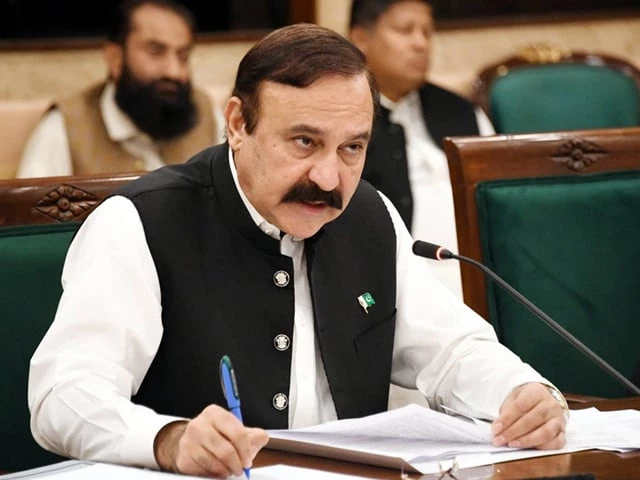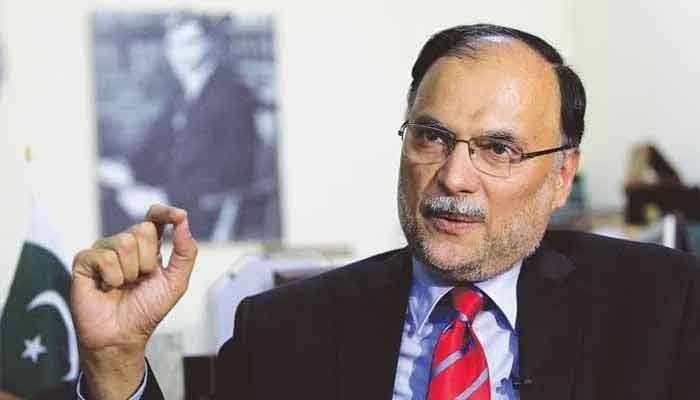

Planning Minister Ahsan Iqbal has called for a major restructuring of Pakistan’s governance system, proposing either the creation of 15 additional provinces or the establishment of 160 fully empowered district governments.
Speaking at a consultative session with media representatives on proposed governance reforms for the Islamabad Capital Territory (ICT), Iqbal said Pakistan’s existing two-tier system of federal and provincial governments had failed to improve governance and social indicators.
He argued that democracy had become “monopolised”, with only 1,170 public offices serving a population of around 260 million. According to him, people’s problems cannot be addressed effectively unless local governments create between 150,000 and 200,000 public offices.
“If politicians will not do anything, the events will take over,” he warned.
Iqbal, who is also secretary general of the ruling Pakistan Muslim League-Nawaz (PML-N), is the first senior cabinet member to support changes to the existing governance structure following recent remarks by Interior Minister Mohsin Naqvi. He clarified, however, that he had raised the issue of creating new provinces in a newspaper article in June 2025.
The planning minister said Pakistan’s democratic system could not function properly without an effective third tier of government.
He pointed out that the federal government devolved 17 subjects to the provinces in 2010, but the provinces had not transferred even one subject to local governments.
Iqbal said Article 140-A of the Constitution provides for local government, but its provisions remain vague and need greater clarity to ensure the administrative, financial and political empowerment of local governments.
Referring to regional examples, he noted that India has 28 states while Afghanistan has 34 provinces.
According to Iqbal, if Pakistan is unwilling to create new provinces, the alternative is to establish 160 empowered district governments. He argued that the country’s social indicators had continued to deteriorate despite provinces receiving additional resources under the National Finance Commission Award.
Proposed Governance Model for Islamabad
Iqbal also presented a proposed administrative and governance structure for the Islamabad Capital Territory. The plan remains at the draft stage and requires approval from Prime Minister Shehbaz Sharif.
He said Islamabad’s existing administrative structure was based on a presidential order and left its 2.6 million residents without an effective voice in the governance of the federal capital.
At present, he said, bureaucrats dominate Islamabad’s administration, with a Grade-20 officer simultaneously serving as chairman of the Capital Development Authority and chief commissioner of Islamabad.
Iqbal also highlighted gaps in the existing system regarding legislation and approval of Islamabad’s budget.
Two broad options are under consideration: granting Islamabad provincial status or establishing a fully empowered local government.
The minister described the recent tragedy at the Pakistan Institute of Medical Sciences, where at least 14 newborn babies were killed in a fire, as a wake-up call for administrative reform. He said the existing governance structure was fragmented among the Capital Development Authority, the Municipal Corporation of Islamabad and the Ministry of Industries.
Following the incident, Prime Minister Shehbaz Sharif constituted a committee to review Islamabad’s governance system and recommend a new model.
The committee has proposed establishing an Islamabad Capital Territory Government and an elected Islamabad Capital Territory Assembly to serve as the capital’s legislature. However, law and order and the city’s master planning would remain under the federal government.
Under the proposal, the assembly would have 27 members. Of these, 21 would be directly elected, five seats would be reserved for women and one for minorities.
Each National Assembly constituency in Islamabad would be divided into seven constituencies for elections to the proposed assembly. Articles 62 and 63 of the Constitution would also apply to its members.
The assembly would elect its leader, who could be called either the chief minister or mayor. This person would serve as chief executive of the Islamabad Capital Territory government and remain accountable to the elected assembly. Iqbal said Prime Minister Shehbaz Sharif would decide whether the position should be designated chief minister or mayor.
The proposed Islamabad administration would broadly follow the provincial model, although with fewer departments. The committee has proposed 27 departments and at least seven special authorities.
Law and order and master planning would remain under federal control and could operate through the relevant federal minister or a governor appointed for Islamabad.
Except for master planning, the functions of the Capital Development Authority would be transferred to the new Islamabad government. At the local level, only Union Councils would remain, working with the local government department of the Islamabad Capital Territory government.
The proposed reforms would be brought together under a single law, the Islamabad Capital Territory Government Act 2026. It would incorporate the necessary provisions of the Islamabad Capital Territory Local Government Act 2015 and the Capital Development Authority Ordinance 1960 after the required constitutional amendment.
The Islamabad government would formulate its own Rules of Business, while the federal government’s Rules of Business 1973 would also be amended.
Under the proposed administrative structure, Islamabad would have a chief secretary and four secretaries, with each secretary responsible for a group of departments. Law and order and master planning would report through the chief secretary to the relevant federal minister or governor.
Iqbal said the proposed restructuring would not require major new financial arrangements because it would largely reorganise existing institutions, apart from the establishment of the new assembly.