
Arshad Mahmood Awan
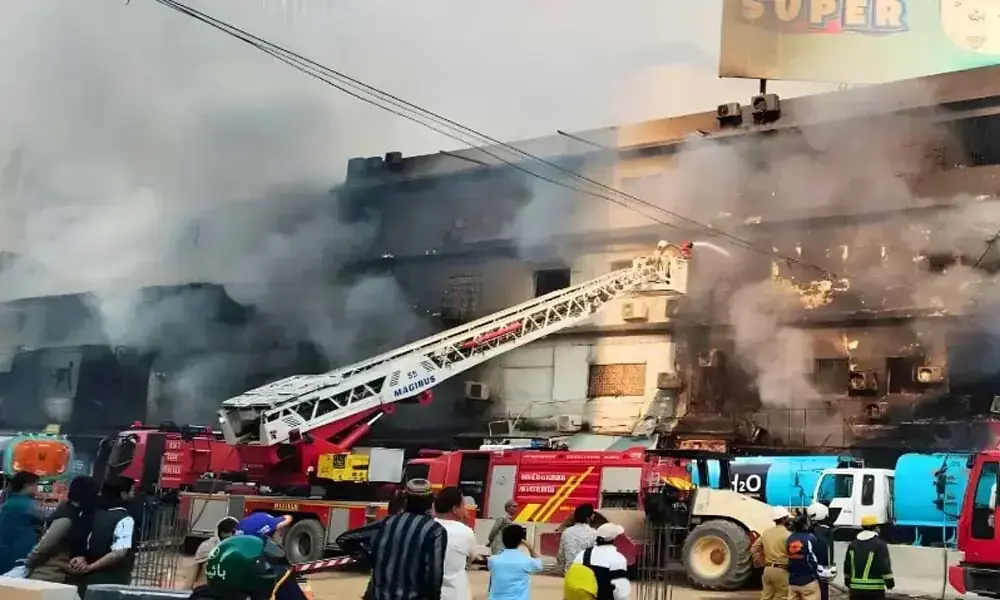
The fire that engulfed Gul Plaza on Karachi’s M.A. Jinnah Road over the weekend is more than a shocking headline—it is a stark reflection of systemic failures in urban governance, regulatory oversight, and emergency preparedness. What unfolded from Saturday night into Sunday evening was a human and economic catastrophe that could—and should—have been prevented.
While the images of flames and smoke are seared into public memory, the most haunting scenes are those of families standing outside the burning building, praying for loved ones who never emerged. Each life lost is a tragedy, made all the more unbearable because these deaths were avoidable. Beyond the human toll, the fire destroyed over 1,200 shops, erasing livelihoods and thrusting countless families into economic uncertainty. For a city like Karachi, the financial and social consequences are staggering, affecting workers, traders, and consumers alike.
At the heart of this disaster lies a glaring failure of prevention. Fires in crowded commercial complexes are not unforeseeable—they are known hazards. Effective prevention requires planning, regulation, and enforcement. Yet Gul Plaza, like so many other structures in Karachi, appears to have functioned in blatant disregard of basic safety norms. Reports suggest a lack of functional fire escapes and other essential safety measures, highlighting a regulatory culture where compliance is optional and oversight is weak. When authorities tasked with protecting public safety neglect their duties, tragedies cease to be accidents—they become predictable.
Poor urban planning and unchecked commercial development further compounded the risks. The narrow, congested streets surrounding Gul Plaza prevented fire engines from positioning effectively, limiting the response from the city’s already overstretched fire services. These infrastructural shortcomings are not random; they are the product of years of unregulated construction, encroachments, and institutional abdication by the Sindh Building Control Authority. In prioritising commercial expansion over safety, regulators have created conditions where emergency responders are set up to fail even before arriving at the scene.
The fire department’s struggle to control the blaze exposes another layer of institutional neglect. Karachi, a megacity of over 20 million people, relies on roughly 30 fire stations—a number woefully inadequate for a city of its size. Firefighters face poorly maintained equipment, insufficient training, low pay, and erratic water supplies. During the Gul Plaza fire, repeated shortages of water hampered efforts to contain the inferno, exposing the absence of basic infrastructure like a functioning network of fire hydrants. This is not merely a technical issue; it is a fundamental governance failure.
The tragedy also underlines the human cost of regulatory complacency. When building codes are ignored, fire safety inspections are lax, and urban planning is reactive rather than proactive, the risk of disaster is not just high—it is inevitable. Gul Plaza is not an isolated case. Across Karachi, similar structures operate with minimal oversight, putting residents, workers, and emergency personnel at constant risk. Each neglected safety standard, every unchecked violation, chips away at the city’s resilience.
For Karachi to prevent a recurrence, piecemeal responses like condolence statements and inquiry committees are insufficient. Meaningful reform must include strict enforcement of building codes, professionalisation of the fire department, investment in training and equipment, and the creation of an effective emergency infrastructure. Regulatory bodies must act decisively to remove unsafe structures and hold those responsible accountable. Without such measures, the city risks repeating the same pattern of preventable loss.
Equally important is public awareness and civic engagement. Citizens, business owners, and local authorities must understand that fire safety is a collective responsibility. Ignoring warning signs or circumventing safety regulations may offer short-term gains but carries catastrophic long-term consequences. The Gul Plaza fire serves as a grim reminder that economic development without safety safeguards is hollow progress.
In the end, the tragedy at Gul Plaza is more than a fire—it is a mirror reflecting Karachi’s governance failures. It is a wake-up call that public safety cannot be sacrificed for profit or convenience. Every life lost, every shop destroyed, every family displaced is a testament to years of neglect, weak enforcement, and institutional decay. Until systemic reforms are implemented, Karachi’s residents will continue to pay the ultimate price for failures that are neither accidental nor unavoidable.
The Gul Plaza fire should not fade from memory as a moment of sorrow alone. It must become a catalyst for change—a demand for accountability, for investment in emergency services, for stricter regulation, and for a city where citizens can live and work without the constant shadow of preventable disaster.