
Dr Bilawal Kamran
The relationship between Bangladesh and India’s Seven Sisters states has long been shaped by geography, connectivity, and strategic imperatives. The narrow Siliguri Corridor, often referred to as the “Chicken’s Neck,” is the central lifeline linking mainland India with its seven northeastern states, Arunachal Pradesh, Assam, Manipur, Meghalaya, Mizoram, Nagaland, and Tripura. Only 20 to 25 kilometers wide at its narrowest point, this corridor has assumed disproportionate importance in the regional security architecture, trade, and infrastructure planning of both India and Bangladesh. In recent months, the term “Seven Chicken Stories” has gained currency in diplomatic circles and the media, reflecting both India’s vulnerabilities and Bangladesh’s emerging strategic posture in late 2025.
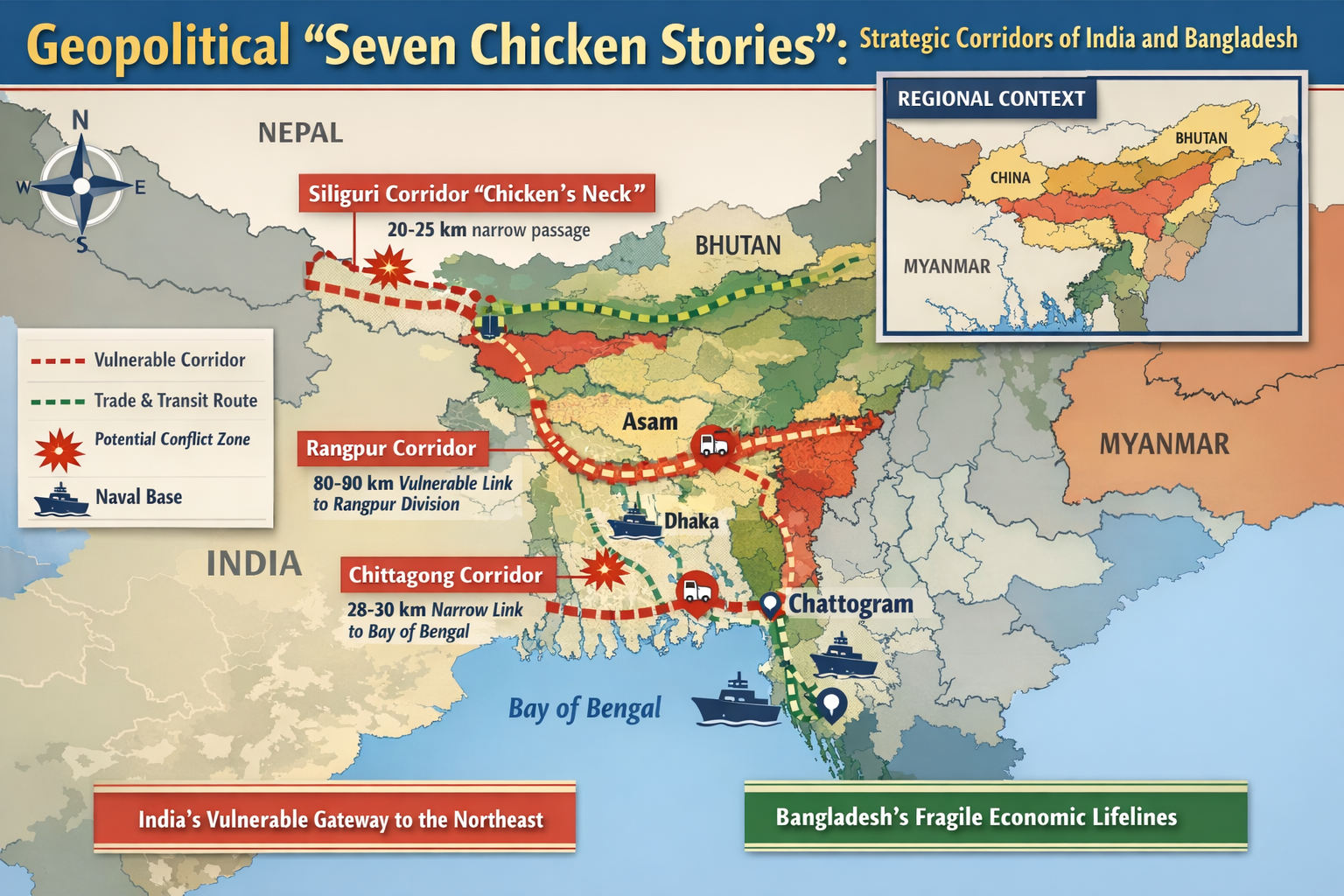
The primary “chicken story” remains the Siliguri Corridor. This narrow strip of land traverses the northern part of West Bengal and is flanked by Nepal, Bhutan, and Bangladesh. Its strategic significance cannot be overstated. It is the only direct land connection between India’s northeastern states and the national heartland, and any disruption along this corridor could severely hamper military mobility, trade flows, and civilian transport. Historically, India has recognized the sensitivity of the Siliguri Corridor, and successive governments have invested in road and rail upgrades, military infrastructure, and surveillance mechanisms to mitigate the risk of external interference or natural disruption. The corridor’s narrow geography, however, inherently limits redundancy and leaves the region exposed to geopolitical leverage, whether from neighboring states or internal disturbances.
In December 2025, the Siliguri Corridor once again became a focal point of diplomatic tension. Hasnat Abdullah, a prominent leader of Bangladesh’s National Citizen Party, made statements suggesting that Bangladesh could “isolate” India’s Seven Sisters if India continued policies perceived as destabilizing to Bangladesh. The statement, though rhetorical in nature, underscored the strategic leverage that Bangladesh holds over India’s northeastern connectivity. By controlling cross-border transit and infrastructure access, Bangladesh is positioned to influence trade routes, energy supplies, and mobility in a region heavily dependent on a single narrow corridor.
Adding to the geopolitical dynamics, Bangladesh’s Interim Government Chief Adviser, Muhammad Yunus, described the Seven Sisters as “landlocked” and characterized Bangladesh as the “only guardian of the ocean” for the region. This statement signals a deliberate framing of Bangladesh not merely as a neighbor but as a strategic gateway with potential economic influence. By positioning Bangladesh as the conduit to the Bay of Bengal and the wider Indian Ocean, Yunus implicitly invited China and other global actors to consider partnerships or economic initiatives leveraging Bangladeshi territory. The rhetoric reflects a broader attempt by Dhaka to assert its regional relevance, particularly as the northeastern states increasingly seek alternative trade routes and infrastructure support to reduce their reliance on the narrow Siliguri Corridor.
India, however, has not remained silent. Assam Chief Minister Himanta Biswa Sarma responded to the December 2025 statements by highlighting that Bangladesh itself has two “chicken necks” that are more vulnerable than India’s corridor. The first is the Rangpur Corridor, an 80 to 90 kilometer strip running from West Bengal into the Rangpur division of northern Bangladesh. Any disruption along this corridor could isolate the entire Rangpur division, affecting administrative control, economic activity, and cross-border trade. The second is the Chittagong Corridor, a 28 to 30 kilometer narrow link connecting South Tripura to the Bay of Bengal and facilitating access to Bangladesh’s primary economic hub and port. Disruptions here could sever vital trade routes, undermine revenue collection, and threaten energy and food logistics. By emphasizing these vulnerabilities, Indian officials sought to signal that the balance of strategic dependence in the region is not one-sided and that Bangladesh’s own territorial and economic corridors are equally susceptible to disruption.
The strategic context surrounding these “seven chicken stories” is complex. India’s Seven Sisters are geographically encircled by Bangladesh, Bhutan, China, and Myanmar, creating a scenario where the Siliguri Corridor serves as their only domestic lifeline. The corridor’s importance extends beyond transportation; it underpins the deployment of security forces, the distribution of essential goods, and the integration of northeastern states into national economic and political systems. Recognizing this fragility, India has pursued alternative routes to diversify access. Infrastructure investments such as the Maitree Bridge and enhanced transit facilities through Bangladesh’s Chittagong Port are designed to reduce dependency on the narrow Siliguri strip, enabling trade and mobility even in scenarios of regional tension. These efforts also reflect India’s broader strategic calculus of connecting the northeast to international markets and countering potential disruptions posed by diplomatic disagreements with Bangladesh.
Bangladesh, meanwhile, has other “sevens” of significance beyond the geopolitical corridor issue. The country hosts seven Shakti Peethas, which are sacred shrines in Hinduism, and the seven Bir Sreshtho, representing the highest military gallantry awards from the 1971 Liberation War. These symbolic sevens reinforce Bangladesh’s cultural and historical narrative, projecting soft power domestically and regionally. While not directly linked to the Siliguri Corridor debate, these markers contribute to national identity and influence Bangladesh’s perception of its own strategic importance in regional politics.
The implications of these corridors extend beyond diplomacy to economic and security concerns. Trade between India’s northeastern states and the mainland relies heavily on the Siliguri Corridor. Even minor disruptions due to natural disasters, infrastructure failures, or political tensions could have disproportionate economic consequences. For instance, perishable goods, industrial supplies, and energy resources all transit this narrow corridor, and delays or blockages could exacerbate inflationary pressures and reduce economic efficiency. Similarly, Bangladesh’s Rangpur and Chittagong corridors facilitate the movement of goods, energy, and critical services. Any disruptions in these channels could undermine Bangladesh’s own economic growth and connectivity with global markets.
From a security perspective, the corridors are critical in regional military calculations. India’s northeastern states, located near sensitive international borders, require rapid mobility of forces to respond to potential threats from China, Myanmar, or insurgent groups. The Siliguri Corridor is therefore a strategic chokepoint, and its vulnerability has been analyzed extensively in Indian defense planning. Conversely, Bangladesh’s narrow corridors necessitate domestic security vigilance to prevent cross-border infiltration, smuggling, or terrorist activity. The dual vulnerabilities create a situation where both countries must consider not only bilateral relations but also regional security dynamics involving third parties such as China, the United States, and Myanmar.
The international dimension further complicates the situation. China, for example, has strategic interests in the northeastern region of India and in Bangladesh through economic initiatives and infrastructure projects. By positioning itself as a partner in the Bay of Bengal and in regional connectivity projects, China can leverage its influence in Dhaka to indirectly access or affect India’s Seven Sisters. Similarly, international trade and development agencies view Bangladesh as a critical transit hub, given its geographical location and infrastructure potential. Any disruption to its corridors would therefore have ramifications beyond the immediate bilateral context, affecting regional trade flows and international investment.
Policy options for both India and Bangladesh involve a combination of diplomacy, infrastructure investment, and security coordination. For India, further diversification of access to the northeast is essential, including expanded air and rail connectivity, investment in cross-border trade agreements, and robust disaster response mechanisms. Engagement with Bangladesh to ensure predictable transit through Chittagong and other ports can reduce the strategic leverage associated with narrow corridors. For Bangladesh, strengthening the security and resilience of the Rangpur and Chittagong corridors, while maintaining constructive diplomatic engagement with India, can prevent escalation and ensure regional economic stability. Transparent communication, joint infrastructure planning, and confidence-building measures are therefore critical to mitigating the risks inherent in these “chicken necks.”
Technological developments also offer new opportunities to address corridor vulnerabilities. Real-time traffic monitoring, advanced logistics planning, and predictive infrastructure maintenance can reduce the impact of disruptions. Both countries can invest in smart border management systems, improved customs protocols, and coordinated disaster response plans. By integrating technology into infrastructure planning, India and Bangladesh can enhance the resilience of their narrow corridors while facilitating economic integration and reducing the potential for geopolitical exploitation.
Finally, public perception and domestic politics play an important role. In India, the vulnerability of the Siliguri Corridor often becomes a point of political debate, influencing defense allocation and infrastructure priorities. In Bangladesh, rhetoric about the “guardian of the ocean” and strategic leverage over India’s northeastern states reflects domestic political considerations and a desire to assert regional influence. Managing domestic expectations while maintaining constructive bilateral relations is therefore a delicate balancing act, requiring political foresight and careful diplomacy.
In conclusion, the “Seven Chicken Stories” encapsulate the intricate web of geography, security, economics, and diplomacy that defines Bangladesh–India relations. The Siliguri Corridor, the Rangpur Corridor, and the Chittagong Corridor are not merely narrow strips of land; they are critical arteries that underpin regional connectivity, trade, and security. As geopolitical tensions escalate, both countries must invest in infrastructure, technology, and diplomatic engagement to ensure that these corridors remain functional and secure. The broader strategic environment, including China’s regional interests and global economic interdependence, further underscores the importance of proactive planning. Ultimately, understanding and managing these “chicken necks” is essential not only for bilateral stability but also for the broader regional order in South Asia.