
Danish Raja
Vox Populi vs. the Status Quo
In modern representative democracies, people ensure their representation through vote in the elections. Thus, elections are the source of smooth democratic transition on the one hand and public participation on the other. Elections are not an end per se but rather a means to an end: democratic continuity by the will of the governed. It ultimately bolsters democracy in the long run. However, this can only happen when all the contenders get an equal and level-playing field to take part in the electoral process; institutions responsible for conducting elections are well-prepared, impartial in their approach, and immune from any external influence; and above all, the whole mechanism of elections be free and fair.
While this happens in the civilized democracies of the world, in countries like Pakistan, elections are nothing but a fait accompli, where not the voters who vote, but rather the ones who count, decide the outcome. As evidenced by recent elections and reinforced by the historical experience in Pakistan, elections have always been managed in two phases: pre-poll political engineering and post-poll manipulation. One may say that this has always happened in Pakistan’s electoral history. What’s avant-garde this time? Well, this election in itself was unprecedented in many instances. No mainstream political party in Pakistan, in the past, witnessed such a stringent crackdown on its top-tier leadership, workers, and supporters that Pakistan Tehreek-e-Insaf went through since the tragic 9th May incident of 2023. Its top-tier leadership was either put behind bars facing terrorism and sedition charges or was forced to part ways with the PTI.
Similarly, thousands of its active political workers were also incarcerated for unleashing arson against the so-called state installations. When the decision-makers realized that despite all the state-sponsored calculations against the PTI, their popular support was intact, they went a step ahead and established an unprecedented precedent by depriving the party of its iconic bat symbol just a month before the general elections. Despite insurmountable barriers, hundreds of PTI-backed nominees ran into the office to submit their nomination papers. In the broad daylight, we witnessed their nomination papers being snatched by the unknowns and the candidates being arrested. Adding insult to injury, Chairman PTI Imran Khan was convicted in three cases (apparently frivolous) a week before the elections. For the powers that be, this was meant to be the last nail in the coffin of the PTI. The entire state institution left no stone unturned in disseminating disappointment for the PTI voters.
However, against all the odds, people, particularly young men and women, came out in large numbers and voted for their party. The people’s response against the oppression was unprecedented, loud, and unequivocal. People used their ballot power to turn the tables, defying the odds. The foregone conclusions of elections ended up in topsy-turvy, not only for the establishment-backed political parties but also for the establishment itself. The Vox Populi gave a clarion call to those at the helm of affairs that the system’s meddling in political affairs is unwarranted from now onward. But instead of wholeheartedly accepting the public mandate, the entire state apparatus started manipulating the results; those winning on 8th February were made to lose by the next day.
The blatant post-poll rigging was sui generis in its essence, as acknowledged by a senior bureaucrat (Commissioner Rawalpindi, who later backed down from his allegations) that candidates losing with thousands of votes were made to win with the same margin on the very next day.
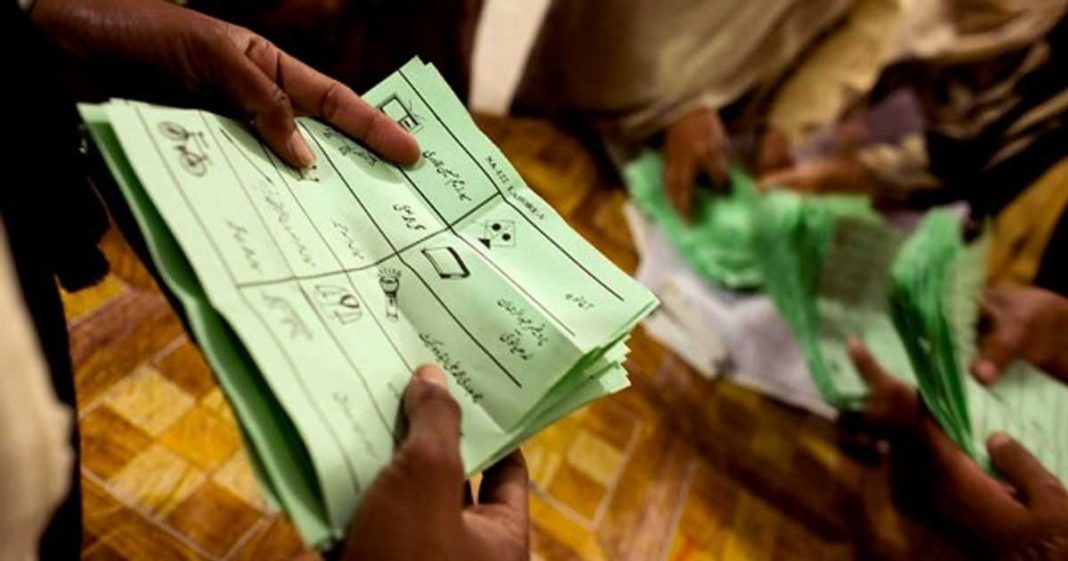
Pakistan’s recent election is a case study in itself. There is rarely any precedent in the South Asian region that a party whose top-tier political leaders are either imprisoned or hidden; whose head being convicted in three cases with a total punishment of 31 years; whose dozens of electables were forced to leave either the party or the politics; whose political leaders were not freely allowed to organize any political rally, let alone the power show; whose contestants were forced to step down days before the elections; whose candidates were made to contest with the symbols of shoes; pumpkin; baigan; sparrow; violin and hundreds of others (given the fact more than 40 percent of the population is illiterate); whose workers and families were facing continuous raids on their houses; facing media blackout (neither the name, nor the picture of Imran Khan was allowed to be featured on TV); the top-class and widely viewed experts on the TV and newspapers declaring the PTI’s defeat before the elections to spread disappointment in its voters; and above all, the complete blackout of mobile phone service on the very polling day, even then the party almost swept the elections had the results not been tampered with later on. How did they make it possible?
They used digital means of communication to organize virtual power shows. The most astonishing aspect of their virtual campaign was organizing digital political rallies on TikTok. They uploaded the list of their candidates with their respective symbols on the website, which too was blocked weeks before the election by the Pakistan Telecommunication Authority. They harnessed Imran Khan’s Facebook page and updated their nominated candidates’ names, constituencies, and symbols. Their social media team used innovative techniques to create awareness among the people across the cities and villages. They utilized Khan’s AI-generated speeches during their virtual electoral campaign. Despite its oppression, the party emerged as the single largest political party in the elections. This has never happened, at least in Southern Asia.
This election was not against any particular political party; rather, it was a fight between the system that wants to preserve the status quo and the people who strive to bring the much-awaited real change.
Although the hidden hands manipulated the results, to the people’s surprise, these measures have only staved off the simmering silent revolution. The elections that were supposed to bring political stability reinforced political instability with renewed vigor and intensity. The PDM 2.0, assembled by the establishment’s glue, would be a weak government lacking political and moral legitimacy amid serious controversies over post-election rigging. Mian Shehbaz Sharif, an apple of the establishment’s eye who miserably failed in his first tenure to revive the economy, is set to run the country with an utterly different cabinet. His performance will determine the fate of the PDM government, but one thing is certain. The incumbent government will be under immense pressure, both inside and outside the parliament, from the opposition members of the PTI who joined the Sunni Ittehad Council (SIC). The recent decision by the Election Commission of Pakistan, whereby it stripped the SIC of its special seats for women and minorities in the parliament, tells another story of the mindset of the system against the PTI. This decision has far-reaching implications as it is another attempt to disenfranchise those who deserve representation in the parliament.
States with a modicum of sagacity learn from their mistakes and avoid repeating them. Still, in the context of Pakistan, those at the helm of affairs remain adamant about repeating the same mistakes repeatedly; instead of rectifying the previous wrongdoings and pursuing course correction for the nation’s and the state’s greater interest, the powers that be decided to unite its favorites. Now the question arises: has the public verdict through the ballot gone up in smoke? The answer is undoubtedly no. The youth of Pakistan, which would remain in the majority for the next few decades, has unequivocally sent the message to the system that it is dissatisfied and aggrieved at the contemporary state of affairs. They do not want the establishment to regulate this power show anymore. They disregard the military’s heavy-handed role in political affairs. The youth also rejected those political parties that appeared to be siding with the establishment.
Not only this, but the educated youth has also spurned those who were once celebrated as ‘electives.’ The political parties running through dynastic and patronage culture are losing the political support base. In the wake of recent elections and the public vote against all the odds, one outcome has become unavoidable: the lava of public resentment being boiled up over the years is bound to erupt. They cannot stop the simmering revolution from happening; they can only prolong it, and that too, not for a longer period. The people’s voice cannot be muted forever; it has to be heard, and it is high time that the powers that be succumbed to the vox populi. Pakistan can only move forward with implementing the people’s will.
Please, subscribe to the YouTube channel of republicpolicy.com