
Hafeez Ahmed Advocate
Dr. Ishrat Husain has been speaking critically about Pakistan’s bureaucracy with considerable confidence in recent months. The criticism is not without merit in its diagnosis. But there is a deeper problem. The man delivering it carries the weight of his own record, and that record does not survive honest scrutiny. When the Civil Service Reforms Task Force, established under his leadership during Imran Khan’s tenure, completed its work, it did not dismantle the colonial bureaucratic order. It entrenched it further, dressed in the language of modernisation.
This is the central contradiction that must be named plainly.
Dr. Husain spent his career inside the very structure he now critiques. He was a product of the colonial civil service model, rose through its ranks, benefited from its hierarchies, and ultimately headed a reform process that extended its reach rather than challenged its foundations. The Civil Service of Pakistan, with its reservation of posts, its generalist dominance, and its contempt for administrative federalism, did not weaken during his watch. It grew stronger. The posts multiplied. The power concentrated further upward. And the government that trusted him with this mandate, Pakistan Tehreek-e-Insaf and Imran Khan, was systematically misled about what was actually being done in the name of reform.
The philosophical failure at the heart of Dr. Husain’s reform agenda was not technical. It was structural. His framework lacked any genuine conception of administrative federalism. This is not a minor omission. In every functioning federal democracy in the world, each tier of government possesses its own distinct, accountable bureaucracy. The federation has its servants. The provinces have theirs. The district governments have theirs. Each is answerable to its respective political executive and legislature. This is not an idealistic arrangement. It is the operational foundation of democratic governance in federal states. Without it, federalism is a constitutional fiction, a text that confers rights no administrative structure exists to protect.
Dr. Husain’s concepts of the National Executive Service and the Provincial Executive Service moved in precisely the opposite direction. They sought to impose a single, centrally controlled, elitist civil service structure upon provincial and district posts that should by every principle of federalism belong to their own accountable governments. The names sounded progressive. The architecture was colonial. What changed was the branding, not the power structure.
During the same period, amendments were quietly made to the controversial Civil Service of Pakistan Composition and Cadre Rules of 1954, that founding document of bureaucratic centralisation which this writer has examined and challenged at length in The Bureaucratic Coup. These amendments further empowered Pakistan Administrative Service officers at the expense of everyone else. Even the definition of government itself was rewritten. In a democratic system, government is not a single individual. It is the collective expression of the political executive, the cabinet, and the legislature working within constitutional limits. Yet the amended definition repositioned the bureaucracy as the representative of the Prime Minister or Chief Minister alone, reducing democratic government to a personality and elevating the civil servant as its instrument. This is not reform. This is the formalisation of authoritarian administrative logic.
More troubling still, agreements related to the CSP Composition and Cadre Rules 1954 were classified during Imran Khan’s tenure. Senior CSP officers of that period, including Arbab Shahzad and Azam Khan, were involved in this process. Classifying these agreements served one purpose: to prevent scrutiny of what was being done and why. Transparency and reform are not compatible with secrecy. The two cannot coexist. The decision to classify points unmistakably toward the awareness that what was being done could not withstand public examination.
The most damaging act, however, was the deliberate misrepresentation of data presented to the PTI government. Dr. Husain’s Civil Service Reforms Task Force told Imran Khan and his ministers that the number of federal PAS posts was being reduced. This was false. The number increased substantially. In Punjab alone, PAS seats rose from 115 to 440. This is not a rounding error or a matter of interpretation. It is a fundamental inversion of reality, presented to a government that had placed its trust in those claiming to serve it. The PTI came to power promising to break the administrative status quo. What it received instead was a bureaucratic operation that used the cover of reform to consolidate exactly the system the government believed it was dismantling.
This is why a deep and lasting negative perception of PTI’s so-called civil service reforms took root within the bureaucracy itself. Officers who watched the process understood what had happened: power had been further centralised, specific cadres had been empowered, and the institutional architecture of the colonial state had been reinforced under the banner of change. The government had been captured by the very machine it promised to reform.
It is within this full context that Dr. Ishrat Husain’s current criticism of Pakistan’s civil service must be assessed. The intellectual and moral authority required to lead this conversation demands a reckoning with one’s own role. Without that reckoning, criticism becomes commentary, and commentary without accountability changes nothing.
The true direction of genuine civil service reform in Pakistan is clear to those willing to follow the logic of the Constitution. The federal government must have its own separate civil service, confined to federal functions. A joint service should exist for Council of Common Interests affairs and intergovernmental coordination. Each provincial government must have its own independent, professionally staffed, and politically accountable service. District governments must have their own local bureaucracies, rooted in and responsible to their communities. And across all tiers, the generalist colonial model must give way to specialised, professional, and merit-based administration.
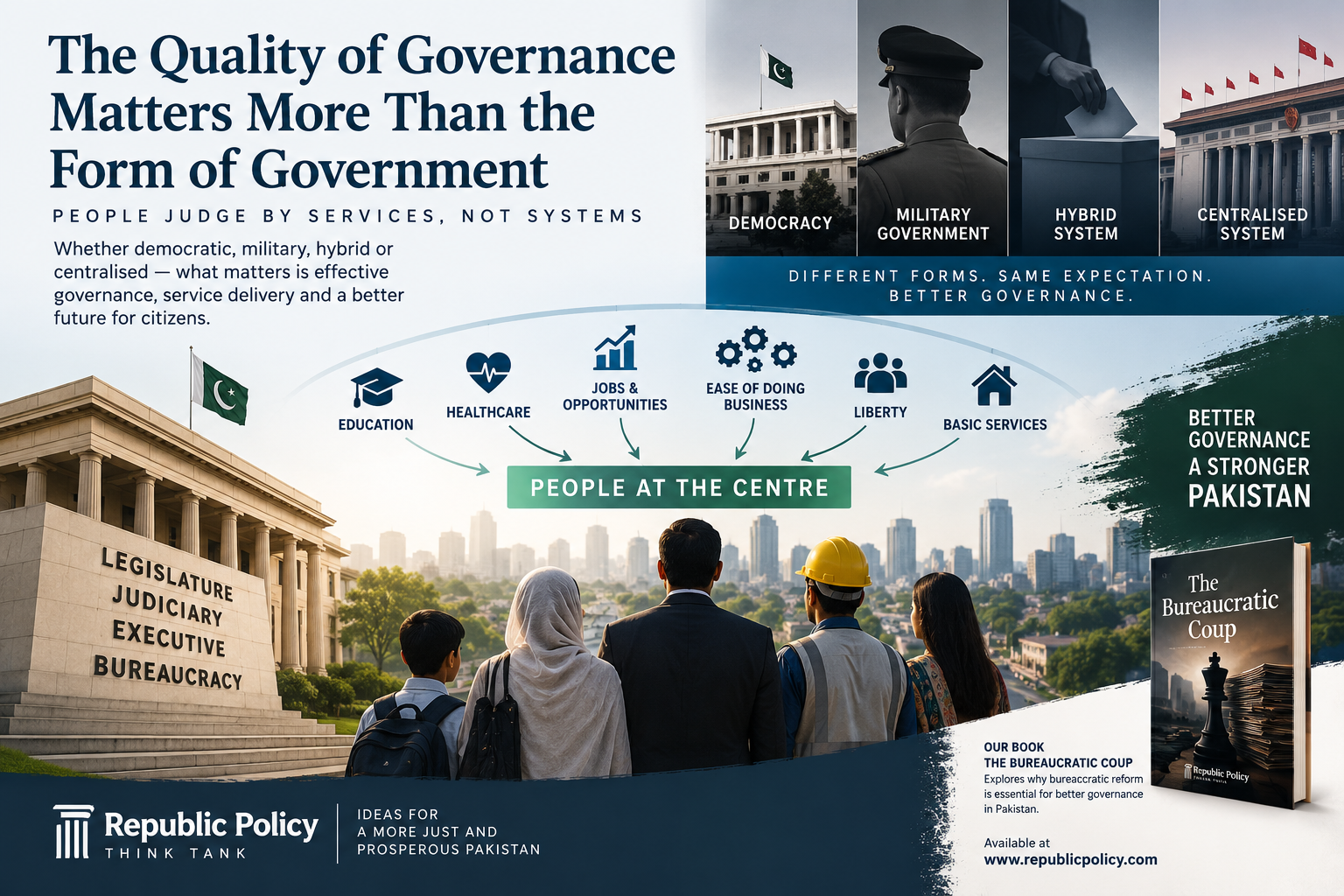
A thorough examination of the civil service reforms of the Imran Khan era, and of Pakistan’s deeper colonial bureaucratic inheritance, is available in The Bureaucratic Coup, published by Republic Policy and available at Vanguard Books and all major bookstores. The argument has been made in full. The evidence has been assembled. What remains is the political will to act on it.