
Dr Nadeem Ul Haq
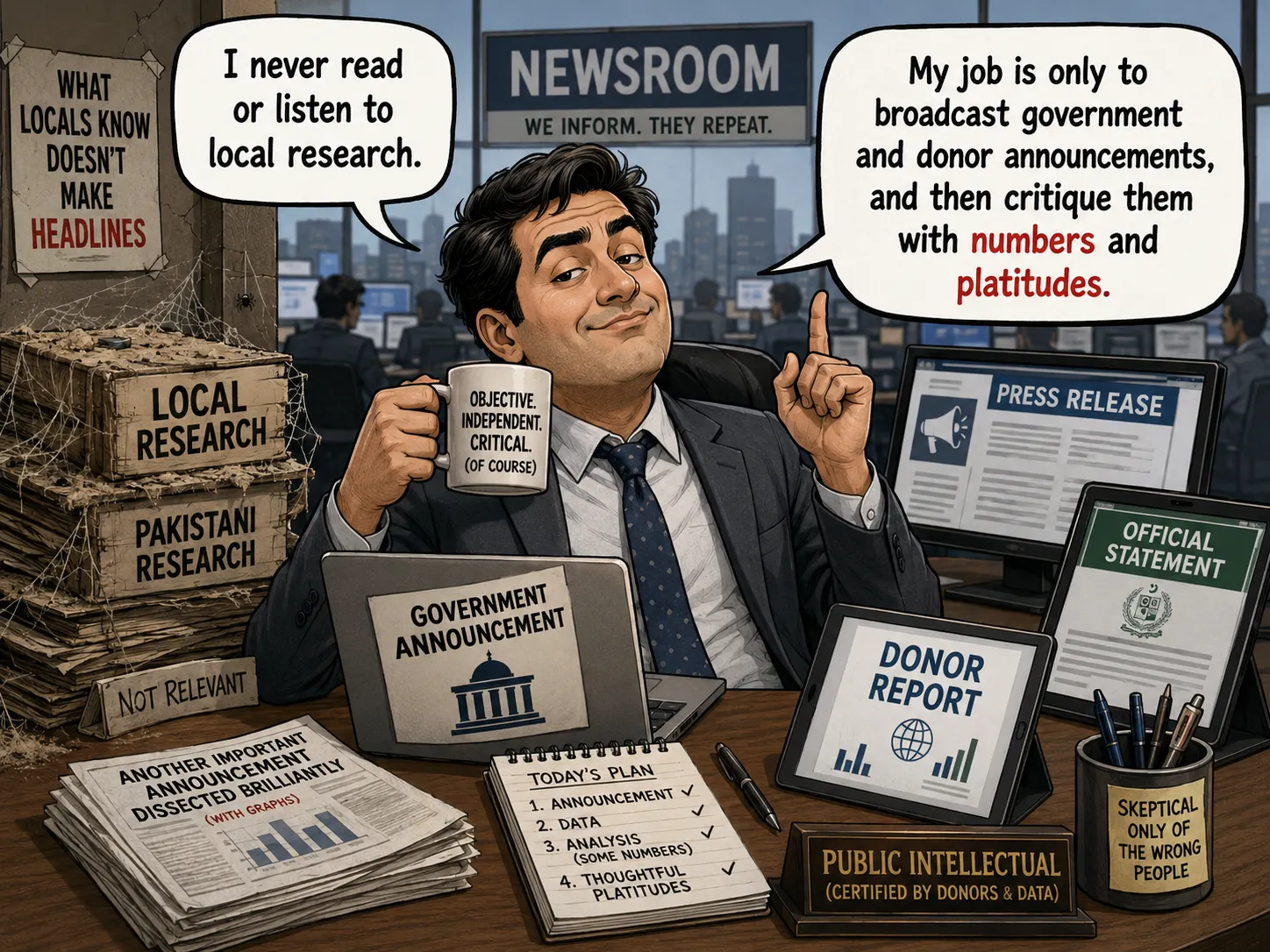
“ I never read or listen to local research” Actual statement by a known local journalist
Section I: The Journalism
Budget week is Pakistan’s annual stress test for economic journalism. The country produces a budget every June. The press covers it every June. And every June, roughly the same thing happens: the numbers are transcribed, ministers are quoted, and the story ends where inquiry should begin.
This year the basic reporting was competent on headline arithmetic. The Economic Survey, budget size, tax target, PSDP cut, defence increase, salary adjustment, pension increase and IMF constraints were all reported promptly. But that is where journalism ended and transcription began.
The Economic Survey — a government narrative document produced to frame the budget — was treated by the press as an objective assessment. GDP growth was reported at 3.7 percent, above last year’s 3.18 percent but below the 4.2 percent target announced with confidence only a year earlier. Yet almost no story asked where this number came from, how it was constructed, whether it reconciles with investment, credit, exports, employment, tax collection, energy use or firm-level activity, or whether a 4 percent-plus target has even been achieved recently. The pattern is familiar: growth is overestimated, the target is missed, a fresh optimistic target is announced, and accountability disappears. The press still reports each cycle as news rather than as evidence of a broken forecasting and policy apparatus.
The more revealing failure was on development spending. Coverage dutifully noted that the National Economic Council cut the overall development outlay by 25 percent to Rs3.218 trillion, reduced the federal PSDP to Rs1 trillion, and approved no new projects except for the interior and defence ministries. The near-universal response was to treat this as regrettable fiscal compression, as if a larger PSDP is automatically better for growth. Nobody asked the harder question: better than what?
Pakistan’s PSDP has been the subject of sustained research critique for more than two decades. My own work, including my book and the Framework for Economic Growth passed by the National Economic Council, argued explicitly for reforming the Planning Commission and moving away from a brick-and-mortar, input-driven PSDP toward a results-based growth-governance system. The issue was never simply “more development spending.” The issue was whether public spending produces growth, crowds in private investment, improves productivity, and builds the software of the economy.
One would think journalists covering the budget would have some institutional memory of this debate. The throw-forward problem — hundreds of projects thinly funded, chronically delayed, inflated by cost overruns, politically inserted and weakly evaluated — has been documented repeatedly. A smaller PSDP, if accompanied by genuine rationalisation, could be more productive than a larger one used as a political distribution machine. But the press did not raise this possibility. It simply reported lower development spending as an unambiguous loss.
This is what happens when economic journalism does not read Pakistani research while confidently implying that Pakistani researchers have little to say. If journalists do not listen, do not read, and do not remember even reforms passed by the NEC, we should not be surprised that every budget is reported as a new event rather than another turn in a failed planning ritual.
The same uncritical stance appeared on revenue. Dawn reported officials admitting the FBR target was unrealistic, yet unavoidable because “we are under IMF programme and have to agree with the target.” That sentence should have triggered a national debate. What does sovereignty mean when the budget is built around targets officials themselves do not believe? Why are ministries so intellectually thin that they enter IMF negotiations without credible local research, alternative scenarios or evidence-based bargaining positions?
The issue is not merely IMF pressure. It is domestic policy failure: a state that cannot produce its own numbers, defend its own analysis, or negotiate from its own research. Perhaps the deeper embarrassment is that both the ministry and the journalists covering it seem equally innocent of local research: one negotiates without it, the other reports without asking why it was absent.
The deepest failure of this week’s journalism was its disconnection from the research literature on precisely the topics it covered. Pakistan has decades of serious work — from SBP researchers, academic economists, and my own work — on tax policy, investment quality, regulatory burden, firm dynamics, planning failure and institutional reform. The PIDE-PRIME Growth Commission that I led, for instance, called for a clear and consistent tax policy that promotes investment and growth rather than arbitrary changes driven by revenue targets. None of this entered the budget coverage.
Instead, the analytical framework was outsourced almost entirely to the IMF: targets, red lines, approvals, benchmarks. The result is not economic journalism in any serious sense. It is amplifying on IMF documents, conducted at one remove from Pakistani economic reality.
Section II: The Op-Eds
The economics op-eds of June 5–12 showed some fatigue with Pakistan’s stabilization theatre, but they still did not break decisively from the official-donor frame.
The better op-eds of the week recognised three things:
· stability is not growth,
· the budget has become an accounting ritual, and
· productivity must become the centre of policy.
That is progress. But most stopped at diagnosis. They did not connect the budget debate to Pakistan’s own reform literature: the critique of the PSDP, Planning Commission reform, cities as engines of growth, deregulation, markets, the footprint of government and growth governance. The result was familiar commentary: sensible, but incomplete; critical, but still trapped in official and donor language.
The first theme was stabilisation without transformation. Dawn’s “A difficult story” rightly argued that productivity must become the dominant target of economic policy. Business Recorder’s “Budget FY27: choosing growth over stability” made a similar point: the government is celebrating stability while growth remains weak and investment subdued. But this is not a new insight. The Framework for Economic Growth, passed by the National Economic Council, argued more than a decade ago that Pakistan had to move away from project allocation toward productivity, markets, cities, innovation and reform of the planning machinery. The op-eds rediscovered the problem but did not acknowledge that Pakistan already had a home-grown growth framework.
The second theme was the budget as ritual. Dawn’s “Another year, another accounting exercise?” and Kaiser Bengali’s “Making the budget relevant” correctly argued that budgets have become repetitive exercises: targets are announced, missed, revised and replaced. But the problem is larger. Pakistan’s growth is also choked by sludge: NOCs, permissions, inspections, tax notices, approvals, overlapping regulators and bureaucratic vetoes. The op-eds attacked the accounting ritual, but not the permission regime or excessive government footprint behind it. Sludge gets little attention because it is less visible than tax rates or PSDP cuts, but for firms it is often the real cost of the state.
The third theme was taxation. Nasir Jamal’s “Politics over tax reform” rightly treated the trader scheme as political accommodation, not reform. Business Recorder’s “Myth of untaxed traders” made the sharper point: undocumented is largely a myth. The state already has data through electricity connections, CNICs, bank flows, property records and supply chains. The problem is not invisibility but enforcement, politics and trust. Yet retailers are not all large tax evaders. Most are small, low-margin businesses operating in a weak economy, facing rent, utility bills, harassment and uncertainty. Bringing them into the tax net cannot be done through raids, notices and arbitrary turnover taxes. It must be gradual, simple and linked to a growing economy in which small businesses see a future worth documenting.
The fourth theme was official optimism versus lived reality. Business Recorder’s “Contesting finance minister’s narrative” rightly challenged the habit of blaming growth failures on shocks — war, floods, commodity prices, politics or the IMF. But the deeper problem is domestic policy design. Pakistan runs a heavily centralised, colonial-style government with little real autonomy, weak operational efficiency and constant official interference in market transactions. High energy costs, regulatory uncertainty, tax harassment, PSDP misallocation, weak cities, SOEs and bureaucratic control are not external shocks. They are policy choices that keep the cost of economic activity high. The op-eds moved in the right direction, but did not connect official optimism to the state machinery that makes firms cautious, markets thin and growth fragile.
The fifth theme was the economy in suspension. Business Recorder’s “Economy being kept in an induced coma?” used the right metaphor. Stabilisation without reform is sedation. Growth below four percent cannot be celebrated in a country with Pakistan’s youth bulge, debt burden, unemployment pressure and urbanisation challenge. But the piece, like much of the week’s commentary, did not specify what would wake the economy up. The answer is not another macro target. It is reforming the operating system: deregulation, competitive markets, city governance, planning reform, energy-market restructuring, SOE discipline and civil-service incentive reform.
The sixth theme was human capital. Dawn’s human-capital pieces were welcome because they moved the debate beyond fiscal aggregates. But they still treated human capital too softly. The issue is not simply more spending on education and health. It is whether spending produces learning, employability, skills, research, innovation and productivity. My recent work on universities and employability shows that Pakistan’s education system is bureaucratically driven, weakly connected to markets and short of incentives for excellence. Yet the budget debate still talks as if allocations automatically produce outcomes. That is the same input-driven thinking that weakened the PSDP.
The seventh theme was savings and investment. Some op-eds recognised that Pakistan cannot grow without domestic savings, investment and productive capacity. But the analysis remained thin. Low savings are not merely a household habit. They reflect low trust, weak financial markets, negative real returns, policy uncertainty, lack of credible instruments and a state that absorbs resources without producing public goods. Low investment is not just a financing problem. It is a governance problem: land, courts, taxes, energy, regulation, contract enforcement and policy credibility. Local research has much to say on all this, but the op-eds rarely used it.
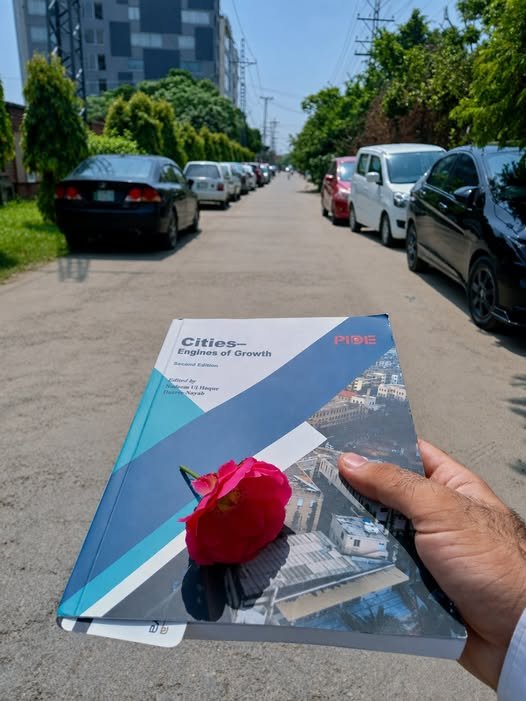
The week’s conclusion is clear. The commentariat is beginning to see the failure of stabilisation-led economics, but it has not yet built a Pakistani reform narrative. It still borrows too much language from ministries, donors and IMF documents: stabilisation, productivity, reform, investment, fiscal space. These words are not wrong, but they are empty unless attached to institutions. Pakistan’s own research has already supplied many missing links: civil-service reform, market reform, cities as engines of growth, markets rather than permissions, regulatory guillotine, university reform, energy-market reform and a move from inputs to results.
The op-eds were better than the reporting, but still incomplete. They criticised the budget, but not enough of the state that produces it. They asked for growth, but not enough about the institutions that block it. They saw that the economy is stuck, but did not fully name the machine that keeps it stuck.
The departure from local research is not a minor omission. It is the central weakness of Pakistan’s economic commentary. Without memory of Pakistani work, every op-ed becomes another rediscovery of old problems. Without domestic reform frameworks, every budget debate remains trapped in donor language and official arithmetic.