
The United States military completed its latest wave of strikes against Iran on Friday, according to Central Command, marking the seventh consecutive night of its renewed bombing campaign. CENTCOM said the strikes hit surveillance sites, military logistics infrastructure, underground weapons storage, and maritime capabilities, using fighter jets, aerial drones, and warships. Washington has said the goal is to continue degrading Iranian military capabilities, even as Tehran launched another wave in its own widening series of attacks on US allies across the region.
A pattern taking shape
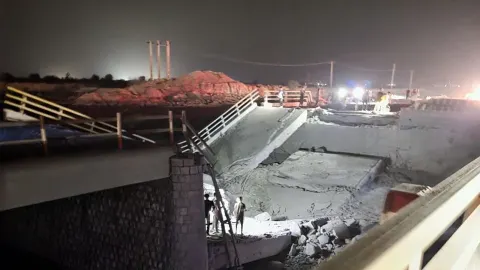
Strikes late Friday into early Saturday hit the port city of Bandar Abbas and the nearby islands of Qeshm and Larak, both located in the Strait of Hormuz, according to Iranian state media. Bridges and a tunnel on a highway connecting Bandar Abbas to Hajiabad further inland were also reportedly targeted, alongside strikes in Ahvaz, Darab, Yazd, Omidiyeh, and Bushehr county, some of them well inland from the coast. CNN has not been able to independently verify Iran’s claims. One analyst told CNN that the pattern of strikes on bridges, railway junctions, and power lines connecting Iran’s coastal cities to its interior could point to a broader US strategy aimed at advancing options for seizing control of the Strait of Hormuz.
Tehran’s warning
Mohsen Rezaei, a senior Islamic Revolutionary Guard Corps official and military adviser to Supreme Leader Mojtaba Khamenei, warned Friday that continued US strikes would trigger a full-scale Iranian offensive within days. State broadcaster IRIB quoted him saying that if the attacks persisted for another two or three days, Iran would move into a phase of full-scale offensive operations.
Arab nations push back
Iran’s own strikes on US allies have drawn sharp criticism across the region. Late Thursday into Friday, Iranian forces struck Oman, Jordan, Kuwait, and Qatar, where a child was wounded by shrapnel from an intercepted attack. In Iraq, an Iranian missile and drone strike killed nine fighters from an Iranian-Kurdish group. Qatar’s foreign ministry, which had mediated earlier talks between Washington and Tehran, called for a serious return to dialogue. The UAE’s foreign minister described the Iraq strike as a flagrant violation of Iraqi and Iraqi Kurdish sovereignty, while Jordan’s foreign minister denounced the attacks as a blatant breach of international law and warned against further escalation. Kuwait issued a strong denunciation of what it called reprehensible Iranian aggression against Bahrain, Qatar, and Jordan.
The human cost
The Iranian cities under attack are among the country’s poorest and most ethnically diverse, home to large minority populations distinct from Persian-majority centers like Tehran, and have long suffered underinvestment and high unemployment despite hosting much of Iran’s energy industry and commercial ports. The conflict has also claimed lives beyond the two nations directly involved. An Indian seafarer who went missing after an Iranian attack on his ship was confirmed dead this week, according to the Forward Seamen Union of India. India, the world’s largest supplier of maritime labor with more than 300,000 sailors serving global fleets, has since ordered ship owners not to deploy Indian crews on vessels transiting the Strait of Hormuz.