
Jeered Out of the Chamber
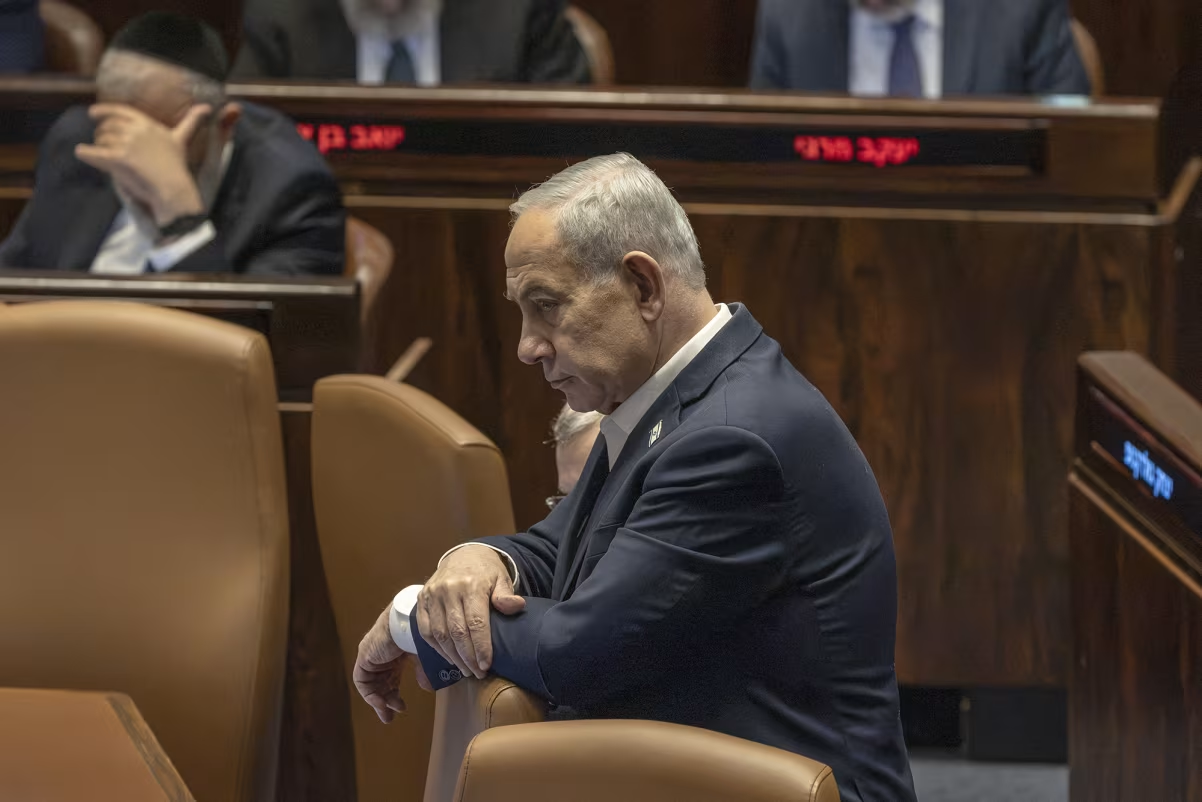
A wave of jeers greeted Prime Minister Benjamin Netanyahu in Israel’s parliament this week as opposition lawmakers shouted “Shame! Leave! Go!” so loudly that he walked out of the chamber rather than sit through the vote. The bill passed anyway.
A Legislative Blitz Before Dissolution
Netanyahu’s absence did nothing to slow his coalition’s legislative push before the Knesset dissolved on Friday ahead of an October 27 election. A cluster of contentious bills, designed largely to satisfy his ultra-Orthodox and far-right allies, were rushed through in the government’s final days, according to analysts.
At the heart of the push is a simple political fact: Netanyahu’s government has just become the first Israeli administration since 1988 to complete a full term, a milestone Netanyahu himself, despite being the country’s longest-serving prime minister, had never achieved before. Political analyst Nadav Eyal wrote that Netanyahu is fighting for his political survival and that the ultra-Orthodox parties are essential to it, with the aim of proving to them that he alone can deliver.
The Draft Exemption Fight
The most explosive item was legislation enshrining the mass exemption of ultra-Orthodox youth from military service. Although Israeli law requires all 18-year-olds to serve, ultra-Orthodox men have long avoided conscription under arrangements the Supreme Court has repeatedly struck down. The issue has grown more urgent during wartime, with the IDF short by at least 12,000 soldiers while an estimated 72,000 eligible ultra-Orthodox men remain unenlisted.
Facing public backlash against a sweeping exemption law, Netanyahu instead advanced a two-part workaround. One law enshrines Torah study as a foundational state value, a move critics say lays constitutional groundwork to help exemptions survive future court challenges. A second grants temporary immunity to tens of thousands of draft evaders until January 2027. IDF Chief of Staff Lt. Gen. Eyal Zamir publicly called the legislation inconceivable and warned it could erode trust among soldiers who do serve, a warning that drew backlash from Netanyahu’s allies, including calls from some Likud lawmakers for his dismissal. The bill passed regardless, though the High Court has since issued a temporary injunction freezing it after opposition parties petitioned against it.
A Broader Coalition Trade
The draft legislation was only one part of a broader coalition trade agreement. In exchange for their support, ultra-Orthodox parties backed a bill curbing the authority of the attorney general, a central piece of the government’s judicial overhaul that could allow it to override legal interpretations and revive efforts to remove Attorney General Gali Baharav-Miara. Separate legislation overhauling broadcasting regulation, criticized as expanding government influence over media, and a bill expanding gender-segregated academic programs, denounced by universities and women’s groups, also passed this week.
Other coalition partners used the moment to advance their own priorities. Finance Minister Bezalel Smotrich announced roughly 2.4 billion shekels (about $790 million) in new West Bank settlement funding and disclosed the legalization of 34 new outposts, bringing the total settlements approved under the current government to 104.
Public Opposition and Political Fallout
Public opinion runs sharply against the package. A July Channel 12 survey found 66 percent of Israelis oppose the Torah-study law, and 61 percent would prefer the next government exclude ultra-Orthodox parties altogether. Netanyahu’s rivals have seized on the issue: Gadi Eisenkot, his leading challenger, called it “a reckless deal: a bloc in exchange for a state,” while former Prime Minister Naftali Bennett described it as a low, anti-Zionist moment that showed contempt for soldiers and the public they serve.
Betting That Memory Fades
Netanyahu appears to be betting the political cost will fade. A Likud insider said public memory is short and that preserving a unified bloc matters more than any single law’s unpopularity, adding that Netanyahu remains unconcerned even if the courts intervene, since a legal fight would reinforce the anti-judiciary message already central to his campaign.