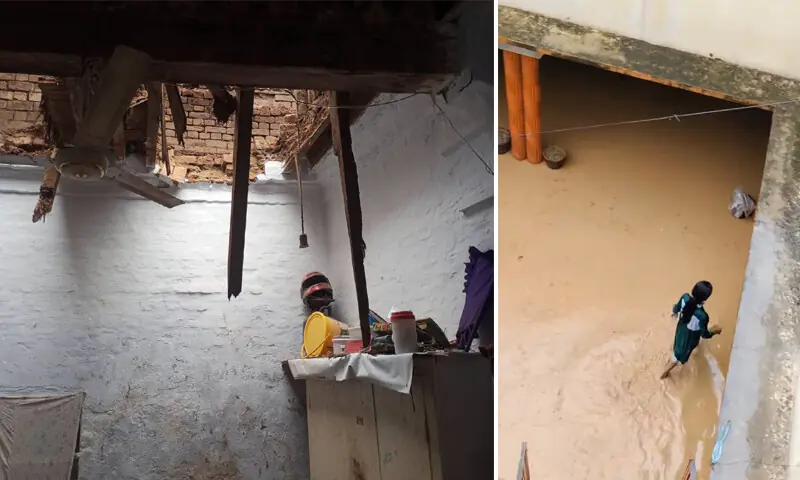

Torrential rain battered the Jhelum district on Saturday, collapsing a timber workshop and a house in Pind Dadan Khan town and injuring at least five people, including a woman, as flash floods from the surrounding hills swept into nearby villages.
The workshop’s collapse trapped four people beneath the debris, while a separate house collapse in Alam Shah town left a woman injured. Assistant Commissioner Ayesha Shafqat confirmed that all the injured had been moved to Civil Hospital for treatment.
The downpour sent floodwater cascading from the hills into the villages of Dilawar, Chitti Rajgan, and Dhoke Araiyan, where residents say poorly built drainage channels are largely to blame. In Dilawar, families described watching floodwater pour directly into their homes, some fearing they may lose their houses altogether. The frustration is not new: residents of Chitti Rajgan had already taken to the dual carriageway in protest, pleading with the Punjab government to intervene after a raised road surface began funneling rainwater into their homes and across their farmland. Further collapses were reported in Khewra and Kaliwal, while in Daultala’s Dumgi area, a blocked drainage culvert sent water flooding into more houses.
Rawalpindi and Islamabad Also Soaked
The twin cities of Rawalpindi and Islamabad were not spared either. Rain began around 8am Saturday and continued in bursts through the afternoon before finally easing by evening, dropping temperatures to a cooler 27°C. More rain is expected within the next day.
According to the Met Office, Rawalpindi recorded 13mm of rainfall at Chaklala, with lighter totals across Shamsabad, Kutchery, Gawalmandi, New Kattarian, and Pirwadhai. Islamabad saw similarly patchy totals, from 12mm at Saidpur down to just 1mm at the airport, while Murree recorded 12mm. Meteorologists traced the wet spell to a low-pressure system sitting over southwest Rajasthan, pulling monsoon currents deeper into Pakistan’s southern and central belt.
Forecasters expect more of the same in the days ahead: scattered thunderstorms and rain across southeastern Sindh, upper and central Punjab, upper Khyber Pakhtunkhwa, Kashmir, and parts of Balochistan, with the heaviest falls likely in Sindh’s southeast, Kashmir, and central Punjab. Officials have warned that Sunday’s rain could unleash flash floods in Kashmir’s streams and hill torrents around Dera Ghazi Khan and northeastern Balochistan, while low-lying stretches of Sindh, Gujranwala, Lahore, Sialkot, Gujrat, Sahiwal, Sargodha, Jhang, and Faisalabad face a heightened risk of urban flooding. Strong winds and lightning, they cautioned, could also threaten fragile infrastructure such as solar panels, power lines, and billboards.
Meanwhile, residents across parts of Rawalpindi Cantonment say they’re growing weary of a different problem: persistent power outages and voltage swings they blame on official negligence and for which they’re now demanding a lasting fix.
In response to the rising water levels, Commissioner Salman Ghani inspected the Gawalmandi bridge over Leh Nullah alongside officials from WASA, the Rawalpindi Waste Management Company, Civil Defence, Rescue 1122, and the Municipal Corporation, reviewing drainage capacity and monsoon readiness. He instructed all departments to stay on high alert for the remainder of the monsoon season, with disposal stations, heavy machinery, and dewatering equipment kept ready and in the field at all times.