
Naeem Afzal
The great philosopher Confucius has rightly said, “In a well-governed country, poverty is something to be ashamed of. While in a badly governed country, wealth is something to be ashamed of.” His quote firmly endorses a fundamental fact of modern governance: all governments, whether elected or non-elected, are supposed to deliver and govern effectively.
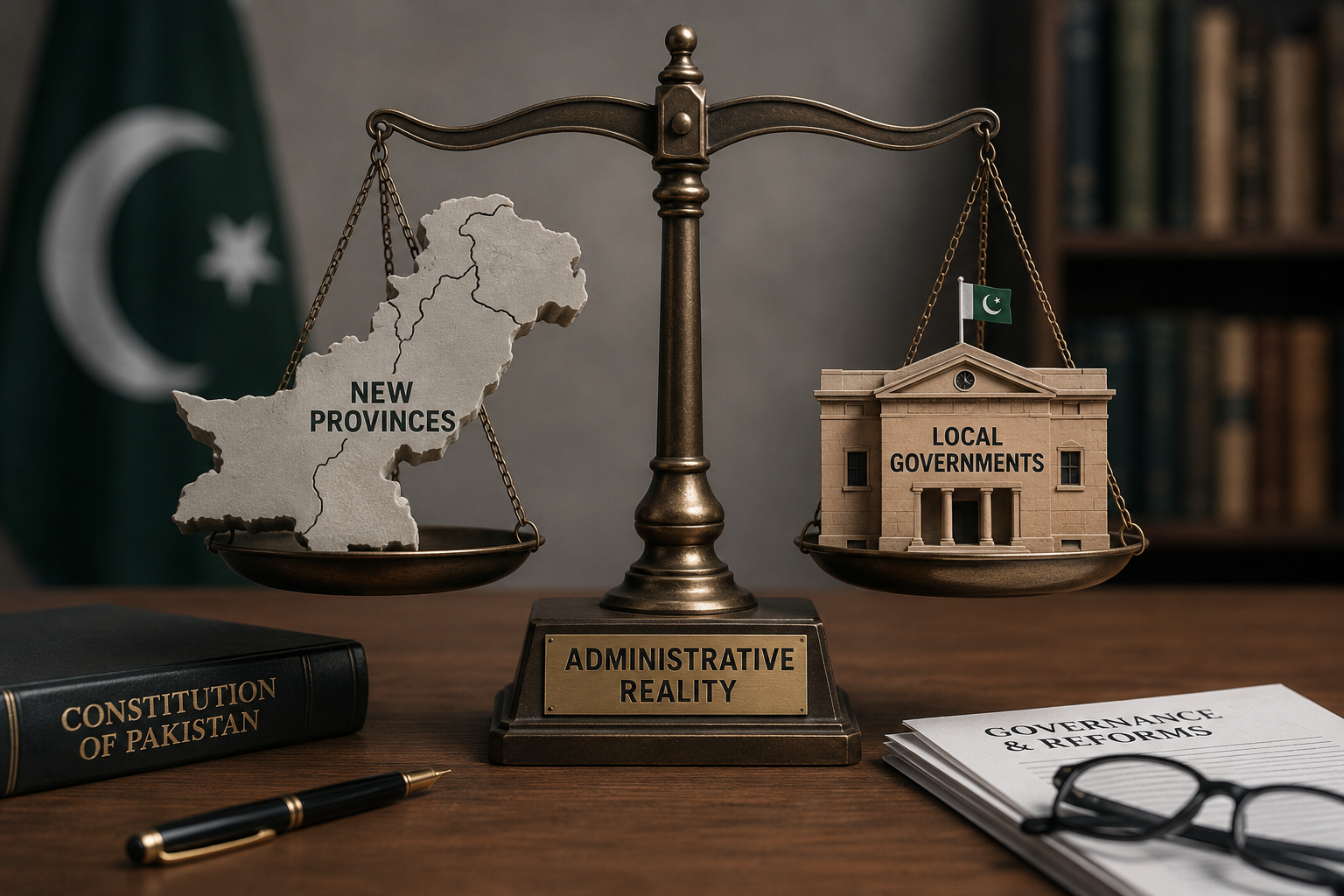
But in Pakistan, the debate on the crisis of governance revolves around a wrong binary choice: new provinces or local governments. This essay, through empirical evidence, argues that the creation of new provinces in Pakistan will not solve the governance failure; rather, it will cement the centralization at more subnational levels.
The debate on creating new provinces in Pakistan rests on three grounds: monopoly of provincial capitals, administrative overload, and exclusionary nature. However, the new provinces would remedy administrative centralization, but they would not be able to solve the accountability problem, which is the domain of local governments only.
“Countries are not rich in relation to their natural resources. But countries are rich whose governments channel the creative energy of men through effective policy-making.” — Margaret Thatcher, from her speech
Pakistan’s current governance framework is federal in spirit but unitary in practice. The four-tier structure dominates the entire governance framework: federal government, provincial governments, divisions, and districts. According to the Constitution of Pakistan 1973, federal services are included in the Federal Legislative List, called federal subjects. Similarly, provinces are bestowed with the responsibility to manage their own subjects. Despite this constitutional mandate, federal bureaucracy dominates provincial and local governance, violating the “federal spirit” of the constitution. It creates a constitutional anomaly: transforming Pakistan into a unitary bureaucratic state.
While the Constitution, through the 18th Amendment, empowered provinces, raising their revenue share to 57.5% of the divisible pool, in spirit, it mandates, “each province by law shall devolve its political, administrative, and fiscal powers to the elected governments.” The provision is 41 words. It leaves everything, from scope to powers of local governments, to the whim of political leaders.
Therefore, Pakistan suffers from a missing link in its governance structure. Local governments are kept fiscally starved by provincial capitals. Research by the Pakistan Institute of Development Economics (PIDE) shows that provincial capitals allocate merely 10% to local governments.
Pakistan’s governance structure has remained frozen for over 79 years. It is completely misaligned with the geographical and demographic reality of 21st-century Pakistan. After the breakdown of the “One Unit Scheme” in the 1970s, Pakistan adopted a federal territory and 4 provinces. The design, once it seemed feasible, didn’t evolve with the demographic changes. With a population exceeding 241 million, the design became obsolete. Now, Lahore alone holds 12.7 million people, making it the fourth largest sub-national polity in the world. Despite being larger than 180 countries of the world, Lahore is under centralized control.
In Pakistan, the debate over new provinces spans decades. But recently, it became a popular narrative with the launching of “Imagine Pakistan 2030,” a flagship project from a Punjabi businessman, Mian Amer Mahmood. Imagine Pakistan 2030 is aimed to push a narrative for the creation of more provinces. It argues for transforming the current divisions (36) into provinces. Despite its lucrative posture, critics argue the narrative is an unrealistic demand.
According to scholars, the debate on “New Provinces” cannot avoid the politics of demand. Senator Yusuf Raza Gillani, in his visit to South Punjab, demanded provincial status for South Punjab. Initially, it seemed a genuine demand. But later scholars termed it a political tactic to capture the administrative control.
There are reasons to claim that the creation of more provinces in Pakistan is not aligned with the administrative and financial reality. For instance, ten more provinces mean ten more CM secretariats, ten more assemblies, ten more high courts, and hundreds of government employees.
The feasible idea is the strengthening of local and city governments in the place of more provinces. All the great cities have effective city governments, which are responsible for the collection of taxes, increasing the wealth of cities, and spending according to the needs of the cities.
“Cities are the engines of growth.” – Dr. Nadeem-Ul-Haque
We do not need a large sum of revenue to create local and city governments. We just need the political will and serious civil service reforms. We need to create coherence between the letter and spirit of the constitution: Article 240 obligates the provinces to devolve the financial and administrative powers to the local level, but the scope and guarantees are left to the discretion of the provincial leadership.
Pakistan’s administrative jam requires policymakers to look beyond the theoretical convenience. They must opt for a pragmatic solution. In the view of administrative reality, strengthening local governments is more pragmatic and experimentally convenient than creating more provinces.