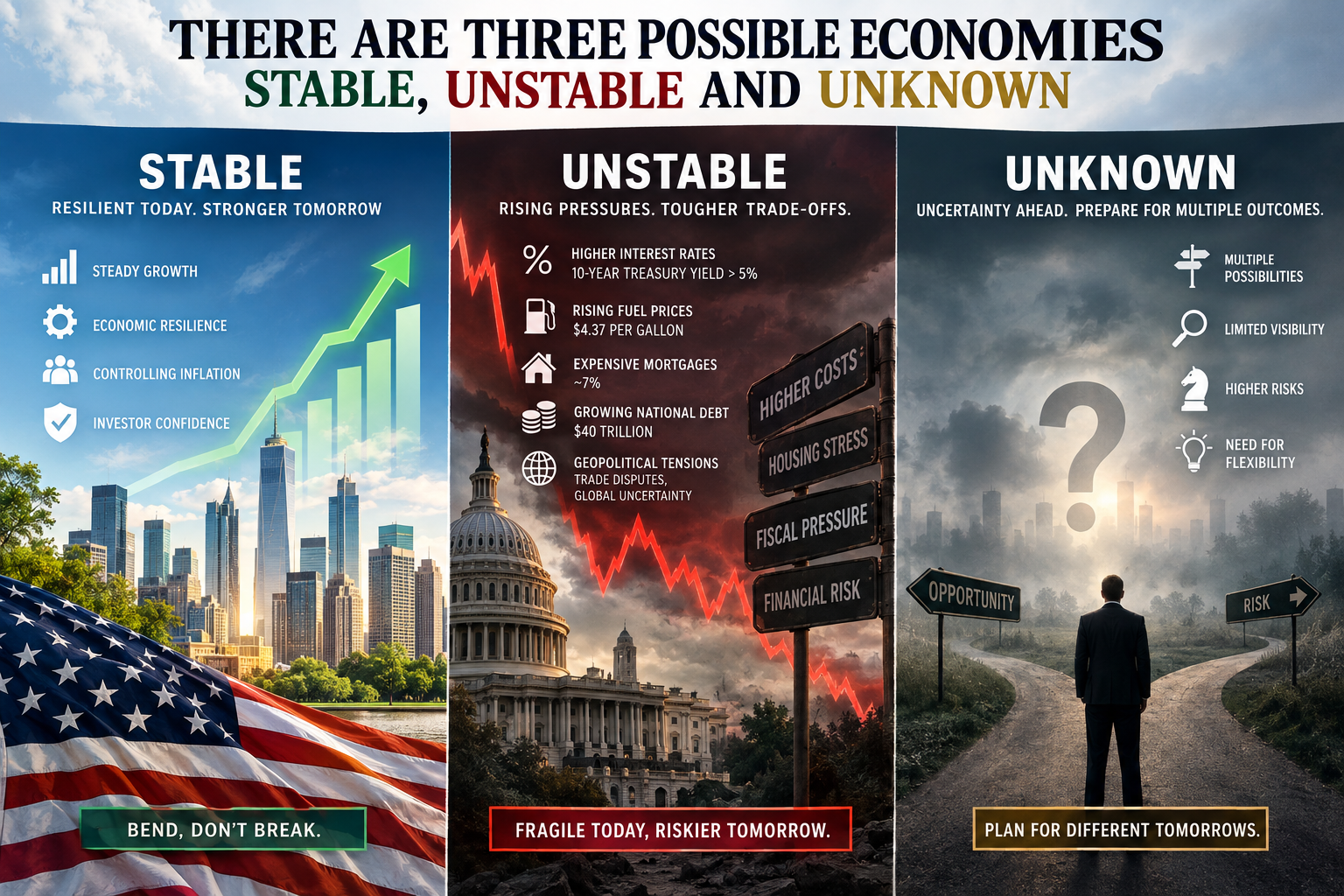

Economists often take pride in their ability to forecast the direction of the economy—or, at minimum, to make informed judgments about what may come next. At present, however, the outlook for the U.S. economy can reasonably be understood through three very different scenarios. Each carries distinct consequences for policymakers, businesses and investors. Taken together, they point toward an economy that may remain caught between stability and uncertainty for several years.
The first and most reassuring scenario is one of economic stability and resilience. Over the past six years, the U.S. economy has demonstrated a remarkable capacity to absorb repeated shocks without suffering lasting damage. It has endured the pandemic, sharp increases in energy prices associated with the conflicts in Ukraine and Iran, and persistent uncertainty surrounding tariffs. Despite these pressures, the United States has continued to record growth that compares favourably with other major economies.
At the same time, the country has avoided a repeat of the severe inflationary pressures experienced in 2022. The Federal Reserve reinforced its commitment to controlling inflation on Wednesday by raising its benchmark interest rate by 25 basis points, describing the economy as strengthening.
Under this interpretation, the American economy is operating in something close to a stable equilibrium. External shocks may temporarily disrupt economic activity, but powerful underlying forces allow the system to absorb the pressure and eventually return toward its previous trajectory. The effects of recent crises have therefore largely proved temporary rather than permanently transformative.
This view has become particularly influential on Wall Street. Investors have repeatedly chosen to look beyond short-term disruptions, while wealth managers have generally encouraged clients to remain invested in stocks and bonds rather than reacting aggressively to every new shock. Policymakers have adopted a similar approach, maintaining that the economy does not require a fundamental change of direction.
Such confidence could be criticised as complacency. Yet, so far, investors who have resisted reacting dramatically to successive crises have generally been rewarded.
The second interpretation presents a considerably more troubling picture. Rather than focusing on the economy’s resilience, it draws attention to several indicators that are moving in potentially disruptive directions.
The yield on the 10-year U.S. Treasury has moved above 5 percent, increasing the cost of financing a national debt that has reached approximately $40 trillion. Average gasoline prices of around $4.37 per gallon are putting additional pressure on household budgets, while mortgage rates have climbed to approximately 7 percent, further intensifying difficulties in the housing market.
These domestic pressures are being compounded by growing geoeconomic tensions, including President Donald Trump’s trade confrontation with Canada.
Under this second scenario, the economy is not simply absorbing temporary shocks; instead, several pressures may be reinforcing one another and gradually weakening economic stability. Higher interest rates increase borrowing costs for households, businesses and the government. Expensive mortgages place further strain on an already vulnerable housing market, while higher government financing costs worsen the fiscal outlook. Together, these developments could also increase risks to financial stability.
Such an environment would require a different approach from investors. Rather than assuming that every disruption will eventually disappear, they may need to become more selective—reducing exposure to weaker or more vulnerable assets, including high-yield debt, while favouring companies with strong balance sheets, effective management and sufficient pricing power to withstand difficult economic conditions.
For policymakers, an unstable economy would similarly require a shift from simply maintaining the existing course toward active containment of emerging risks. Policy would need to operate both defensively and offensively: preventing existing imbalances from becoming more severe while addressing structural pressures that could constrain future growth.
The central challenge is therefore determining whether recent economic disruptions are merely temporary shocks that a resilient U.S. economy can continue to absorb, or whether they are accumulating into deeper and more persistent structural problems. That distinction will shape investment decisions, corporate strategies and economic policy in the years ahead.